

Uncategorized
T20 World Cup 2026: Everything you need to know

The tenth edition of the ICC T20 Cricket World Cup will run from February 7 to March 8, kicking off with Pakistan taking on the Netherlands.
Here is everything you need to know:
Teams
The tournament will feature 20 teams, divided into four groups.
Group A
India (hosts): Suryakumar Yadav (c), Abhishek Sharma, Tilak Varma, Sanju Samson, Shivam Dube, Ishan Kishan, Hardik Pandya, Arshdeep Singh, Jasprit Bumrah, Harshit Rana, Varun Chakaravarthy, Kuldeep Yadav, Axar Patel, Washington Sundar, Rinku Singh.
Pakistan: Salman Ali Agha (c), Abrar Ahmed, Babar Azam, Faheem Ashraf, Fakhar Zaman, Khawaja Mohammad Nafay, Mohammad Nawaz, Mohammad Salman Mirza, Naseem Shah, Sahibzada Farhan, Saim Ayub, Shaheen Shah Afridi, Shadab Khan, Usman Khan, Usman Tariq.
USA: TBA
Netherlands: Scott Edwards (c), Colin Ackermann, Noah Croes, Bas de Leede, Aryan Dutt, Fred Klaassen, Kyle Klein, Michael Levitt, Zach Lion-Cachet, Max O’Dowd, Logan van Beek, Timm van der Gugten, Roelof van der Merwe, Paul van Meekeren, Saqib Zulfiqar.
Namibia: Gerhard Erasmus (c), Zane Green, Bernard Scholtz, Ruben Trumpelmann, JJ Smit, Jan Frylinck, Louren Steenkamp, Malan Kruger, Nicol Loftie-Eaton, Jack Brassell, Ben Shikongo, JC Balt, Dylan Leicher, WP Myburgh, Max Heingo. Reserve: Alexander Volschenk.
Group B
Australia: Mitchell Marsh (c), Xavier Bartlett, Cooper Connolly, Pat Cummins, Tim David, Cameron Green, Nathan Ellis, Josh Hazlewood, Travis Head, Josh Inglis, Matthew Kuhnemann, Glenn Maxwell, Matthew Short, Marcus Stoinis, Adam Zampa.

Australia defeated New Zealand by eight wickets in the 2021 decider. Photo: David Gray/Photosport Ltd 2021
Sri Lanka (hosts): Dasun Shanaka (c), Pathum Nissanka, Kusal Mendis, Kamil Mishara, Kusal Perera, Dhananjaya de Silva, Niroshan Dickwella, Janith Liyanage, Charith Asalanka, Kamindu Mendis, Pavan Rathnayake, Sahan Arachchige, Wanindu Hasaranga, Dunith Wellalage, Milan Rathnayake, Nuwan Thushara, Eshan Malinga, Dushmantha Chameera, Pramod Madushan, Matheesha Pathirana, Dilshan Madushanka, Maheesh Theekshana, Dushan Hemantha, Vijayakanth Viyaskanth, Traveen Mathew.
Ireland: Paul Stirling (c), Mark Adair, Ross Adair, Ben Calitz, Curtis Campher, Gareth Delany, George Dockrell, Matthew Humphreys, Josh Little, Barry McCarthy, Harry Tector, Tim Tector, Lorcan Tucker, Ben White, Craig Young.
Zimbabwe: Sikandar Raza (c), Brian Bennett, Ryan Burl, Graeme Cremer, Bradley Evans, Clive Madande, Tinotenda Maposa, Tadiwanashe Marumani, Wellington Masakadza, Tony Munyonga, Tashinga Musekiwa, Blessing Muzarabani, Dion Myers, Richard Ngarava, Brendan Taylor.
Oman: Jatinder Singh (c), Vinayak Shukla, Mohammad Nadeem, Shakeel Ahmad, Hammad Mirza, Wasim Ali, Karan Sonavale, Shah Faisal, Nadeem Khan, Sufyan Mehmood, Jay Odedra, Shafiq Jan, Ashish Odedara, Jiten Ramanandi, Hasnain Ali Shah.
Group C
England: Harry Brook (c), Rehan Ahmed, Jofra Archer, Tom Banton, Jacob Bethell, Jos Buttler, Sam Curran, Liam Dawson, Ben Duckett, Will Jacks, Jamie Overton, Adil Rashid, Phil Salt, Josh Tongue, Luke Wood.
West Indies: Shai Hope (c), Shimron Hetmyer, Johnson Charles, Roston Chase, Matthew Forde, Jason Holder, Akeal Hosein, Shamar Joseph, Brandon King, Gudakesh Motie, Rovman Powell, Sherfane Rutherford, Quentin Sampson, Jayden Seales, Romario Shepherd.
Scotland: Richie Berrington (c), Tom Bruce, Matthew Cross, Bradley Currie, Oliver Davidson, Chris Greaves, Zainullah Ihsan, Michael Jones, Michael Leask, Finlay McCreath, Brandon McMullen, George Munsey, Safyaan Sharif, Mark Watt, Bradley Wheal. Travelling reserves: Jasper Davidson, Jack Jarvis.
Nepal: Rohit Paudel (c), Dipendra Singh Airee, Sandeep Lamichhane, Kushal Bhurtel, Aasif Sheikh, Sundeep Jora, Aarif Sheikh, Basir Ahamad, Sompal Kami, Karan KC, Nandan Yadav, Gulshan Jha, Lalit Rajbanshi, Sher Malla, Lokesh Bam.
Italy: Wayne Madsen (c), Marcus Campopiano, Gian Piero Meade, Zain Ali, Ali Hasan, Crishan Jorge, Harry Manenti, Anthony Mosca, Justin Mosca, Syed Naqvi, Benjamin Manenti, Jaspreet Singh, JJ Smuts, Grant Stewart, Thomas Draca.
Group D
New Zealand: Mitchell Santner (c), Finn Allen, Michael Bracewell, Mark Chapman, Devon Conway, Jacob Duffy, Lockie Ferguson, Matt Henry, Kyle Jamieson, Daryl Mitchell, James Neesham, Glenn Phillips, Rachin Ravindra, Tim Seifert, Ish Sodhi.

The Black Caps have never won the T20 World Cup. Photo: Photosport
South Africa: Aiden Markram (c), Corbin Bosch, Dewald Brevis, Quinton de Kock, Marco Jansen, George Linde, Keshav Maharaj, Kwena Maphaka, David Miller, Lungi Ngidi, Anrich Nortje, Kagiso Rabada, Ryan Rickelton, Jason Smith, Tristan Stubbs.
Afghanistan: Rashid Khan (c), Noor Ahmad, Abdullah Ahmadzai, Sediqullah Atal, Fazalhaq Farooqi, Rahmanullah Gurbaz, Naveen-ul-Haq, Mohammad Ishaq, Shahidullah Kamal, Mohammad Nabi, Gulbadin Naib, Azmatullah Omarzai, Mujeeb Ur Rahman, Darwish Rasooli, Ibrahim Zadran. Reserves: AM Ghazanfar, Ijaz Ahmadzai and Zia Ur Rahman Sharifi.
Canada: Dilpreet Bajwa (c), Ajayveer Hundal, Ansh Patel, Dilon Heyliger, Harsh Thaker, Jaskarandeep Buttar, Kaleem Sana, Kanwarpal Tathgur, Navneet Dhaliwal, Nicholas Kirton, Ravinderpal Singh, Saad Bin Zafar, Shivam Sharma, Shreyas Movva, Yuvraj Samra.
UAE: TBA
Teams in each group will face each other once in a round-robin format. A win is worth two points and a tie or no result is worth one point each.
The top two teams from each group will progress to the Super 8s, where they will be divided into two groups of four each, and play each other in a round-robin format.
The top two teams from each Super 8s group will progress to the semi-finals.
Venues
Games are being staged at eight stadiums, five in India and three in Sri Lanka.
Stadiums in India: Narendra Modi Stadium (Ahmedabad), MA Chidambaram Stadium (Chennai), Arun Jaitley Stadium (New Delhi), Wankhede Stadium (Mumbai), Eden Gardens (Kolkata).
Stadiums in Sri Lanka: R. Premadasa Stadium (Colombo), Sinhalese Sports Club Cricket Ground (Colombo) and Pallekele International Cricket Stadium (Kandy).
The final will be played either in Ahmedabad or Colombo.

Shaheen Afridi will be a key threat with the ball for Pakistan. Photo: PHOTOSPORT
Past winners
- 2007 India beat Pakistan by five runs
- 2009 Pakistan beat Sri Lanka by eight wickets
- 2010 England beat Australia by seven wickets
- 2012 West Indies beat Sri Lanka by 36 runs
- 2014 Sri Lanka beat India by six wickets
- 2016 West Indies beat England by four wickets
- 2021 Australia beat New Zealand by eight wickets
- 2022 England beat Pakistan by five wickets
- 2024 India beat South Africa by seven runs
-Reuters


Analysis – Three years ago, Christopher Luxon headed into his first head-to-head debate with Chris Hipkins on the back of a poll that had National on 37 points and able to form a government with ACT alone.
Labour under then-Prime Minister Chris Hipkins was on a downward spiral on 27 percent in that same 1News-Verian poll and had no path to power.
Fast-forward three years and both parties headed into Tuesday night’s debate with two fresh new polls.
RNZ-Reid Research’s results had National on 26 percent and Labour on 31, while 1News-Verian had a much tighter race with just one point in it and both parties just under 30.
Those results spell early retirement and unemployment for a decent number of National Party MPs currently enjoying the government benches.
MMP has evolved so much in the past two elections that the combined Labour-National vote has gone from 81 percent at the 2017 election to just 57 in Tuesday’s RNZ-Reid Research poll.
So-called minor parties have grown in both size and influence, capturing the imagination of voters that traditionally voted blue or red.
Increasingly polling is suggesting another new party – Opportunity – has a good chance of making it into Parliament and being a potential kingmaker.
There’s now a very real possibility that the next government could be made up of four political parties.
That has happened before under Sir John Key’s National government in 2008, but because he chose to welcome the Māori Party into the fold, not because he had to.
The minor parties of 2026 have leverage and power going into any coalition talks well beyond any previous election years.
It makes a head-to-head between Christopher Luxon and Chris Hipkins far more redundant in this political age.
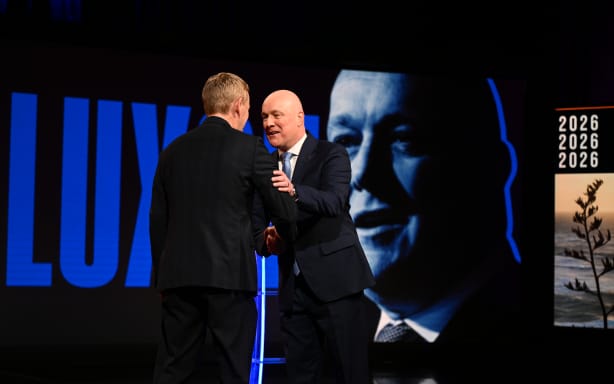
TVNZ/Harley Peters
They can’t fully commit to any of the promises they make because the slate is almost entirely wiped clean after 7 November when political parties sit down to discuss what a future government might look like.
Luxon has ruled out working with Opportunity after the election because of its land tax policy and National campaigning on no new taxes.
On Tuesday night he repeatedly refused to answer whether he would pick the phone up if he needed the party to be prime minister.
Instead, he repeated his previous comments about an untenable land tax, and then told reporters after the debate the question was a “hypothetical” that didn’t need an answer.
To be clear, that’s not a no.
At times in the debate the leaders could have been put in a time machine and transported back to three years ago, so similar were some of the issues and answers to them.
The cost of living crisis continued to be the overwhelming theme, a healthcare system under pressure and patients waiting too long in emergency departments hadn’t improved, and neither Chris had fully grasped the meaning of a yes or no question.
There was no big revelation or pledge – on the latter neither party has the headroom in their fiscal plans to do so.
It’s unlikely undecided voters watching were swayed one way or the other by the end of it.
That’s not to say the two Chrises performed badly.
They were both across their briefs, and while they had some nervous energy at the outset both settled into a comfortable rhythm and got their key messages across.
While Hipkins managed to land a few blows on Luxon over his failure to discipline New Zealand First’s Winston Peters and Shane Jones over racist remarks, Luxon in return made a strong argument on education and had Hipkins concede he had done what Labour couldn’t and got India across the line on a free trade agreement.
The biggest controversy of the night was the pair being asked to pick between the All Blacks and the Warriors with Luxon going Team ABs while Hipkins chose to “Up the Wahs”.
Both would have gone to bed happy with their performance and grateful they didn’t say or do anything they deeply regretted.
There is a week until they face-off again – another week of smiling at the cameras and hoping voters return them to the major party league.
rnz


Police say person who fired gun at officers still at large

New Zealand sides named for RLWC finals

Parliamentary Service working on extra chairs and offices for increased number of MPs


-

 Latest News2 months ago
‘Chilling’: Business groups speak out against National’s supermarket break-up plan
-

 NZ News2 months ago
Tom Phillips report: The missed opportunities to find the children
-

 Politics2 months ago
National vows to try to split Pak’nSave and New World
-

 Latest News2 months ago
Cars bearing Chinese police markings stir unease in Auckland
-

 Fiji News2 months ago
Plans to have new Constitution by Dec 24th 2026
-

 NZ News2 months ago
Cop who stole $68,000 can now be named as champion Muay Thai fighter Haimona Tamati-Te Paki
-

 Politics2 months ago
MBIE confirms botched biometric projects costs blown out to $50.7 million
-

 Latest News2 months ago
Five Karangahape Road venues lose their liquor licences after police intervention