

NZ News
Don’t build in landslide zones, Tauranga officials told 20 years ago

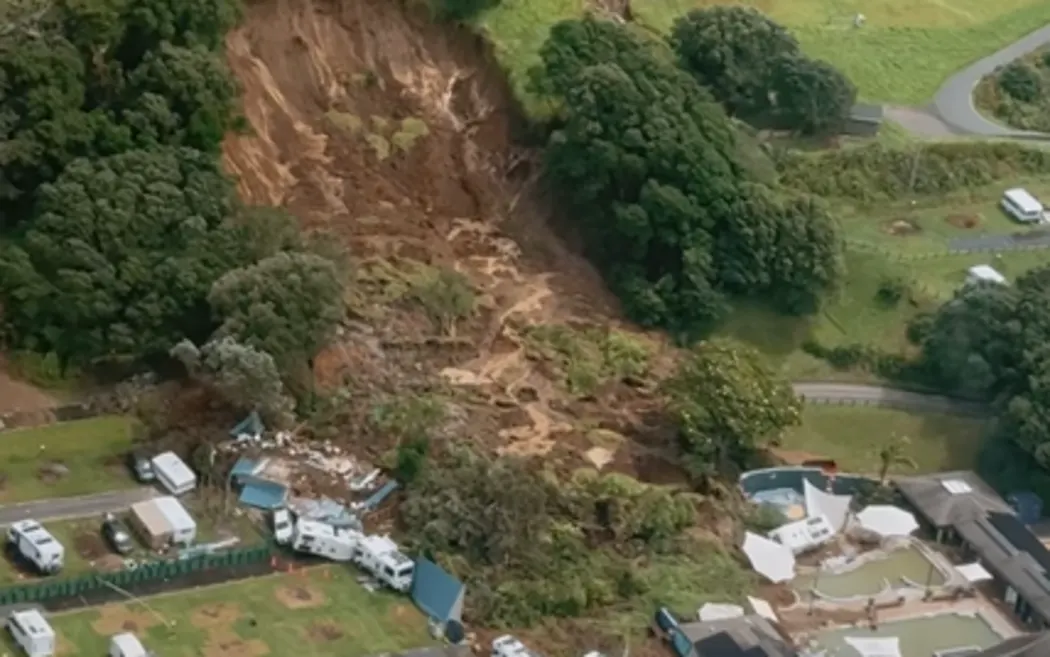
Geotechnical engineers told Tauranga City Council two decades ago that buildings should not be allowed in the “runout” zones of potential landslides unless they have specially constructed protection like a retaining wall.
The runout zone is the area at the base of a slope that might be inundated in a slip.
A motorcamp and hot pools were struck by a landslide at the base of Mauao last week, killing several people.
It is not clear how engineer runout calculations might apply to the area.
The advice in 2005 has been superseded in part by new science that has led to the adoption of smaller runout zone sizes in the Mt Maunganui and Papamoa neighbourhoods, but the thrust was obvious – to steer clear.
“Only in rare circumstances would it be prudent to violate” the zone criteria, wrote two geotechnical engineers in the study into 300-plus landslides across Tauranga triggered by a big storm.
“Because of this we believe that the following changes to the criteria would be appropriate: 1. Buildings are not to be located within the [zone]. Only if special measures are taken, such as construction of properly engineered structures (ie retaining walls, piled foundations and deflection bunds) can these criteria be exceeded.”
The old runout zones in Tauranga were calculated as ‘4H:1V’ – four times the vertical height of the slope (V), extending horizontally from the base (H). The new zone in 2025 was suggested as half that – 2H:1V.
The study on this for the city council last year by engineering consultants WSP covered all the Pacific seaside neighbourhoods except Mauao itself. RNZ has asked the council why Mauao was not mapped, and also for comment on runout zones.
‘Directed away from areas with an unacceptable risk’
Auckland Council has been sharing its country-leading work on landslides with Tauranga and the Bay of Plenty region. Tauranga was “unique” in how prone it was to rain-induced slips, WSP said in 2025.
Mayor Mahé Drysdale told Morning Report they were setting up an independent review into the “facts and events leading up to the landslide”.

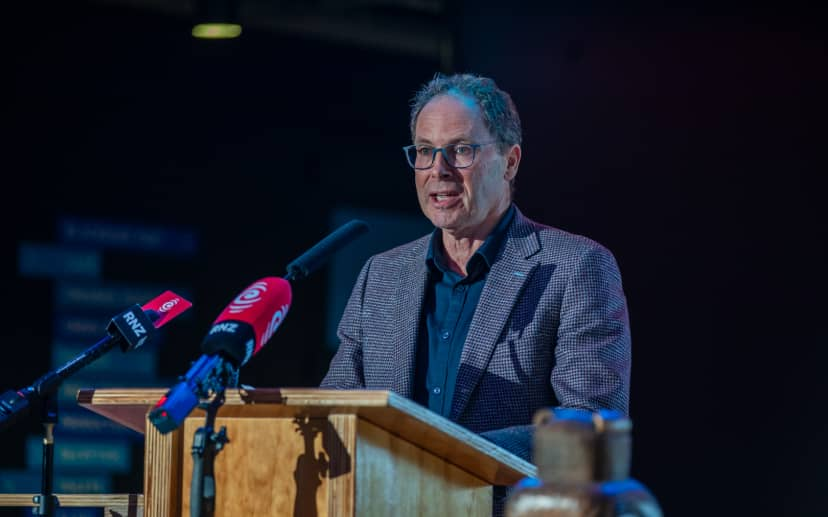
Tauranga Mayor Mahé Drysdale. Photo: Calvin Samuel / RNZ
Auckland Council said because of that review it was inappropriate for it to answer queries about landslide risk on Mt Maunganui.
But it laid out its own advances on landslide mapping that it said meant the information people could get about landslides on Land Information Memorandums, or LIMs, was more reliable, and its controls over what got built and where were better.
“Before our 2025 mapping, we didn’t have good regional maps showing landslide susceptibility because we didn’t have the data available to create them,” chief engineer Ross Roberts said in a statement.
“This meant that it was more difficult to identify where activities were taking place in areas potentially susceptible to landslides.”
It was also difficult and complex to apply controls to existing activities.
Since last year it could statistically model the landslide susceptibility, which was feeding into plans and LIMs.
“This means it can be used by people when choosing where to buy or rent a house, and by infrastructure and asset owners… Together, these mean that future development can be directed away from areas with an unacceptable risk, and existing assets can be assessed and their use modified if appropriate,” Roberts said.
Checks on individual sites were still sometimes needed, such as when protective structures had been built, earthworks had changed the land profile or underlying characteristics were unusual.

Several people are unaccounted for following a slip near a campsite in Mount Maunganui. Photo: Shirley Thomas
‘Avoid building in run-out areas’
Martin Brook, professor of applied geology at University of Auckland, said understanding landslide runout on Mauao was important because the maunga had a history of slips.
“Understanding and modelling the runout of landslides and where the detached material is going to run out and end up and possibly inundate is really important,” he said.
“You should avoid building in run-out areas. That’s sensible, and people would follow that advice in most parts of the Western world.”
But the light-detection (LIDAR) tech used to detect historical landslides was not so useful for runout and he was not aware of much research on it.
“Most of New Zealand is under-researched from a sort of a geological standpoint.”
The country had woken up recently to tsunami risk and signs and advice had sprung up, but had only begun waking up to the risk of landslides since 2023 though they were the country’s most deadly natural hazard, he added.
‘Reliant on outside advice’
Northland geotechnical engineer David Buxton said councils nationwide had really struggled since the 1990s – when they began shedding expertise – to get their own technical advice to back their decisions on the likes of runout zones.
“They’re reliant on outside advice to give these things, but then they’re reliant on in-house people without that depth of technical knowledge to make that decision-making, and I think it would be really good if councils were able to invest in that in-house technical ability.”
Buxton himself, as a consultant, benefited from the current set-up, he said – however it was not just expensive, but led to patchy follow-through sometimes.

Prime Minister Christopher Luxon at He Maimai Aroha on Monday after the Mount Maunganui landslide. Photo: RNZ/Nick Monro
Auckland Council had invested in-house and that was paying off in its response to floods, Buxton said.
The WPS study for Tauranga last year had some gaps – for instance, it did not look at the likely size or volume of likely slips.
“The factors that determine the volume and runout characteristics of the landslide, and the consequent impacts on infrastructure in proximity to the slope, could be considered when looking at specific slopes as part of site-specific studies,” said the short study, that sits alongside two longer engineering reports into landslides in the city and region.
“This should be carried out as part of considering the risk posed to infrastructure or property at particular sites.”
The landslip map showed small zones of “failure” and runout at several streets, the largest of which were around Hopukiore Reserve.
Source: RNZ



Latest News
Opportunities to mitigate multi-million-dollar RNZ budget blowout likely missed – experts
Multiple opportunities to identify and mitigate a multi-million-dollar budget blowout at RNZ appear have been missed, according to the former executive director at Audit New Zealand.
The public broadcaster on Monday revealed a near $12 million shock financial loss after a litany of financial blunders, which will now lead to sweeping job cuts.
The $11.8m loss is more than 25 times the $470,000 RNZ had expected to lose over the year to June.
CEO Paul Thompson took responsibility for the result, and said internal reports gave an inaccurate picture of the finances, meaning the scale of the loss only became clear in October.
RNZ’s former chief financial officer Hilary Parker resigned unexpectedly in early October.
The board said it would commission an independent review into what went wrong.
Independent contractor Stephen Walker, who left the Audit Office earlier this year, said the size of the loss was surprising, as was the length of time it took to identify it – months after the financial year ended.

Supplied / OAG
“Probably more of a concern is that they had seemingly been unaware that they were running up a significant deficit until they were in the preparation stage of their annual report in October.”
Walker said public entities typically produced monthly financial reports.
An interim audit also took place before the end of the financial year, he said, but if the organisation hadn’t identified significant losses at that stage, the auditor could also be in the dark.
“It seems that there’s a real weakness in forecasting and budgeting that’s occurred here and that the monthly accounts, when they’re produced, either haven’t identified these significant variances against budget or the magnitude of them really hasn’t come to light until right towards the end of the financial year,” Walker said.
“And really at that point, there’s no opportunity for the chief executive, the leadership team to take, and the board to take, any corrective action because the year has effectively been completed.”
Walker said the “significant miss” was difficult to account for given it was more than 10 percent of RNZ’s total funding.
He said based on RNZ’s annual report, financial complexity didn’t appear to be a factor.
“This $11.8m loss isn’t made up of one particular item … it seems to have been contributed to by a number of separate expense lines running over budget. So I don’t think it’s necessarily to do with complexity.”
Among the errors, RNZ wrongly counted $2m from land sales as income in its budget. Staff costs also came in $3.2m over budget, including $1.4m in redundancy payments.
Professor at Auckland University’s business school Norman Wong said based on media reports the issues identified were “significant and troubling”.

Supplied / University of Auckland
“But recognising the sale of land as income in their budget is a basic error that one would have expected to have been caught and corrected well before it got to this point.”
With funding reductions at RNZ over the past two years, Walker expected greater scrutiny of financial results.
“Virtually every public entity has had their annual budget reduced. And so you would expect … the leadership team on a monthly basis and board – I’m not sure how frequently the board will consider the information – but you would expect them to be interrogating the results on a regular basis throughout the year,” he said.
Walker said initiating an independent review was the correct course of action and that he’d want to understand what information the leadership team and the board were regularly receiving.
He said he’d “love to say” surprising financial results were rare, but conceded they occured on a semi-frequent basis during his time leading the Audit Office.
“The benefit of independent scrutiny by the Audit Office – and the auditors providing that support to the Auditor General – [is] that the reporting is fairly presented at the end of the year, whether it’s good, bad or ugly.”
rnz


Police say person who fired gun at officers still at large

New Zealand sides named for RLWC finals

Parliamentary Service working on extra chairs and offices for increased number of MPs


-

 Latest News2 months ago
‘Chilling’: Business groups speak out against National’s supermarket break-up plan
-

 NZ News2 months ago
Tom Phillips report: The missed opportunities to find the children
-

 Politics2 months ago
National vows to try to split Pak’nSave and New World
-

 Latest News2 months ago
Cars bearing Chinese police markings stir unease in Auckland
-

 Fiji News2 months ago
Plans to have new Constitution by Dec 24th 2026
-

 NZ News2 months ago
Cop who stole $68,000 can now be named as champion Muay Thai fighter Haimona Tamati-Te Paki
-

 Politics2 months ago
MBIE confirms botched biometric projects costs blown out to $50.7 million
-

 Latest News2 months ago
Five Karangahape Road venues lose their liquor licences after police intervention