

NZ News
PM Jacinda Ardern rejects claims govt is too soft on crime


The prime minister has rejected claims Labour is not tough enough on crime, saying the penalties are the same under both major parties, but prevention and rehabilitation is key.
Prime Minister Jacinda Ardern warned politics sometimes distorts the facts on crime, but going back to the statistics helps to see a clearer picture. Photo: RNZ / Samuel Rillstone
The government yesterday announced $500 million in extra funding to boost the number of front line police officers and address gang violence.
The funding will be spent over four years on tackling gun crime, and organised crime, setting up a new unit to oversee the firearms register, and boosting tactical response training.
But the National Party has said the money would not reduce crime.
National police spokesperson Mark Mitchell told Morning Report the new law and order funding unveiled at the weekend would not solve bigger issues and police should instead be given more agency to deal with criminals.
“It’s a knee-jerk reaction – damage control,” he said.
“Police are not being backed up by the youth justice system or the criminal justice system, and it’s frustrating for them.
“When police officers are arresting juvenile offenders that have just committed a violent ram raid at 11pm and at 3am they’re back out reoffending again. That’s deeply demotivating for the frontline police officers and it’s not safe for the community.
“The police need to be supported by our criminal justice system, they need to have the powers that they can take guns out of criminals’ hands, and they need to review their pursuit policy so we can try and halt the tsunami of juvenile offending.”
He said more than 80 percent of those who failed to stop for police were not charged.
National would set up a national gang taskforce, ensure firearms prohibition order legislation had a warrantless search provision, and ask for a review of the police pursuit policy, he said.
But Prime Minister Jacinda Ardern told Morning Report she was weary of political rhetoric on crime masking the situation, and both Labour and National were firm on crime.
“The facts are that the penalties for these issues have not decreased, so this idea that there’s been a problem with the deterrent factor is just wrong.”
The idea tougher penalties would deter young people from carrying out ram raids was not realistic, she said.
“That … says that there’s a rational calculation from young people who, we know are probably making these decisions without that rational judgement. Most young people who are engaging in crime don’t think they’re going to get caught.
“Well, we need them to know that they are [going to get caught] – there are consequences. But actually … what we need to get smarter on is the prevention and rehabilitation, the stuff that stops people going into crime in the first place – that is where we should be having the discussion.”
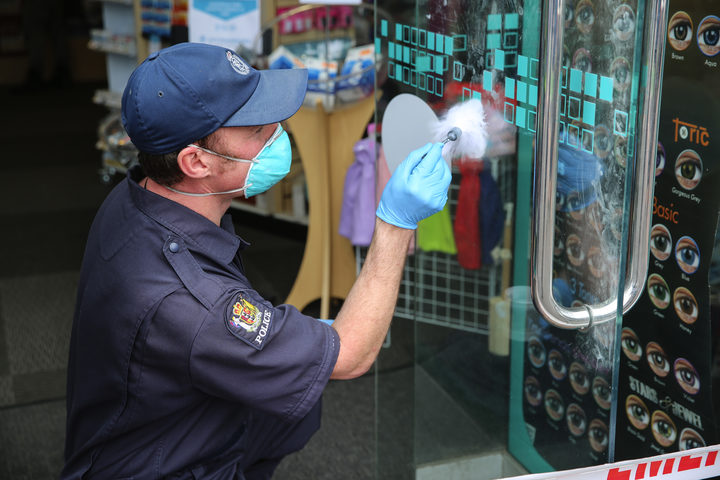
Photo: RNZ / Richard Tindiller
She denied the boost to law and order funding was a rushed announcement, due to the ram raid issues.
“Not at all. If you dig into the funding you can see this is a continuation and expansion of programmes that we’ve been trialling in particular regions.
“The police have been operating the Resilience to Organised Crime in Communities programme and now this funding supports the police to continue the rollout of that – same with the gang harm reduction programme they’ve been running.”
However, she said the increase in ram raids was a trend that only went back a few months.
“We have moved up from the seven on average for a month, we’ve seen a spike and we need to address that.
“The police have got some things that they think might be [behind the increase] … for instance particular senior members in criminal organisations who may be promoting or supporting the use of ram raids, targeting of particular goods … the fact that it’s becoming known and amplified a bit at the moment.”
Ministers are to meet today, and will be discussing possible responses. One possible action could be assisting small business owners to set up preventative measures.
“What we’re working through is something similar to fog cannons for small business owners – we [previously] had a spate of [robberies] particularly around cigarettes, and now we’re seeing similar issues [with ram raids].”
About 1000 fog cannons had been supplied to small businesses, she said.
Police Minister Poto Williams said tougher penalties may work to deter the rise in young people ram raiding businesses, but she did not want to see children as young as seven in custody.
She said when it came to youth crime social drivers needed to be addressed, as well as family responses.
“We need to stop the impact of gangs on our society, first off, the second thing we need to do is to stop people getting into gangs in the first place,” she told Morning Report.
That was part of the $94m over four years being put towards tackling gangs and organised crime, she said.
“Police have a role to play in this but so do other parts of not only the government but the community as well.”
Williams said the government was on track to reach its target of 1800 extra police officers – taking into account attrition, retirement and people leaving the police.
The training of training of more police officers to Armed Offenders Squad (AOS) standard, announced in the government funding package, would result in a better trained service, with the skills required to deal with the most significant events, she said.
“We will have more AOS-trained people on shift.”
Te Pāti Māori co-leader Rawiri Waititi said more police and prisons would not fix systemic problems.
“We can’t police and jail our way out of problems caused by failing education, health, housing and welfare system – unemployment is another issue.
“The burden of imprisonment is carried disproportionately by Māori, so having more police on the beat is not going to fix any of the systemic problems that are disproportionately affecting Māori.
“We need to fund more projects that stop the drivers of crime, the causation, and not wait until it’s too late and then we weigh in with a crude expensive tool that achieves nothing but creates more damage to whānau and tamariki.”










Latest News
Opportunities to mitigate multi-million-dollar RNZ budget blowout likely missed – experts

Multiple opportunities to identify and mitigate a multi-million-dollar budget blowout at RNZ appear have been missed, according to the former executive director at Audit New Zealand.
The public broadcaster on Monday revealed a near $12 million shock financial loss after a litany of financial blunders, which will now lead to sweeping job cuts.
The $11.8m loss is more than 25 times the $470,000 RNZ had expected to lose over the year to June.
CEO Paul Thompson took responsibility for the result, and said internal reports gave an inaccurate picture of the finances, meaning the scale of the loss only became clear in October.
RNZ’s former chief financial officer Hilary Parker resigned unexpectedly in early October.
The board said it would commission an independent review into what went wrong.
Independent contractor Stephen Walker, who left the Audit Office earlier this year, said the size of the loss was surprising, as was the length of time it took to identify it – months after the financial year ended.

Supplied / OAG
“Probably more of a concern is that they had seemingly been unaware that they were running up a significant deficit until they were in the preparation stage of their annual report in October.”
Walker said public entities typically produced monthly financial reports.
An interim audit also took place before the end of the financial year, he said, but if the organisation hadn’t identified significant losses at that stage, the auditor could also be in the dark.
“It seems that there’s a real weakness in forecasting and budgeting that’s occurred here and that the monthly accounts, when they’re produced, either haven’t identified these significant variances against budget or the magnitude of them really hasn’t come to light until right towards the end of the financial year,” Walker said.
“And really at that point, there’s no opportunity for the chief executive, the leadership team to take, and the board to take, any corrective action because the year has effectively been completed.”
Walker said the “significant miss” was difficult to account for given it was more than 10 percent of RNZ’s total funding.
He said based on RNZ’s annual report, financial complexity didn’t appear to be a factor.
“This $11.8m loss isn’t made up of one particular item … it seems to have been contributed to by a number of separate expense lines running over budget. So I don’t think it’s necessarily to do with complexity.”
Among the errors, RNZ wrongly counted $2m from land sales as income in its budget. Staff costs also came in $3.2m over budget, including $1.4m in redundancy payments.
Professor at Auckland University’s business school Norman Wong said based on media reports the issues identified were “significant and troubling”.

Supplied / University of Auckland
“But recognising the sale of land as income in their budget is a basic error that one would have expected to have been caught and corrected well before it got to this point.”
With funding reductions at RNZ over the past two years, Walker expected greater scrutiny of financial results.
“Virtually every public entity has had their annual budget reduced. And so you would expect … the leadership team on a monthly basis and board – I’m not sure how frequently the board will consider the information – but you would expect them to be interrogating the results on a regular basis throughout the year,” he said.
Walker said initiating an independent review was the correct course of action and that he’d want to understand what information the leadership team and the board were regularly receiving.
He said he’d “love to say” surprising financial results were rare, but conceded they occured on a semi-frequent basis during his time leading the Audit Office.
“The benefit of independent scrutiny by the Audit Office – and the auditors providing that support to the Auditor General – [is] that the reporting is fairly presented at the end of the year, whether it’s good, bad or ugly.”
rnz


Police say person who fired gun at officers still at large

New Zealand sides named for RLWC finals

Parliamentary Service working on extra chairs and offices for increased number of MPs


-

 Latest News2 months ago
‘Chilling’: Business groups speak out against National’s supermarket break-up plan
-

 NZ News2 months ago
Tom Phillips report: The missed opportunities to find the children
-

 Politics2 months ago
National vows to try to split Pak’nSave and New World
-

 Latest News2 months ago
Cars bearing Chinese police markings stir unease in Auckland
-

 Fiji News2 months ago
Plans to have new Constitution by Dec 24th 2026
-

 NZ News2 months ago
Cop who stole $68,000 can now be named as champion Muay Thai fighter Haimona Tamati-Te Paki
-

 Politics2 months ago
MBIE confirms botched biometric projects costs blown out to $50.7 million
-

 Latest News2 months ago
Five Karangahape Road venues lose their liquor licences after police intervention