

World
Ukraine war escalates beyond its borders in mounting confrontation

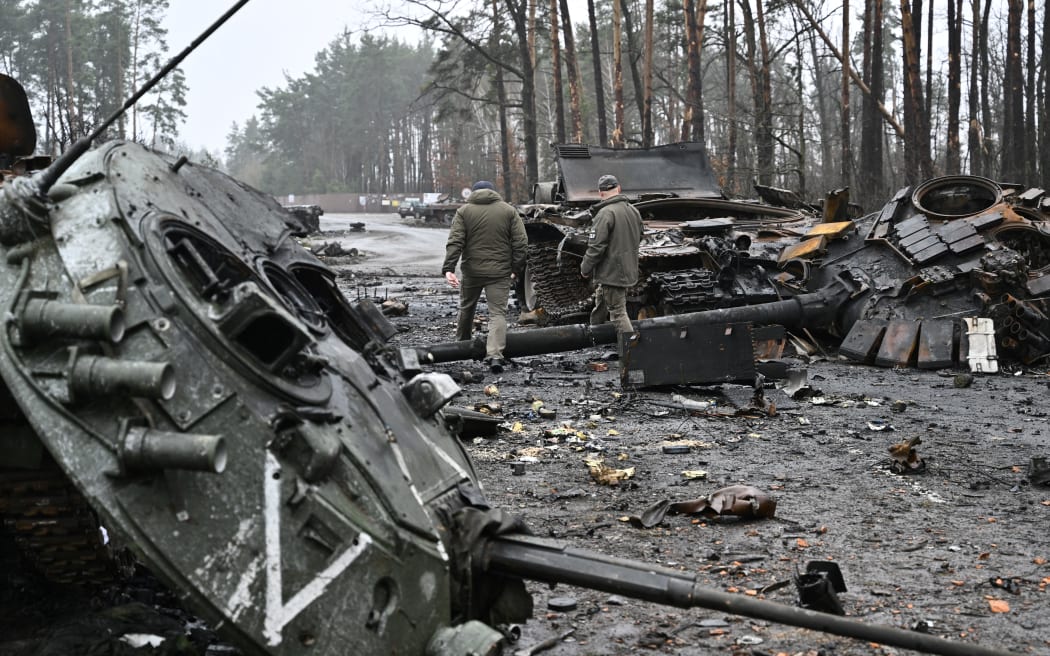
As Russian President Vladimir Putin’s invasion of Ukraine enters its third month, the scene recorded by a Ukrainian-built Leleka drone flying inside Russian airspace and then shared with British tabloid the Sun as propaganda is a reminder of just how far the campaign has been from the short, victorious war the world expected and the Kremlin had maybe hoped for.
All sides appear to be hardening their positions, rhetoric and actions. Russia this week accused the West of risking a wider nuclear confrontation by arming Ukraine in a “proxy war”, while the United States and its allies now talk openly of helping Ukraine “win” and inflict a strategic defeat on Russia that will limit its ability to threaten its immediate neighbourhood.
Like all major military conflicts, the Ukraine war is becoming an economic, technological and industrial confrontation, one with actions and implications escalating well beyond Ukraine.
This week has seen suspected Ukrainian missile strikes on fuel and arms facilities within Russian territory, explosions and increasing talk of escalation in neighbouring Moldova and Moscow cutting gas supplies to Poland and Bulgaria, as well as Tuesday’s meeting of NATO and allied nations on arming Ukraine further.
On Tuesday, UK Armed Forces Minister James Heappey said Britain would have no problem with long-range missiles it was supplying being used to strike targets within Russia, describing them as “a “legitimate” part of war. That produced a furious response from the Kremlin, including a warning to hit “decision-making centres” in Kyiv regardless of whether Western military advisers were there. Ukraine has not confirmed if it is hitting Russian territory.
The global consequences of war, meanwhile, are escalating particularly through the economic effects of rising food and fuel prices. With Russia bombing its railways and targeting infrastructure, Ukraine must bring in and export one of the world’s largest grain harvests between now and September.
Worldwide economic shock
This week, the World Bank said the Ukraine war and sanctions had delivered the largest commodity price shocks since the 1970s. In Europe, the price of natural gas has doubled while the United Nations Food and Agriculture Organisations says food prices are at record highs.
A Monday report by polling firm Deltapoll showed 90 percent of Britons saying they had noticed a significant increase in the cost of living this year, with 50 percent worried they would not be able to make ends meet within six months. In the developing world, it will be worse still, potentially bringing starvation and political upheaval.
The International Monetary Fund expects inflation across the developing world to rise to 8.7 percent this year, up from an already painful 5.9 percent in 2021. Between them, Russia and Ukraine make up almost 30 percent of global wheat supply, almost all through now-blocked Black Sea routes. The Bank of America estimates lost Ukrainian supplies in the two months of war so far down 80 percent “equate to about 10 days of world food supply”.
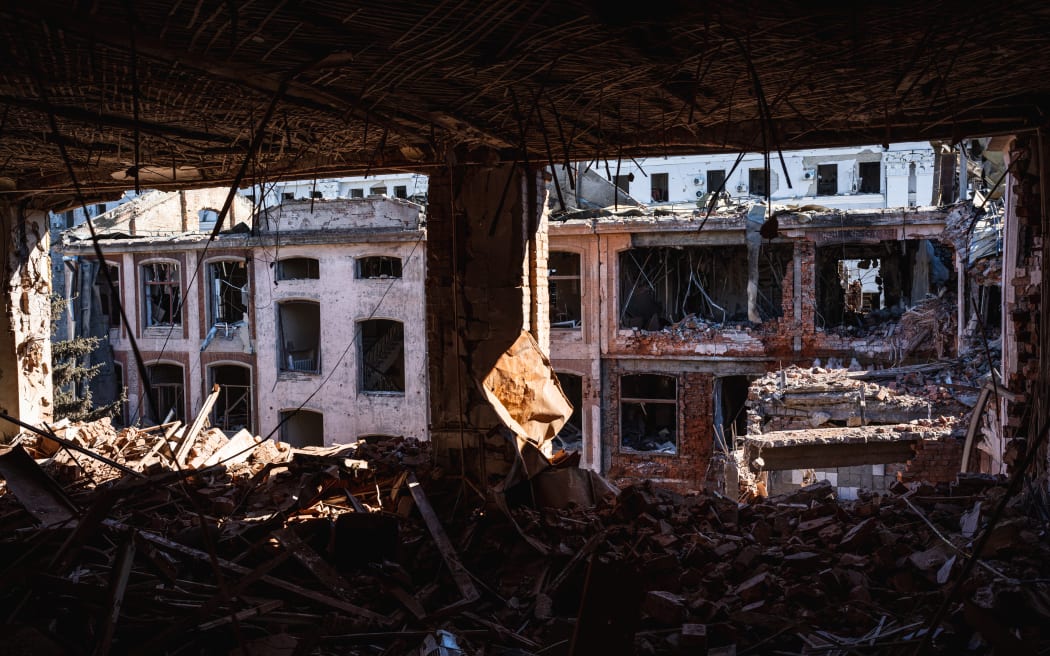
A view from a heavily damaged building after Russian attacks in Kharkiv, Ukraine on March 22, 2022. Photo: 2022 Anadolu Agency
That may get even worse if Ukraine cannot get its harvest in the summer, or if blocked exports and overfilled silos mean it cannot be stored. In March, the World Bank predicted the Ukrainian economy to shrink by as much as 45 percent, while even Kremlin-owned state media predict a Russian economic contraction of 10 percent or more.
No one seems to be backing down. Tuesday saw the first meeting of the 40-nation US-led Ukraine Defense Consultative Working Group, which US officials say will now meet monthly to coordinate arms supplies. Following a visit to Kyiv the previous day, US Secretary of Defense Lloyd Austin paid tribute to Ukraine for standing fast against Putin’s offensive.
Military supply battle
Since the invasion, the United States and its allies have committed around $5 billion in military support, $3.7 billion from the US alone.
According to experts from the Centre for Strategic and International Studies in Washington DC, Russia may have now lost twice the 250 tanks it is believed to be able to build a year, while other estimates say it has used an even higher proportion of precision missiles and is now struggling to get the microchips for more.
This month, one US official told the Washington Post it was possible Ukraine now has more working tanks in service than Russia. The authorities in Kyiv, however, want more to push back Moscow in the Donbas, one of the reasons Germany’s willingness to provide Gepard tanks and anti-aircraft weaponry is so important.
Those new tanks, however, may require months of training and ammunition from Switzerland — not the only supply squeeze for Kyiv.
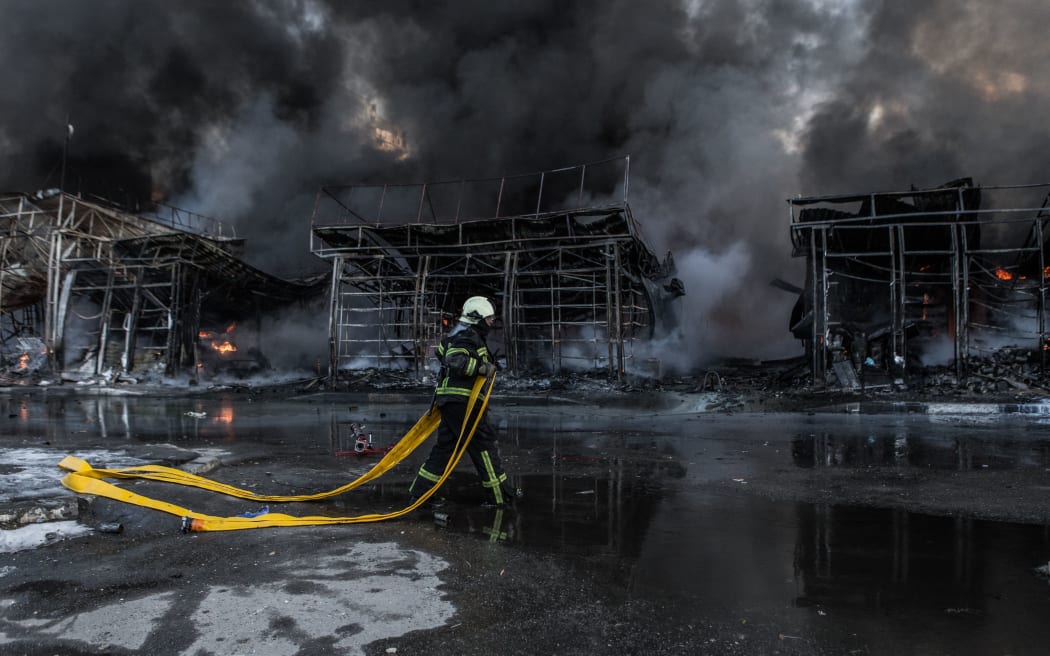
Photo: AFP
This week, Raytheon, manufacturer of the Stinger anti-aircraft missile, said it must now look to restart manufacturing to meet demand but that shortages of key chips and components might delay that process.
Other kit, however, is being rushed out. On April 21, the Pentagon announced a new $800 million support package would include a “loitering munitions” kamikaze drone dubbed “Phoenix Ghost” specifically developed by the US military for Ukraine in recent weeks. It did not provide further details, but other unmanned vehicles reportedly earmarked for first use in Ukraine include unmanned maritime vehicles previously unused in combat.
With explosions reported on Monday in Moldova’s breakaway Transdniestria region blamed by Russian-speaking separatists on Ukraine, the war may yet widen further Russia’s military has declared its intent to grab Ukraine’s entire coastal strip. Ukrainian officials say the Monday blasts which targeted radio transmitters bear all the hallmarks of a Russian “false flag” operation to justify more military action.
For now, all sides seem to believe that they can win more than they have with the next question whether that pushes Moscow’s calculus ever closer to the use of chemical, biological or small-scale nuclear weapons. The next month could be critical.
*** Peter Apps is a writer on international affairs, globalisation, conflict and other issues. He is the founder and executive director of the Project for Study of the 21st Century; PS21, a non-national, non-partisan, non-ideological think tank. Paralysed by a war-zone car crash in 2006, he also blogs about his disability and other topics. He was previously a reporter for Reuters and continues to be paid by Thomson Reuters. Since 2016, he has been a member of the British Army Reserve and the UK Labour Party.
SOURCE: RNZ

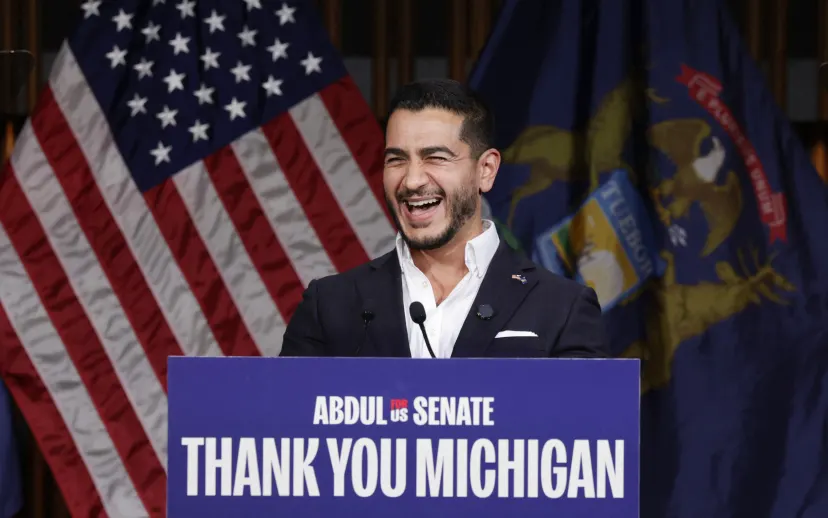

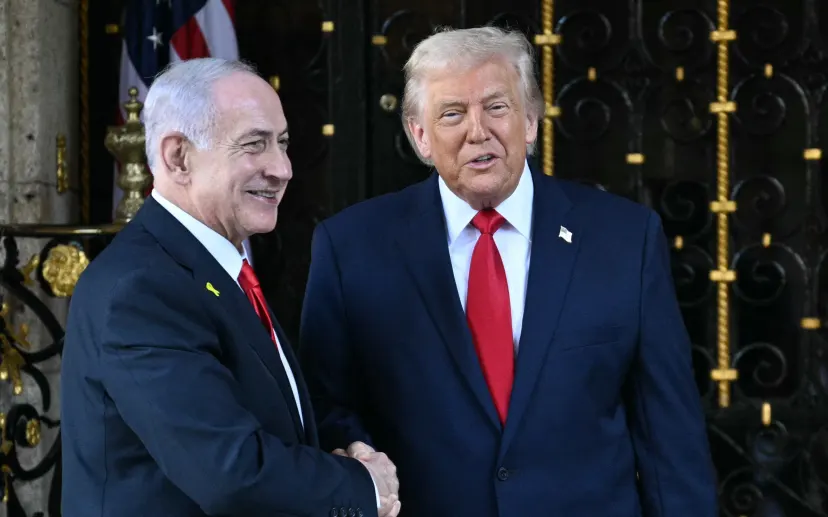
Israeli Prime Minister Benjamin Netanyahu boasted of his endorsement from Donald Trump on the eve of Israel’s election, suggesting the two leaders could restart their war against Iran if he wins, after Trump said they should “finish the job”.
“US President Donald Trump has come with a friendship that has never existed before between an Israeli prime minister and an American president. And it is doubtful we will ever have such a friendly president again,” Netanyahu said in a televised appearance late on Sunday night. “He has another two years, and he says he is calling on you to vote for me.”
In his own social media post on Sunday, Trump, who launched the Iran war jointly with Netanyahu in February, said: “Vote for Bibi Netanyahu for Prime Minister, we have to finish the job that we started!”
Netanyahu said Trump was willing to take action “that would finally, finally, remove the Iranian threat”, but only as long as Netanyahu himself remains in power.
“And I have already instructed the Mossad and the IDF (military) to bring down this regime, to bring down this regime because that is the only way to put an end to this threat,” Netanyahu said, referring to Israel’s main intelligence service and military.
Asked for comment on Netanyahu’s remarks, White House Deputy Press Secretary Anna Kelly said: “As President Trump stated, Iran is in very bad condition, both economically and militarily, and the blockade will remain in full force and effect, with oil flowing in record numbers of barrels through the Hormuz Strait.”
“The United States will not be attacking Iran at any time prior to the midterm elections,” Kelly added via email, referring to the November 3 vote in the US.
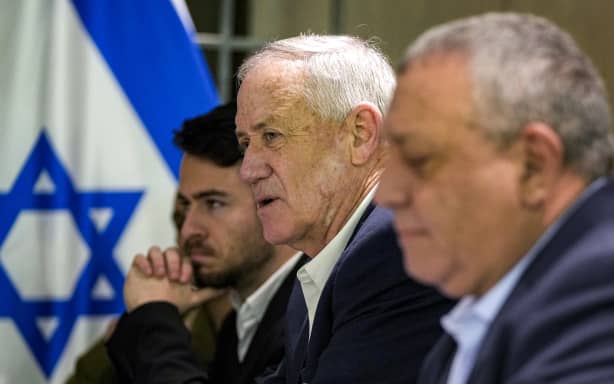
Netanyahu’s leading opponent, centrist former military Chief of Staff Gadi Eisenkot, posted his own comments on social media, praising Trump as “a true friend of Israel”.
“I value his efforts and his commitment to Israel’s security, and I am confident that he will work in full cooperation with any leader chosen by the people.”
Mark Schiefelbein / POOL / AFP
Eisenkot accuses Netanyahu of fear-mongering
Tuesday’s vote, Israel’s first since the October 7, 2023, Hamas attacks, is the first chance for voters to deliver a verdict on the worst security failure in generations and the wars on multiple fronts that followed.
With Netanyahu already at the helm of the most right-wing government in Israeli history, politics have shifted even further to the right. Nearly all Jewish-led parties, including that of the hawkish Eisenkot, now oppose the “two-state solution” that underpinned decades of peace negotiations with the Palestinians.
But many voters say the divisive politics of Israel’s longest-serving leader make the country weaker. Polls suggest Netanyahu’s Likud Party will lose seats, potentially depriving his coalition of right-wing, far-right and ultra-Orthodox parties of its narrow majority.
Eisenkot and an array of opposition parties ranging from the rump of the centre-left to the right, also have no clear path to unseat him.
Netanyahu, 77, is an unrivaled master of political survival: the only time since 2009 that opponents managed to wrest him briefly from the premiership, it took four inconclusive elections within two years to get him out. He was back 18 months later.
Neither side planned major public events for Monday. But both posted on social media, drumming on the election’s major themes: for Netanyahu, that he is the only leader with the mettle to face down Israel’s enemies; for his opponents, that his divisive politics have weakened the country.
Netanyahu shared an AI-generated video on Monday of Iran’s Supreme Leader Ayatollah Mojtaba Khamenei, whose father Ali Khamenei was killed on the first night of US-Israeli strikes on Iran in February. Lying in a hospital bed, the younger Khamenei says his own vote would be “definitely not Bibi. Another term like this and I will be meeting my father sooner than expected.”
On Sunday Netanyahu posted a computer-generated photo of a mushroom cloud over Tel Aviv, saying Israel was in existential danger from Iran.
Eisenkot responded by accusing him of “relying on a campaign of fear-mongering, lies, and threats – including images of nuclear bombs in the heart of Tel Aviv. This time, it won’t work for him.”
Trump’s endorsement of Netanyahu carries its own political risks a week before a legislative election in which his own Republicans are seeking to hold onto power.
The Iran war is deeply unpopular in the United States, blamed for a surge in prices especially for fuel. Major fighting has been suspended for months after ceasefire negotiations held without Israeli participation.
Source: Reuters & RNZ


Police say person who fired gun at officers still at large

New Zealand sides named for RLWC finals

Parliamentary Service working on extra chairs and offices for increased number of MPs


-

 Latest News2 months ago
‘Chilling’: Business groups speak out against National’s supermarket break-up plan
-

 NZ News2 months ago
Tom Phillips report: The missed opportunities to find the children
-

 Politics2 months ago
National vows to try to split Pak’nSave and New World
-

 Latest News2 months ago
Cars bearing Chinese police markings stir unease in Auckland
-

 Fiji News2 months ago
Plans to have new Constitution by Dec 24th 2026
-

 NZ News2 months ago
Cop who stole $68,000 can now be named as champion Muay Thai fighter Haimona Tamati-Te Paki
-

 Politics2 months ago
MBIE confirms botched biometric projects costs blown out to $50.7 million
-

 Latest News2 months ago
Five Karangahape Road venues lose their liquor licences after police intervention