

Latest News
Fish thought to be lost from Auckland’s wetlands found after decade of searching

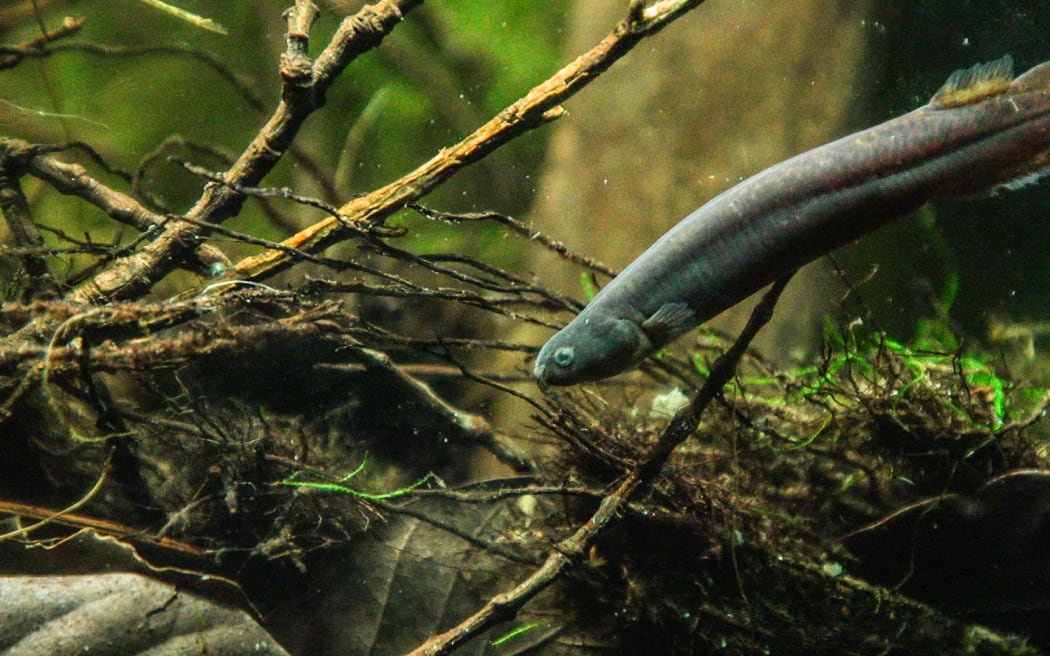
Auckland Council’s senior regional fresh water advisor, Matt Bloxham said the finds of the small eel-like critters in October were surprising.
“We’ve been looking since 2014, spreading the net as it were to other areas… mudfish have really specific requirements in terms of habitat so not every wetland is going to hold habitat useful to mudfish but finding them has proven harder than than we expected.
“It was this year that we found two new populations so it’s been quite an amazing year for us.”
He said the latest finds were located in a small body of water of only a few metres, the space likely created by roaming deer.
Bloxham said there’s a number of pressure points that have strained black mudfish numbers like introduced flora and pest fish, but the greatest threat is the loss of about 90 percent of our wetlands.

A black mudfish. Photo: Nick Monro
“Unfortunately you know, they are wholly reliant on on their habitat remaining good in order to make a living.
“Wetlands are slowly becoming modified by nutrients and sediment and the encroachment of the smothering vegetation.”
Black mudfish populations have been reduced to pockets in between Waikato and Northland, he said.
The precarious nature of their existence is such, that Bloxham said the small strip of water they were found just weeks ago had now mostly evaporated.
Auckland Zoo ectotherm keeper, Julie Underwood said the native fish would’ve since secreted themselves into the mud, lying dormant.
“They have abilities like surviving out of water so they don’t have scales they have leathery skin with a mucus layer and they can actually absorb oxygen through that as long as they’re damp.
“So when the wetland dries out they can hunker into the mud and kind of survive that dry period when all the other fish have to leave the area so it’s a good survival technique.”

Where the mudfish were discovered. Photo: Nick Monro
Underwood had been part of Auckland Zoo’s breeding programme which started in 2015 after black mudfish (Neochanna diversus) were brought to them from mana whenua in Hikurangi, Northland.
The zoo had been working in collaboration with local iwi and a collective of hapū kaitiaki from the North Island, Ngā Kaitiaki o Ngā Wai Māori.
She said the work had been a success.
“So we’re 350 fish later and we’ve run out of room so we’ve actually stopped active breeding and now we’re just sort of gearing up and looking for places to release them back to the wild.
“The idea was to basically create tiny wetlands a really naturalistic habitat step back and try and let the fish do their thing and then we more step in with looking after the eggs and raising the fry so that’s the trickier bit.
“For us luckily if we put the fish in together we generally get eggs but it’s kind of following that through and raising those fry to adulthood that’s a little bit more technical.”

Auckland Zoo ectotherm keeper, Julie Underwood. Photo: Nick Monro
Underwood said it was a good example of what could be done for conservation without needing to spend a whole lot of money or use a lot of technical equipment.
Auckland Zoo ectotherm team leader, Don McFarlane said the next step was now the greatest challenge, finding these native fish a suitable home away from pests and human influence.
He said partners like Ngā Kaitiaki o Ngā Wai Māori had been learning how to care for the fish at Auckland Zoo, with the aim to re-release the zoo’s Waikaka back to where they came from.
“What we’re looking for is, first and foremost, is the hapu from Hikurangi, Ngā Kaitiaki o Ngā Wai Māori, choose that site and that it’s a site that is in their rohe and a site that they can protect and have guardianship over.
“Because the site needs to be protected, but not just a few months or a few years, but in perpetuity. That’s quite an ask.
“We are struggling with council and our hapū friends in Hikurangi to find a suitable place to put them.
“And that tells you everything about the state of the wetlands in New Zealand. We’re a little bit restricted further because we want them to go back from whence they came.”

The wetlands where the mudfish live are diminishing. Photo: Nick Monro
McFarlane said New Zealand’s wetlands were diminishing despite their importance ecologically.
“Where on earth do we find a pristine wetland that we can protect, that has oversight long term to protect? It’s less than 10 percent of wetlands left. In that is the answer to our problem. We’ve got to protect what’s left, basically and that’s with government.”
“We may have to consider, like many other international conservation organisations are starting to look at, sites that are still protected that are actually not from where the animal originally came from, simply because you have no choice.”
“They can’t live in zoo situations or captive situations forever.”
He said one of the greatest tragedies in the story of New Zealand’s black mudfish, is the fact they were once one of our most abundant fish.

The area in Helensville where they were found. Photo: Nick Monro
“They were a source of food for Māori once, so there’s a cultural heritage loss here as well, which is undervalued and underappreciated.”
“There’s deep cultural associations with this fish for many Māori, many Iwi, and it’s disappearing. How do you value these things? It is very difficult. Uniqueness is important, I think it’s fair to say, and it is fast disappearing.”
“The world is becoming a very bland place when diversity is lost, and the thing is they are the canary in the mine for the habitats in which they’re associated.”
The discoveries were fantastic, McFarlane said, but it was a reminder of the habitats they were reduced to existing in.
“We must do what we can to take action to save what’s left,” he said.
rnz

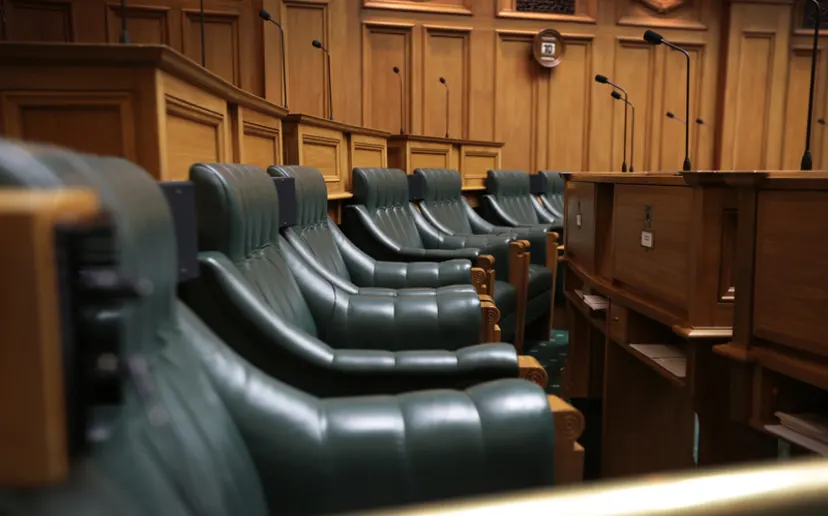
The chief executive of the Parliamentary Service is confident there will be enough room to accommodate the increased number of MPs and their staff coming into Parliament.
On current numbers, up to 131 MPs could be sitting in the Chamber following the election, brought on by a record overhang result.
Clerk of the House of Representatives Dr David Wilson told the Spinoff that currently the debating chamber had enough chairs to seat 124 MPs – including the Speaker of the House – and work was being done to accommodate more by altering the seating arrangement.
In a statement, Parliamentary Service chief executive Rafael Gonzalez-Montero said planning for a larger Parliament had been going for “some time”.
“Now that the election results have confirmed an increase to the number of members we are looking at several options.
“We are confident we will be able to accommodate all members within the Chamber.”
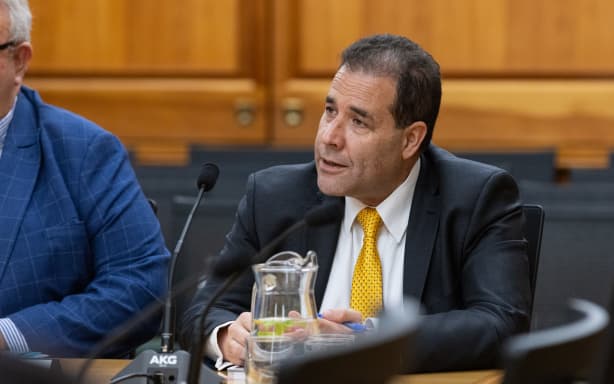
VNP / Phil Smith
Gonzalez-Montero said office accommodation for members and their staff would be “stretched” for a short time, but the new Members’ Building was only a few months away from “practical completion”.
That building – located behind Parliament – was due to be ready to occupy in April next year and had capacity to accommodate around 30 backbench MPs.
“All members should be in fit-for-purpose accommodation from that point,” Gonzalez-Montero said.
Following the 2023 election, 123 MPs sat in the Chamber – a record number at the time. That decreased to 122 following the resignation of National MP Judith Collins.
Collins held the seat of Papakura and stepped down in May and Parliament voted against holding a by-election because it was too close to the election.
The election result also meant high-ranking National Party MPs like Chris Bishop, Paul Goldsmith, Nicola Willis and Gerry Brownlee – Speaker of the House and an MP for 30 years – would likely not make it back into Parliament.
Only resigning or retiring MPs were permitted to give a valedictory speech meaning none of them would get the chance to give a valedictory statement.
Asked if their would be special allowances for valedictories, Wilson said in a statement that normally only MPs were allowed to speak in the House but the House could suspend its own rules or temporarily alter them.
“It could do so to allow former members to address the House.”
Wilson said no such arrangements could be made until the next Parliament opened and members sworn in.
rnz


Police say person who fired gun at officers still at large

New Zealand sides named for RLWC finals

Parliamentary Service working on extra chairs and offices for increased number of MPs


-

 Latest News2 months ago
‘Chilling’: Business groups speak out against National’s supermarket break-up plan
-

 NZ News2 months ago
Tom Phillips report: The missed opportunities to find the children
-

 Latest News2 months ago
Cars bearing Chinese police markings stir unease in Auckland
-

 Politics2 months ago
National vows to try to split Pak’nSave and New World
-

 Fiji News2 months ago
Plans to have new Constitution by Dec 24th 2026
-

 Politics2 months ago
MBIE confirms botched biometric projects costs blown out to $50.7 million
-

 NZ News2 months ago
Cop who stole $68,000 can now be named as champion Muay Thai fighter Haimona Tamati-Te Paki
-

 Latest News2 months ago
Five Karangahape Road venues lose their liquor licences after police intervention