

Business
Twitter board agrees to $44b takeover by Elon Musk


The board of Twitter has agreed to a US$44 billion takeover offer from billionaire Elon Musk.

Musk has suggested a series of changes to Twitter from relaxing its content restrictions to eradicating fake accounts. Photo: AFP
Musk, who made the shock bid less than two weeks ago, has claimed he is the right person to “unlock” the social media firm’s “extraordinary potential”.
He also called for a series of changes from relaxing its content restrictions to eradicating fake accounts.
The firm initially rebuffed Musk’s bid, but it will now ask shareholders to vote to approve the deal.
Musk is the world’s richest man, according to Forbes magazine, with an estimated net worth of US$273.6b mostly due to his shareholding in electric vehicle maker Tesla which he runs. He also leads the aerospace firm SpaceX.
“Free speech is the bedrock of a functioning democracy, and Twitter is the digital town square where matters vital to the future of humanity are debated,” he said in a statement announcing the deal.
“I also want to make Twitter better than ever by enhancing the product with new features, making the algorithms open source to increase trust, defeating the spam bots, and authenticating all humans.
“Twitter has tremendous potential – I look forward to working with the company and the community of users to unlock it.”
The move comes as Twitter faces growing pressure from politicians and regulators over the content that appears on its platform. It has drawn critics from left and right over its efforts to mediate misinformation on the platform.
In one of its most high-profile moves, last year, it banned former US President Donald Trump, perhaps its most powerful user, citing the risk of “incitement of violence”.
At the time Musk observed: “A lot of people are going to be super unhappy with West Coast high tech as the de factor arbiter of free speech.”
News of Musk’s takeover has been cheered by the right in the US, although Trump on Monday told Fox News he had no plans to rejoin the platform.
The White House declined to comment on the takeover but spokesperson Jen Psaki told reporters: “No matter who owns or runs Twitter, the president has long been concerned about the power of large social media platforms.”
What is Elon Musk’s record on Twitter?
Musk, who has more than 80 million followers on Twitter, has a controversial history on the platform himself.
In 2018, US financial regulators accused him of misleading Tesla investors with his tweets, claims that were resolved in a US$40b settlement and that Musk continues to deny.
And in 2019 he was hit with a defamation suit – which he successfully defeated – after calling a diver involved in rescuing schoolboys in Thailand “pedo guy” on the platform.
On Monday, Musk, who has been known to clash with journalists and block critics, suggested that he saw Twitter as a forum for debate.
“I hope that even my worst critics remain on Twitter, because that is what free speech means,” he wrote just hours before the deal was announced.
Can Musk turn Twitter around?
As part of the takeover, which is expected to close later this year, Twitter’s shares will be delisted and it will be taken private.
Musk has suggested this will give him freedom to make the changes he wants to the business.
Among other ideas, he has suggested allowing longer posts and introducing the ability to edit them after they have been published.
Twitter shares on Monday closed more than 5 percent higher after the deal was announced.
But the price remained lower than Musk’s US$54.20 per share offer, a sign that Wall Street believes he is overpaying for the firm.
Musk has said he did not “care about the economics” of the purchase. However, he will take on a company with a chequered record of financial performance.
Despite its influence, Twitter has rarely turned a profit and user growth, particularly in the US, has slowed.
The company, founded in 2004, ended 2021 with $5b in revenue and 217 million daily users globally – a fraction of the figures claimed by other platforms such as Facebook.
Twitter board chair Bret Taylor said it had fully assessed Musk’s offer and it was “the best path forward for Twitter’s stockholders”.
It is not clear who will lead the company moving forward. Twitter is currently led by Parag Agrawal, who took over from co-founder and former boss Jack Dorsey last November.
But in his offer document, Musk told Twitter’s board: “I don’t have confidence in management.”
Agrawal on Monday said: “Twitter has a purpose and relevance that impacts the entire world. Deeply proud of our teams and inspired by the work that has never been more important.”
How did the deal come together?
Musk’s targeting of Twitter has moved at remarkable speed. It emerged at the beginning of April that he had become the largest shareholder in the firm with a 9.2 percent stake.
He was then invited to join Twitter’s board but turned down the offer before launching a surprise bid for the company on 14 April, saying he wanted to “unlock” its potential as a bastion of freedom of speech.
Twitter tried to fend off his bid, threatening to dilute the shareholdings of anyone who bought more than a 15 percent in the firm. However, its stance shifted after Musk revealed more financial details about his proposed bid.
He has secured US$25.5b of financing for the deal and will take a US$21b stake in the business.
The board unanimously approved the bid, which will now be presented to shareholders for a vote.
– RNZ













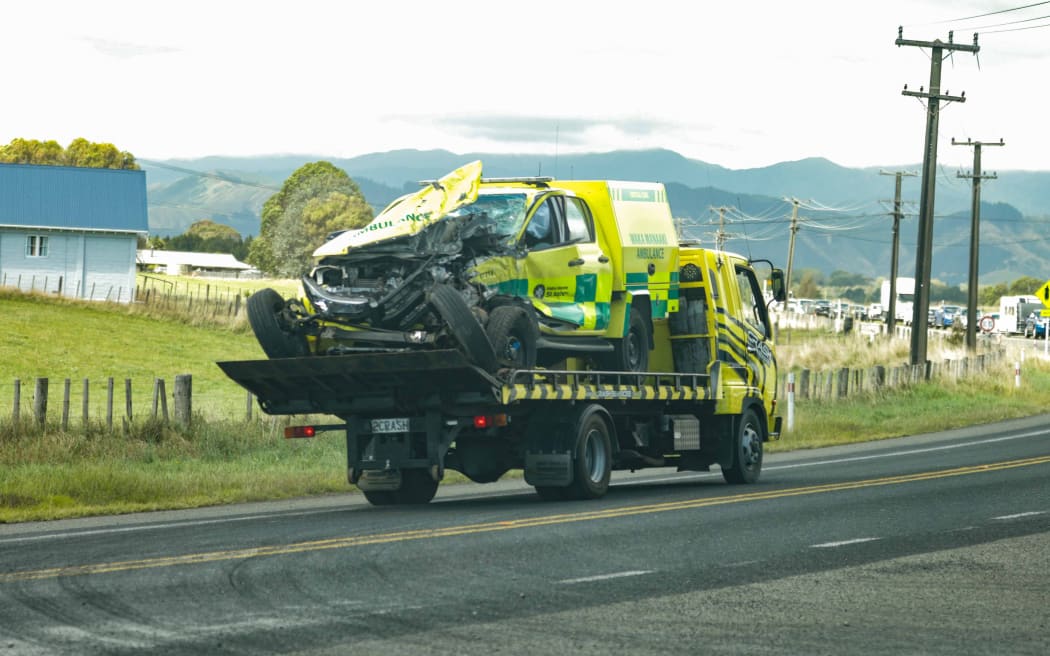
A St John’s paramedic and a LPG delivery driver have been seriously injured in a crash on State Highway 1, north of Levin.
St John’s area operations manager Gareth Collings said a rapid response unit was caught up in the crash which happened at 10.40 am near Poroutawhao, north of Levin.
“The paramedic in the rapid response unit and the driver of the other vehicle were both treated for serious injuries and transported to Palmerston North Hospital by ambulance. Our thoughts are with those impacted by this incident and we are offering support to our people who were involved,” Collings said.
St John would be “supporting police” investigating the cause of the crash.

A Genesis Energy LPG delivery vehicle was involved in the crash. Photo: RNZ / Samuel Rillstone
Genesis Energy’s Ed Hyde confirmed one of its LPG delivery drivers was involved in the crash.
“Genesis has another vehicle on the way to the scene to collect the LPG cylinders and we will work with emergency services to make the site safe,” Hyde said.
Workers on a nearby site told RNZ they saw a St John vehicle travelling north with flashing lights before the crash.
St John has been approached for comment.
A reporter at the scene said workers unloaded household gas canisters from the bed of a smashed-up truck outside Lewis Farms on SH1.
The truck has lost its front wheels and the damaged cab was resting on the ground.
More than 100 vehicles were backed up at a cordon before traffic was allowed through.
~ RNZ


Police say person who fired gun at officers still at large

New Zealand sides named for RLWC finals

Parliamentary Service working on extra chairs and offices for increased number of MPs


-

 Latest News2 months ago
‘Chilling’: Business groups speak out against National’s supermarket break-up plan
-

 NZ News2 months ago
Tom Phillips report: The missed opportunities to find the children
-

 Politics2 months ago
National vows to try to split Pak’nSave and New World
-

 Latest News2 months ago
Cars bearing Chinese police markings stir unease in Auckland
-

 Fiji News2 months ago
Plans to have new Constitution by Dec 24th 2026
-

 NZ News2 months ago
Cop who stole $68,000 can now be named as champion Muay Thai fighter Haimona Tamati-Te Paki
-

 Politics2 months ago
MBIE confirms botched biometric projects costs blown out to $50.7 million
-

 Latest News2 months ago
Five Karangahape Road venues lose their liquor licences after police intervention