

Latest News
What building owners think about the earthquake law change


Wellington building owners say changes to earthquake prone standards are a step in the right direction, while waiting for further details on what it will mean for them.
Under the new regime, unreinforced masonry buildings with unsecured facades and walls above public areas or neighbouring buildings will automatically be considered earthquake prone.
Concrete buildings with more than three storeys will be assessed for earthquake prone status under a “targeted retrofit methodology” to determine “critical vulnerabilities” that can lead to a collapse.
The government expected the changes to remove about 2900 buildings from the register, make remediation cheaper for a further 1440 buildings and 880 would not need any remedial work.
Only about 80 buildings would still require a full retrofit, due to the risks posed.
The government estimated it would save $8.2b across the country.

Building and Construction minister Chris Penk. Photo: RNZ / Samuel Rillstone
Building and construction minister Chris Penk said the previous regime, while well-intentioned, had proved to be uneconomic and difficult to achieve.
“Going forward, we’re really comfortable that it will be the most high-risk buildings, and the most high-risk aspects of those buildings, that will be remediated,” he said.
“Practical, realistic, sensible”
When Alison Bartley bought an old stable building on Ghuznee Street in 2007, it was 80 to 100 percent earthquake complaint.
But since the law change in 2017, it has been deemed earthquake prone.
The building was originally built in 1891, and the previous owner had strengthened it.
Bartley said the cost of further remediation was “ridiculously” high, and was pleased the government was scrapping the regulations.
“They’re practical, realistic, sensible changes. And the fact that other places around the country had to be strengthened to the same standard as Wellington was just crazy. One-size-fits-all didn’t work, and that’s what we had.”
Despite that, she had held on to the property.
“I can’t really sell it, because no banks will lend on an earthquake prone building.
“The only people who would have bought it would have been developers who would pull it down, and I don’t want to see historic buildings like this pulled down. I think they add to the character of the city.”
The government will not compensate those who have already spent money remediating their properties.
“I don’t think anyone should regret having invested in making their building more safe.
“The question is really, going forward, whether it’s right to require others to do a thing that has proven beyond them economically, where that can’t be justified in a proportionate or balanced system,” Penk said.

Hazel Kirkham, left, and Geraldine Murphy from the lobby group Inner City Wellington. Photo: RNZ / Michael Cropp
The Inner-City Wellington residents’ association said some apartment owners had sold up, but were unlikely to have made a good deal.
The association’s spokesperson for seismic matters Geraldine Murphy said while some would be disappointed to have spent the money, or sold their property, they would still likely back the changes.
“Those people who have been in those positions supported the work that we were doing to get it reviewed, because we knew that the system was not right,” Murphy said.
“It plainly had gone down a direction that wasn’t intended, because the focus was always supposed to be on the most vulnerable, risky buildings. But it got way beyond that.”
The association has been lobbying for a change since 2019, and Murphy said it was a step in the right direction.
“It’s still early days for people to see what it means for them, but I know that many people felt that the current system was just unworkable,” she said.
“It does look quite targeted, and there’s different categories and things. So at this stage I’m feeling quite positive that we’re moving in a direction that’s better than where we were. We couldn’t continue on what we had, we had to change it.”
Murphy expected that even buildings needed a total retrofit would not be at the size or scale of what would have been required under the previous system, but was waiting to see more details on what that would mean.
Wellington City Council was considering what the changes would mean for council-owned buildings, but welcomed the announcement.

Wellington Mayor Tory Whanau. Photo: RNZ / Samuel Rillstone
Mayor Tory Whanau said it removed a billion-dollar burden for building owners across the city.
“Many apartment and business owners simply cannot afford to upgrade their buildings to the current standards; you can see that reality in the empty buildings around town.
“These rule changes will save hundreds of owners from expensive repairs and focus resources on those buildings that are at the highest risk.”
The council was also checking to see whether the changes meant the Capital E building was no longer earthquake prone, and had extended the pause on the City to Sea Bridge demolition until council officers reported back.
Bartley said she did not see any excuse now for the council to demolish the bridge.
RNZ



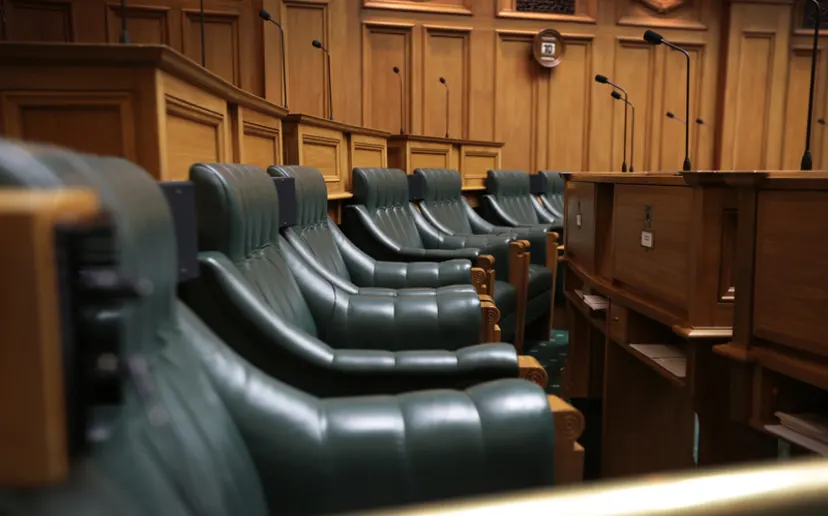
The chief executive of the Parliamentary Service is confident there will be enough room to accommodate the increased number of MPs and their staff coming into Parliament.
On current numbers, up to 131 MPs could be sitting in the Chamber following the election, brought on by a record overhang result.
Clerk of the House of Representatives Dr David Wilson told the Spinoff that currently the debating chamber had enough chairs to seat 124 MPs – including the Speaker of the House – and work was being done to accommodate more by altering the seating arrangement.
In a statement, Parliamentary Service chief executive Rafael Gonzalez-Montero said planning for a larger Parliament had been going for “some time”.
“Now that the election results have confirmed an increase to the number of members we are looking at several options.
“We are confident we will be able to accommodate all members within the Chamber.”
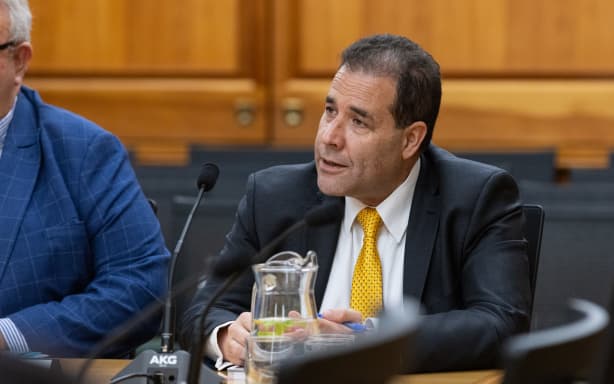
VNP / Phil Smith
Gonzalez-Montero said office accommodation for members and their staff would be “stretched” for a short time, but the new Members’ Building was only a few months away from “practical completion”.
That building – located behind Parliament – was due to be ready to occupy in April next year and had capacity to accommodate around 30 backbench MPs.
“All members should be in fit-for-purpose accommodation from that point,” Gonzalez-Montero said.
Following the 2023 election, 123 MPs sat in the Chamber – a record number at the time. That decreased to 122 following the resignation of National MP Judith Collins.
Collins held the seat of Papakura and stepped down in May and Parliament voted against holding a by-election because it was too close to the election.
The election result also meant high-ranking National Party MPs like Chris Bishop, Paul Goldsmith, Nicola Willis and Gerry Brownlee – Speaker of the House and an MP for 30 years – would likely not make it back into Parliament.
Only resigning or retiring MPs were permitted to give a valedictory speech meaning none of them would get the chance to give a valedictory statement.
Asked if their would be special allowances for valedictories, Wilson said in a statement that normally only MPs were allowed to speak in the House but the House could suspend its own rules or temporarily alter them.
“It could do so to allow former members to address the House.”
Wilson said no such arrangements could be made until the next Parliament opened and members sworn in.
rnz


Police say person who fired gun at officers still at large

New Zealand sides named for RLWC finals

Parliamentary Service working on extra chairs and offices for increased number of MPs


-

 Latest News2 months ago
‘Chilling’: Business groups speak out against National’s supermarket break-up plan
-

 NZ News2 months ago
Tom Phillips report: The missed opportunities to find the children
-

 Politics2 months ago
National vows to try to split Pak’nSave and New World
-

 Latest News2 months ago
Cars bearing Chinese police markings stir unease in Auckland
-

 Fiji News2 months ago
Plans to have new Constitution by Dec 24th 2026
-

 NZ News2 months ago
Cop who stole $68,000 can now be named as champion Muay Thai fighter Haimona Tamati-Te Paki
-

 Politics2 months ago
MBIE confirms botched biometric projects costs blown out to $50.7 million
-

 Latest News2 months ago
Five Karangahape Road venues lose their liquor licences after police intervention