

World
Russian forces launch fresh assault on eastern Ukraine

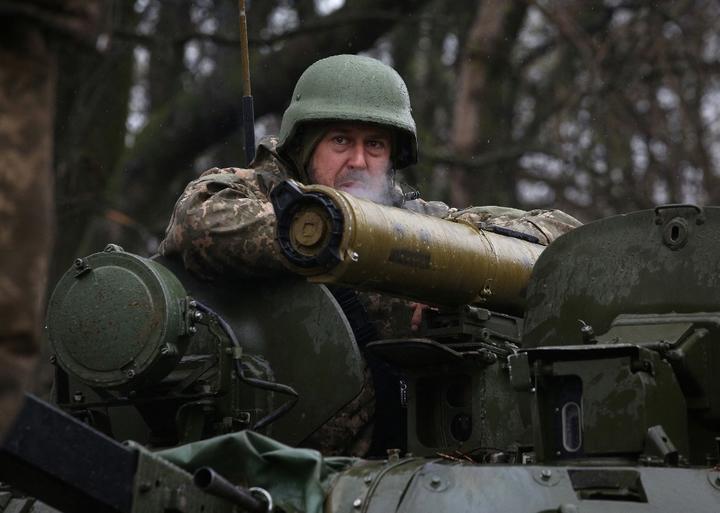
Ukrainian President Volodymyr Zelensky says the Battle of the Donbas has begun.
His statement was made after Ukraine officials confirmed Russian forces had launched a new offensive push along most of Ukraine’s eastern flank.
Ukraine’s army has been bracing for a new Russian assault since Moscow retreated from earlier attempts to take the capital Kyiv – and shifted its forces to the east.
Donbas has been the scene of fighting with separatist groups since 2014.
“We can now say that Russian forces have started the battle of the Donbas, for which they have long prepared,” Zelensky said in a video address.
“A very large part of the entire Russian army is now focused on this offensive.”
Earlier, Ukraine’s top security official, Oleksiy Danilov, said Russian forces had attempted to break through Ukrainian defences “along almost the entire front line of Donetsk, Luhansk and Kharkiv regions”.
In a post on Facebook, the Ukrainian armed forces command said that Russia’s main military force was concentrating on taking control of the entirety of the Donetsk and Luhansk regions that make up the swathe of land known as the Donbas.
“The second phase of the war has begun… Believe in our army, it is very strong,” the Ukrainian president’s chief of staff, Andriy Yermak, wrote on the Telegram messaging app.
Driven back by Ukrainian resistance in the north, Moscow has refocused its ground offensive, bulking up its forces in the eastern Donbas with troops that it pulled out of Ukraine’s north and neighbouring Belarus, a close Russian ally.
At the same time, Russia has been launching long-distance strikes at other targets including the Ukrainian capital, Kyiv.
Ukrainian officials said Russian shelling killed four people in the eastern Donetsk region on Monday, while a man and a woman were killed in Kharkiv when shells hit a playground near a residential building.
The regional governor of Kharkiv said authorities were continuing the evacuation of people from two areas where they expect fighting to take place.
Russia’s reinforcements have set the stage for a protracted battle that military analysts say is certain to inflict heavy losses on both sides as the Russians try to encircle Ukraine’s fighters dug in to defend the Donbas region.
Missile attack in western Ukraine
Elsewhere, a Russian missile attack killed seven people in Lviv, the first civilian victims in the western city about 60 kilometres from Poland.
Maksym Kozytskyy, the governor of Lviv, said preliminary reports suggested there were four strikes there, three on warehouses that were not in use by the military and another on a car service station.
“It was a barbaric strike at a service station, it’s a completely civilian facility,” he told a news conference.

Damage to buildings after five aimed Russian missile strikes hit Lviv, Ukraine, killing seven people. Photo: 2022 Anadolu Agency
The mayor of Lviv, Andriy Sadoviy, said the youngest person killed was 30. The blast also wounded 11 and shattered windows of a hotel housing evacuees from elsewhere in the country, he added.
“Seven peaceful people had plans for life, but today their life stopped,” he said.
Russia’s defence ministry said it had hit hundreds of military targets in Ukraine overnight. It said air-launched missiles had destroyed 16 military facilities in the Kharkiv, Zaporizhzhia, Donetsk and Dnipropetrovsk regions and in the port of Mykolayiv, which are in south and east Ukraine.
It added that the Russian air force had launched strikes against 108 areas where Ukrainian forces were concentrated and Russian artillery struck 315 Ukrainian military targets.
Howitzer training
Western capitals and Kyiv accuse Russian President Vladimir Putin of unprovoked aggression.
Russia denies targeting civilians in what it calls a special operation to demilitarise Ukraine and eradicate dangerous nationalists. It rejects what Ukraine says is evidence of atrocities, saying Ukraine has staged them to undermine peace talks.
Last week, US President Joe Biden announced an additional US$800 million (NZ$1.2bn) in military assistance to Ukraine, expanding the aid to include heavy artillery ahead of a wider Russian assault expected in eastern Ukraine.
The US military expects to start training Ukrainians on using howitzer artillery in coming days, a senior US defence official said on Monday, adding that the training would take place outside Ukraine.
French President Emmanuel Macron said on Monday his dialogue with Putin had stalled after mass killings were discovered in Ukraine.

A medical staff member checks the eyes of a soldier at a military hospital in Zaporizhzhia in south-eastern Ukraine. Photo: AFP or licensors
‘Hell on Earth’
Russia has been trying to take full control of the south-eastern port city of Mariupol, which has been besieged for weeks and which would be a huge strategic prize, linking territory held by pro-Russian separatists in the east with the Crimea region that Moscow annexed in 2014.
Major Serhiy Volyna, commander of Ukraine’s 36th marine brigade which is still fighting in Mariupol, appealed for help in a letter to Pope Francis, saying women and children were trapped among fighters in the city’s steel works.
“This is what hell looks like on earth … It’s time (for) help not just by prayers. Save our lives from satanic hands,” the letter said, according to excerpts tweeted by Ukraine’s ambassador to the Vatican.
No fewer than 1,000 civilians were hiding in underground shelters beneath the vast Azovstal steel plant, the city council said on Monday.
Video and audio footage showed explosions rumbling and smoke rising from the steelworks, which contain myriad buildings, blast furnaces and rail tracks.
Azovstal is the main remaining stronghold of Ukrainian forces in Mariupol. The city’s defenders include Ukrainian marines, motorised brigades, a National Guard brigade and the Azov Regiment, a militia created by far-right nationalists that was later incorporated into the National Guard.
Denis Prokopenko, a lieutenant colonel of the Azov Regiment, said in a Telegram video post that while he was at the steel plant, Russian and separatist forces were dropping anti-bunker bombs and blasting the area with rockets and other weapons, including from ships, “knowing that there are civilians here”.
Russia’s invasion has damaged or destroyed up to 30 percent of Ukraine’s infrastructure at a cost of US$100bn (NZ$148bn), a Ukrainian minister said, adding reconstruction could be achieved in two years using frozen Russian assets to help finance it.
The United Nations said on Monday the civilian death toll from the war had surpassed 2,000, reaching 2,072 as of midnight on 17 April from the start of the Russian invasion on 24 February.
About four million Ukrainians have fled the country.






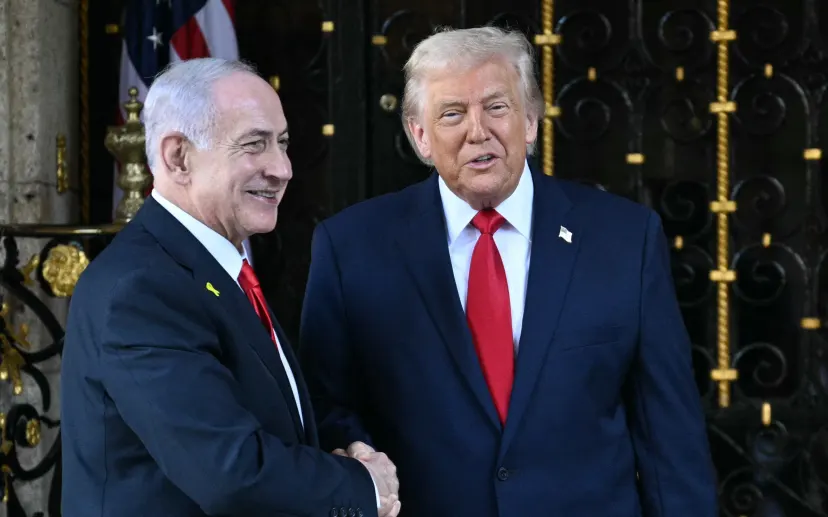
Israeli Prime Minister Benjamin Netanyahu boasted of his endorsement from Donald Trump on the eve of Israel’s election, suggesting the two leaders could restart their war against Iran if he wins, after Trump said they should “finish the job”.
“US President Donald Trump has come with a friendship that has never existed before between an Israeli prime minister and an American president. And it is doubtful we will ever have such a friendly president again,” Netanyahu said in a televised appearance late on Sunday night. “He has another two years, and he says he is calling on you to vote for me.”
In his own social media post on Sunday, Trump, who launched the Iran war jointly with Netanyahu in February, said: “Vote for Bibi Netanyahu for Prime Minister, we have to finish the job that we started!”
Netanyahu said Trump was willing to take action “that would finally, finally, remove the Iranian threat”, but only as long as Netanyahu himself remains in power.
“And I have already instructed the Mossad and the IDF (military) to bring down this regime, to bring down this regime because that is the only way to put an end to this threat,” Netanyahu said, referring to Israel’s main intelligence service and military.
Asked for comment on Netanyahu’s remarks, White House Deputy Press Secretary Anna Kelly said: “As President Trump stated, Iran is in very bad condition, both economically and militarily, and the blockade will remain in full force and effect, with oil flowing in record numbers of barrels through the Hormuz Strait.”
“The United States will not be attacking Iran at any time prior to the midterm elections,” Kelly added via email, referring to the November 3 vote in the US.
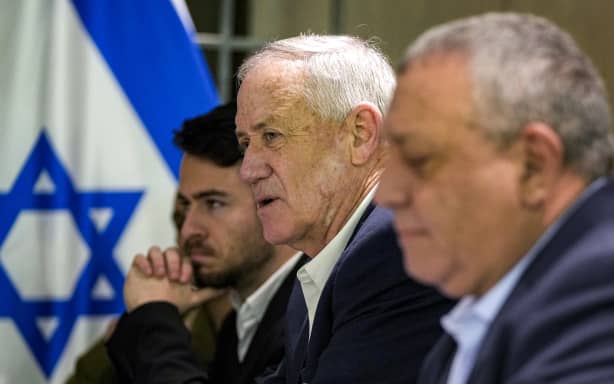
Netanyahu’s leading opponent, centrist former military Chief of Staff Gadi Eisenkot, posted his own comments on social media, praising Trump as “a true friend of Israel”.
“I value his efforts and his commitment to Israel’s security, and I am confident that he will work in full cooperation with any leader chosen by the people.”
Mark Schiefelbein / POOL / AFP
Eisenkot accuses Netanyahu of fear-mongering
Tuesday’s vote, Israel’s first since the October 7, 2023, Hamas attacks, is the first chance for voters to deliver a verdict on the worst security failure in generations and the wars on multiple fronts that followed.
With Netanyahu already at the helm of the most right-wing government in Israeli history, politics have shifted even further to the right. Nearly all Jewish-led parties, including that of the hawkish Eisenkot, now oppose the “two-state solution” that underpinned decades of peace negotiations with the Palestinians.
But many voters say the divisive politics of Israel’s longest-serving leader make the country weaker. Polls suggest Netanyahu’s Likud Party will lose seats, potentially depriving his coalition of right-wing, far-right and ultra-Orthodox parties of its narrow majority.
Eisenkot and an array of opposition parties ranging from the rump of the centre-left to the right, also have no clear path to unseat him.
Netanyahu, 77, is an unrivaled master of political survival: the only time since 2009 that opponents managed to wrest him briefly from the premiership, it took four inconclusive elections within two years to get him out. He was back 18 months later.
Neither side planned major public events for Monday. But both posted on social media, drumming on the election’s major themes: for Netanyahu, that he is the only leader with the mettle to face down Israel’s enemies; for his opponents, that his divisive politics have weakened the country.
Netanyahu shared an AI-generated video on Monday of Iran’s Supreme Leader Ayatollah Mojtaba Khamenei, whose father Ali Khamenei was killed on the first night of US-Israeli strikes on Iran in February. Lying in a hospital bed, the younger Khamenei says his own vote would be “definitely not Bibi. Another term like this and I will be meeting my father sooner than expected.”
On Sunday Netanyahu posted a computer-generated photo of a mushroom cloud over Tel Aviv, saying Israel was in existential danger from Iran.
Eisenkot responded by accusing him of “relying on a campaign of fear-mongering, lies, and threats – including images of nuclear bombs in the heart of Tel Aviv. This time, it won’t work for him.”
Trump’s endorsement of Netanyahu carries its own political risks a week before a legislative election in which his own Republicans are seeking to hold onto power.
The Iran war is deeply unpopular in the United States, blamed for a surge in prices especially for fuel. Major fighting has been suspended for months after ceasefire negotiations held without Israeli participation.
Source: Reuters & RNZ


Police say person who fired gun at officers still at large

New Zealand sides named for RLWC finals

Parliamentary Service working on extra chairs and offices for increased number of MPs


-

 Latest News2 months ago
‘Chilling’: Business groups speak out against National’s supermarket break-up plan
-

 NZ News2 months ago
Tom Phillips report: The missed opportunities to find the children
-

 Politics2 months ago
National vows to try to split Pak’nSave and New World
-

 Latest News2 months ago
Cars bearing Chinese police markings stir unease in Auckland
-

 Fiji News2 months ago
Plans to have new Constitution by Dec 24th 2026
-

 NZ News2 months ago
Cop who stole $68,000 can now be named as champion Muay Thai fighter Haimona Tamati-Te Paki
-

 Politics2 months ago
MBIE confirms botched biometric projects costs blown out to $50.7 million
-

 Latest News2 months ago
Five Karangahape Road venues lose their liquor licences after police intervention