

NZ News
Using pests to catch pests: Ferrets enlisted in Queenstown rabbit fight

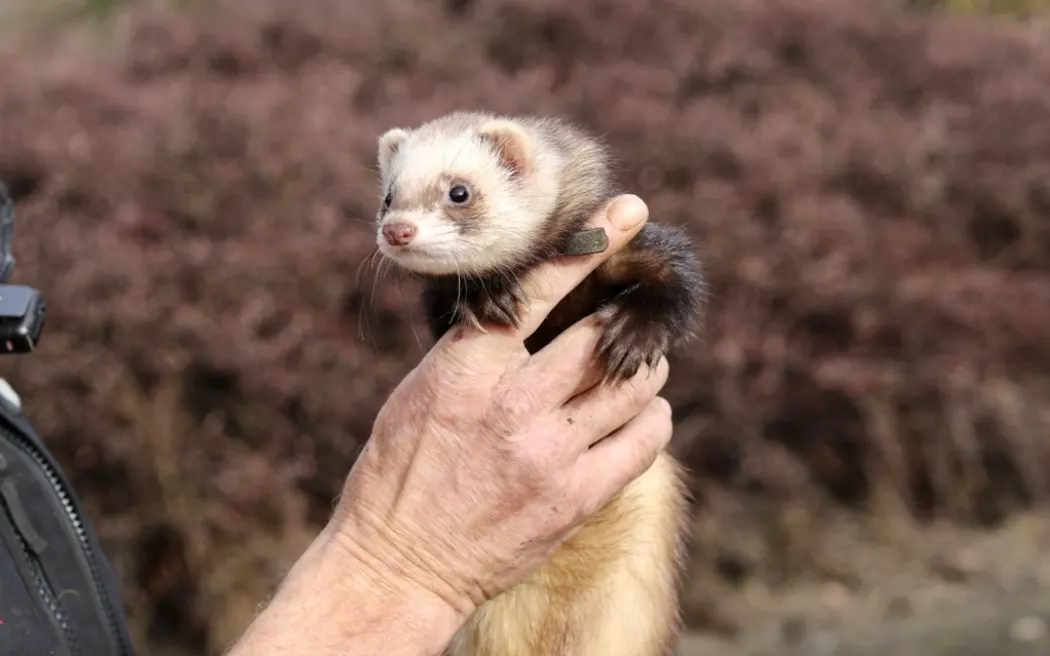
A team of tamed ferrets has been making short work of a long-eared problem in the battle against Queenstown’s rampant rabbit population.
The mustelids are part of an unusual pest control operation run by Jim Curry and his partner Jacqui Elson, who believe the best way to fight an introduced pest is with another.
Earlier this week, star ferret Oprah Winfrey took the lead to flush out a warren at a vacant property in Lower Shotover, as detection dogs waited at the ready to catch runaways.
Curry said the premise was simple – fences up, ferret in and “hopefully we’ll watch the fireworks as rabbits come flying out both sides”.
Over two days of methodical work, the ferrets managed to flush out more than 100 rabbits, which were quickly dispatched with a break of the neck.
Elson said it was just another job in what had become a near non-stop string of requests since relocating their business ‘Jim’s Bunny Hunters’ to Queenstown.
She said they took on work across farms, lifestyle blocks and commercial sites, often booked by curious locals who had seen their rabbit-laden ute.
“They’ll stop and follow us into like petrol station or cafe or something, because they’ve seen what we’ve got on the ute. People will literally stalk you into a petrol station saying ‘I saw your licence plate. We need you,'” she said.
Curry said school pick-ups were especially time-consuming because of the ferrets’ popularity – and trips around the country often garnered a lot of attention.
“We’re the only people licensed to transport ferrets all around New Zealand, between islands, which gets you some interesting look on the ferries,” he said.

As the ferrets flush out the warrens, rabbits emerge into a fenced-off area where they’re caught by detection dogs. Photo: RNZ / Katie Todd
A safer way to tackle the problem
Each of the ferrets was caught from the wild, mostly by Curry.
They could not be imported or bred because ferrets are classified as an “unwanted organism” under the Biosecurity Act.
While Curry and Elson were not the only ferreters in the region, they had special MPI approval to keep more than the usual limit of three ferrets.
Elson said the ferrets were highly effective hunters and were a safer alternative to poison.
On a recent job, she said their results eclipsed those of professional shooters.
“The commercial shooters were getting, I think they said about 900, 1000 in a year, and we got about that, including young ones, in three-and-a-half days,” she said.
“They were getting predominantly males, whereas because we’re using the ferrets to get into the holes, we’re getting predominantly females with young as well. So it’s more efficient, makes a huge difference,” she said.

Jim Curry grew up in the UK and said ferrets had been a “lifelong obsession”. Photo: RNZ / Katie Todd
Elson said they made the most of each rabbit caught.
“We can use an introduced pest, to then catch other introduced pests and then use the rabbits to give back to wildlife rescues for hawks and falcons, little owls, or other zoos. Whatever else isn’t fed to our animals then goes to trapping programmes for wild cats, other ferrets, stoats, rats,” she said.
After each hunt, Elson and Curry filled in the rabbit holes to make sure the area was clear, then if any rabbits remained they would return under the cover of darkness for shooting.
Curry said often the most challenging part of the operation was coaxing the ferrets back out, which were known to linger obstinately underground, despite wearing special tracking collars.
“The stubborn ones can take a bit of work to get out,” he said.
A dream realised
Ferrets have been a lifelong obsession for Curry, who grew up in the UK.
“I’d been reading all the Farmer’s Weekly magazines and various hunting magazines and books and things about ferreting for years. I always wanted to do it, but I didn’t have the money or the knowledge or the land,” he said.

Hillary Clinton, Kamala Harris and Jacinda Ardern waiting to be deployed for work. Photo: RNZ / Katie Todd
Seven years ago in Darfield, someone posted on Facebook about a chicken killer and Curry retrieved the culprit – a ferret he dubbed Colin Farrell.
Two more followed and soon Curry was not just rescuing ferrets but putting them to work.
“I just went ‘right, sod this, I’ve always wanted to do it’. I ordered some trackers and then ordered purse nets from the UK. It basically started with me knocking on people’s doors saying ‘hi, I see you’ve got some rabbits. Can I come and catch them?'” he said.
The pair began in Canterbury but Elson said it was a no-brainer when the opportunity arose to shift to rabbit-plagued Queenstown.
Curry said the ferret flock had expanded to a star-studded line-up over time.
“We have Oprah Winfrey, Hillary Clinton, Kamala Harris, and Jacinda Ardern, an R Kelly, a P Diddy and a Drake. And then we have a Joe Biden,” he said.

Jim Curry says they are the only people licensed to transport ferrets all around New Zealand. Photo: RNZ / Katie Todd
A persistent problem
Otago Regional Council (ORC) considered rabbits one of the area’s worst pests, posing a serious threat to the local biodiversity, the environment and economy.
Southern Lakes Sanctuary chief executive Paul Kavanagh said they were known to let other predators thrive and tore up land and ate fertile grass, with 10 rabbits devouring the equivalent of one sheep’s requirements.
“In many of our ecosystems in central Otago, predator numbers are controlled by food availability. So where we get a lot of rabbits, we in turn get a lot of feral cats, stoats, ferrets, weasels,” he said.
He described the region’s rabbit numbers as “relatively out of control”.
“Anecdotally, we’ve heard it’s getting worse in some areas, especially Cromwell, places like that,” he said.
In 2023 the ORC discovered rabbit densities of up to 16 rabbits per square kilometre in some parts of Otago.
The council said it was undertaking further rabbit night counts across the region and expected to have updated population estimates soon.
Staff regularly carried out inspections across the region to identify rabbit hotspots and had helped to develop five “community rabbit management programmes” across the region, the council said.
The ORC said it could help landowners tackle their rabbit problem but ultimately it was the landowners or occupiers responsibility to manage the problem.
Source: RNZ



Latest News
Opportunities to mitigate multi-million-dollar RNZ budget blowout likely missed – experts

Multiple opportunities to identify and mitigate a multi-million-dollar budget blowout at RNZ appear have been missed, according to the former executive director at Audit New Zealand.
The public broadcaster on Monday revealed a near $12 million shock financial loss after a litany of financial blunders, which will now lead to sweeping job cuts.
The $11.8m loss is more than 25 times the $470,000 RNZ had expected to lose over the year to June.
CEO Paul Thompson took responsibility for the result, and said internal reports gave an inaccurate picture of the finances, meaning the scale of the loss only became clear in October.
RNZ’s former chief financial officer Hilary Parker resigned unexpectedly in early October.
The board said it would commission an independent review into what went wrong.
Independent contractor Stephen Walker, who left the Audit Office earlier this year, said the size of the loss was surprising, as was the length of time it took to identify it – months after the financial year ended.

Supplied / OAG
“Probably more of a concern is that they had seemingly been unaware that they were running up a significant deficit until they were in the preparation stage of their annual report in October.”
Walker said public entities typically produced monthly financial reports.
An interim audit also took place before the end of the financial year, he said, but if the organisation hadn’t identified significant losses at that stage, the auditor could also be in the dark.
“It seems that there’s a real weakness in forecasting and budgeting that’s occurred here and that the monthly accounts, when they’re produced, either haven’t identified these significant variances against budget or the magnitude of them really hasn’t come to light until right towards the end of the financial year,” Walker said.
“And really at that point, there’s no opportunity for the chief executive, the leadership team to take, and the board to take, any corrective action because the year has effectively been completed.”
Walker said the “significant miss” was difficult to account for given it was more than 10 percent of RNZ’s total funding.
He said based on RNZ’s annual report, financial complexity didn’t appear to be a factor.
“This $11.8m loss isn’t made up of one particular item … it seems to have been contributed to by a number of separate expense lines running over budget. So I don’t think it’s necessarily to do with complexity.”
Among the errors, RNZ wrongly counted $2m from land sales as income in its budget. Staff costs also came in $3.2m over budget, including $1.4m in redundancy payments.
Professor at Auckland University’s business school Norman Wong said based on media reports the issues identified were “significant and troubling”.

Supplied / University of Auckland
“But recognising the sale of land as income in their budget is a basic error that one would have expected to have been caught and corrected well before it got to this point.”
With funding reductions at RNZ over the past two years, Walker expected greater scrutiny of financial results.
“Virtually every public entity has had their annual budget reduced. And so you would expect … the leadership team on a monthly basis and board – I’m not sure how frequently the board will consider the information – but you would expect them to be interrogating the results on a regular basis throughout the year,” he said.
Walker said initiating an independent review was the correct course of action and that he’d want to understand what information the leadership team and the board were regularly receiving.
He said he’d “love to say” surprising financial results were rare, but conceded they occured on a semi-frequent basis during his time leading the Audit Office.
“The benefit of independent scrutiny by the Audit Office – and the auditors providing that support to the Auditor General – [is] that the reporting is fairly presented at the end of the year, whether it’s good, bad or ugly.”
rnz


Police say person who fired gun at officers still at large

New Zealand sides named for RLWC finals

Parliamentary Service working on extra chairs and offices for increased number of MPs


-

 Latest News2 months ago
‘Chilling’: Business groups speak out against National’s supermarket break-up plan
-

 NZ News2 months ago
Tom Phillips report: The missed opportunities to find the children
-

 Politics2 months ago
National vows to try to split Pak’nSave and New World
-

 Latest News2 months ago
Cars bearing Chinese police markings stir unease in Auckland
-

 Fiji News2 months ago
Plans to have new Constitution by Dec 24th 2026
-

 NZ News2 months ago
Cop who stole $68,000 can now be named as champion Muay Thai fighter Haimona Tamati-Te Paki
-

 Politics2 months ago
MBIE confirms botched biometric projects costs blown out to $50.7 million
-

 Latest News2 months ago
Five Karangahape Road venues lose their liquor licences after police intervention