

NZ News
Kids sleep on chairs, family eats meals of only rice to pay bills

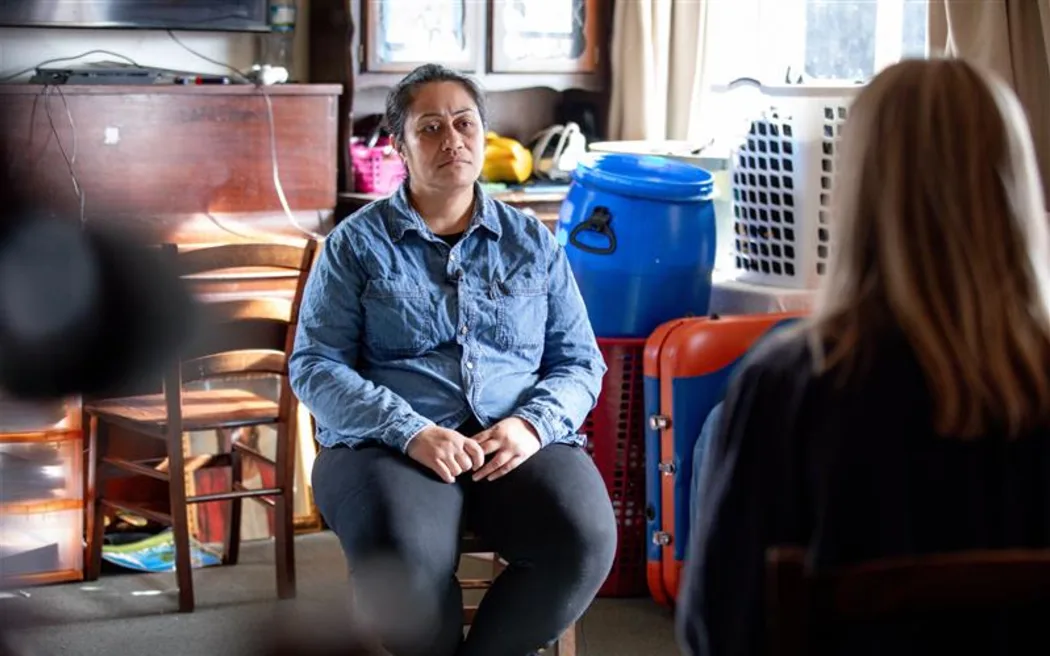
There are a dozen people in the Latu household in the Auckland suburb of Mangere, but not enough beds for everyone.
Three of Unaloto Latu’s children have to sleep on couches in the living room.
“Those three big chairs over here, our younger children sleep here… we know that sometimes it’s hard for them but they have no choice.”
She and her husband have eight children aged between six and 18, and two relatives staying.
Her husband has been off work with a knee injury for about three years and their household income, reliant on the benefit, is always stretched.
They are not alone – social services said they are seeing an alarming level of poverty as families struggle with the cost of living.

Unaloto Latu. Photo: RNZ / Marika Khabazi
Four agencies RNZ spoke to said they regularly hear of families sleeping in one room and turning off the power during the day as they try to stay warm and pay their electricity bills.
Charities – including the city missions, Variety, Kids Can and Family Works – are running winter appeals to help support families facing hardship.
Latu sells her homemade cakes to help pay for eggs and milk for her family – but it is not enough.
“Kids can go without milk, meat and bathroom stuff, cleaning stuff. Sometimes they need clothes and shoes, broken, husband can fix it he says he can get another two weeks from that.”
The power and internet bills are paid but Latu said dinner is sometimes just rice – her children’s schools are part of the government lunch programme.
“Sometimes if we have, we have. If not, they come [home] and just go in their room,” she said.
“It’s crazy right now and it looks like everything in the shop is going up each week…milk, before i can buy six [bottles] milk a week for our kids but now two.”
Latu said she sometimes struggles to remain positive.
“It is so hard but I always say to my friends and family I don’t want to sit down and focus on that side, because I’m a very emotional person I’m going to cry the whole day not doing anything thinking of those things. I try to keep moving forward.”
Latu said she is grateful to Variety for sponsoring her children, meaning they each receive $50 a month as a contribution to household costs.
Stats NZ figures show electricity costs have gone up almost 9 percent since June last year. Petrol has gone up 15.5 percent over the same period.
Consumer NZ’s annual energy retailer survey found seven percent of New Zealanders have had to take out loans to pay their power bills – unchanged since last year.
Chief executive Jon Duffy said the number of people concerned about the cost of electricity has jumped 10 percent in the last year.
“These financial concerns have led us into a dire situation where 11 percent of people are underheating their homes.”
Duffy said the underlying market structure needs an urgent overhaul in order to slow down the growing number of New Zealanders experiencing energy hardship.
This week, the Electricity Authority announced it would force big electricity retailers to offer cheaper prices for off-peak power use prices, and fair prices to people who sell surplus power to the grid from roof top solar panels at peak times.
It is changing sector rules to require retailers with more than five-percent market share to offer time of use prices from the middle of next year, after a report by a joint task force of the Authority and the Commerce Commission.
The changes were aimed to give consumers more choice in how and when they use power, and put downward pressure on prices.
Presbyterian Support Northern general manager of social services Grenville Hendricks said this winter is worse for those on the breadline.
The organisation is helping 800 fewer families after its government funding was cut by $1.5 million last year.
“Agencies are struggling to keep their services running, let alone try and support people coming in,” he said.
“It’s also a challenge when there’s been issues around benefit payments, there’s been reductions in the numbers of available social housing.”
Hendricks said that all contributed to people struggling to pay their bills, including power.
“People are trying to manage as best they can, but given all the other circumstances that are currently happening in New Zealand with the cost of living, unemployment, reduction in social services, it means that actually the power challenge becomes exacerbated.”
He said they have heard of families sleeping in one room and children sharing beds to keep warm, and that the health of those not sleeping in beds or in damp mouldy houses was suffering.
Zero Hunger Collective executive officer Tric Malcolm said she is hearing examples across the country of families struggling to pay for basics.
“What is normal now, most people wouldn’t have even dreamed of several years ago.”
She said for the first time in almost a decade they were hearing stories of families across the country struggling to keep their power on this winter.
“I haven’t heard these stories since the global financial crisis. Families are putting the heating on in one room and sleeping in that one room so that they can save energy,” Malcolm said.
“It’s those moments that cause me worry and make me feel sad because people aren’t able to access good dry, warm homes because they don’t have enough funds in their household income.”
She said people then reduce the amount that they eat.
Auckland City Missioner Helen Robinson said its services are experiencing increased demand and people would often cover their rent and utilities before buying food.
“People are making terrible, terrible choices. Do I send kids to school, do I have the power on? Do I pay for the washing machine to be fixed, do I have the power on? Do I get food?” she said.
“What we know is that the demand for food, so therefore the inadequacy of people’s weekly income, is significantly increasing, so much so that we can’t meet the need and I am deeply distressed to acknowledge that.”
Variety sponsors about 10,000 children and chief executive Susan Glasgow said the wait list has more than 3000 children living in material deprivation.
“Unfortunately these are children all throughout New Zealand who are living in material deprivation, in cold, damp homes, sleeping on the floor, not having enough school uniforms to go around all the children in a household, they’re living in really tough times.”
Glasgow said they hear from families regularly who are struggling to afford to heat their homes, and they often sleep in one room sometimes with the oven on for warmth.
“New Zealand is teetering on the brink. I think if we don’t take some pretty severe steps very soon we’re going to see more children plunged into poverty and the long term outcomes for New Zealand are going to be dire,” she said.
“We want a healthy, vibrant group of young people who can contribute to our economy, who are well educated, who can support us in our dotage. You know, it’s just good for New Zealand to invest, and it’s not about charity, it’s about investment in our future as a country.”
Unaloto Latu dreams of a bright future for her children and encourages them to help others.
“Our hope for our children, we always teach them to go to school and study hard so you can get a job that will give you what you need.”
And when they have grown up, Latu has dreams of her own.
“For myself, my hope and dream is when my kids are all in good places I want to travel around the world.”
Source: RNZ



Latest News
Opportunities to mitigate multi-million-dollar RNZ budget blowout likely missed – experts

Multiple opportunities to identify and mitigate a multi-million-dollar budget blowout at RNZ appear have been missed, according to the former executive director at Audit New Zealand.
The public broadcaster on Monday revealed a near $12 million shock financial loss after a litany of financial blunders, which will now lead to sweeping job cuts.
The $11.8m loss is more than 25 times the $470,000 RNZ had expected to lose over the year to June.
CEO Paul Thompson took responsibility for the result, and said internal reports gave an inaccurate picture of the finances, meaning the scale of the loss only became clear in October.
RNZ’s former chief financial officer Hilary Parker resigned unexpectedly in early October.
The board said it would commission an independent review into what went wrong.
Independent contractor Stephen Walker, who left the Audit Office earlier this year, said the size of the loss was surprising, as was the length of time it took to identify it – months after the financial year ended.
Supplied / OAG
“Probably more of a concern is that they had seemingly been unaware that they were running up a significant deficit until they were in the preparation stage of their annual report in October.”
Walker said public entities typically produced monthly financial reports.
An interim audit also took place before the end of the financial year, he said, but if the organisation hadn’t identified significant losses at that stage, the auditor could also be in the dark.
“It seems that there’s a real weakness in forecasting and budgeting that’s occurred here and that the monthly accounts, when they’re produced, either haven’t identified these significant variances against budget or the magnitude of them really hasn’t come to light until right towards the end of the financial year,” Walker said.
“And really at that point, there’s no opportunity for the chief executive, the leadership team to take, and the board to take, any corrective action because the year has effectively been completed.”
Walker said the “significant miss” was difficult to account for given it was more than 10 percent of RNZ’s total funding.
He said based on RNZ’s annual report, financial complexity didn’t appear to be a factor.
“This $11.8m loss isn’t made up of one particular item … it seems to have been contributed to by a number of separate expense lines running over budget. So I don’t think it’s necessarily to do with complexity.”
Among the errors, RNZ wrongly counted $2m from land sales as income in its budget. Staff costs also came in $3.2m over budget, including $1.4m in redundancy payments.
Professor at Auckland University’s business school Norman Wong said based on media reports the issues identified were “significant and troubling”.

Supplied / University of Auckland
“But recognising the sale of land as income in their budget is a basic error that one would have expected to have been caught and corrected well before it got to this point.”
With funding reductions at RNZ over the past two years, Walker expected greater scrutiny of financial results.
“Virtually every public entity has had their annual budget reduced. And so you would expect … the leadership team on a monthly basis and board – I’m not sure how frequently the board will consider the information – but you would expect them to be interrogating the results on a regular basis throughout the year,” he said.
Walker said initiating an independent review was the correct course of action and that he’d want to understand what information the leadership team and the board were regularly receiving.
He said he’d “love to say” surprising financial results were rare, but conceded they occured on a semi-frequent basis during his time leading the Audit Office.
“The benefit of independent scrutiny by the Audit Office – and the auditors providing that support to the Auditor General – [is] that the reporting is fairly presented at the end of the year, whether it’s good, bad or ugly.”
rnz


Police say person who fired gun at officers still at large

New Zealand sides named for RLWC finals

Parliamentary Service working on extra chairs and offices for increased number of MPs


-

 Latest News2 months ago
‘Chilling’: Business groups speak out against National’s supermarket break-up plan
-

 NZ News2 months ago
Tom Phillips report: The missed opportunities to find the children
-

 Politics2 months ago
National vows to try to split Pak’nSave and New World
-

 Latest News2 months ago
Cars bearing Chinese police markings stir unease in Auckland
-

 Fiji News2 months ago
Plans to have new Constitution by Dec 24th 2026
-

 NZ News2 months ago
Cop who stole $68,000 can now be named as champion Muay Thai fighter Haimona Tamati-Te Paki
-

 Politics2 months ago
MBIE confirms botched biometric projects costs blown out to $50.7 million
-

 Latest News2 months ago
Five Karangahape Road venues lose their liquor licences after police intervention