Connect with us

HTML Image

i

Tech

How to tell if an image or video has been created by AI – and if we still can

Published

on

Explainer – Love it or hate it, artificial intelligence is everywhere these days.

But for every new technology, there are always people who will exploit it.

AI-generated images are unavoidable online, with many intentionally being used to mislead, scam or monetise outrage.

If you are not a computer or AI expert, how do you even know what’s what anymore?

The good news: You can often still tell the real from the AI. The bad news: It’s getting harder all the time.

False images and videos are frequently being churned out in response to real-life events – many regarding the Israel-Iran conflict were just the latest example of propaganda hitting social media.

RNZ spoke to AI and fact-checking experts about how the average internet scroller can figure out if that amazing viral image of Abraham Lincoln with his iPhone might just possibly be fake.

How can I even tell if an image is fake now?

“It’s really hard,” Victoria University senior lecturer in AI Andrew Lensen admitted.

“Generative AI models, where users provide a description (caption) of what they want and the model tries to create it, have come a long way over the past few years.”

Andrea Leask, deputy CEO of the online safety non-profit organisation Netsafe, said the easy availability of apps and technology using AI had played a big part.

“Anyone can generate AI content,” she said. “A child can create digitally altered images.”

Ben James is the editor of AAP FactCheck, a division of the Australian Associated Press. (Full disclosure: This reporter also writes for AAP FactCheck.) James said the flaws and mistakes in AI imagery were becoming much more subtle.

“AI fakes are far more sophisticated than they were six months ago, and they will continue to evolve. Gone are the days of six-fingered people.”

Lensen agreed, noting the early rubbery clunkiness of older AI images was rapidly fading away.

“We all laughed at Will Smith eating spaghetti or people having seven fingers in 2023, but now the AI models are sufficiently advanced that it basically no longer happens.

“I think for the general public, reliably recognising AI images is no longer possible, and for AI/media experts, there’s not much time left.”

James said that AAP FactCheck asked three questions at the beginning of every check it does: Who is making the claim, what is the evidence, and what do trusted sources say.

“Whether we are talking to journalists, schoolchildren, or seniors, we always return to that three-question process.

“It doesn’t have to be overly burdensome, but it is a way of prompting those key critical thinking skills and will, nine times out of ten, keep you out of trouble.”

So what can the average person do to detect an AI image?

Looking closely at images can reveal clues they are not what they appear to be.

“AI still struggles with textures and shadows,” James said.

“It also struggles with small details, particularly writing. Look for name badges, logos, road signs, and similar elements; often, the words will be garbled.

“Be wary of perfection. Often, AI images are just a little too perfect: airbrushed skin, background details all perfectly framed.”

With video, there could also be tell-tale signs.

“Look for distortions, particularly around the face, hair and hands,” Netsafe’s Leask said.

“For example, flickering around the face and hair, inconsistencies in skin texture, unnatural eye movements or finger placements.”

Another simple solution is to use what’s called a reverse image detector – a search engine that looks for other instances of a photo to determine where it first came from.

It can be useful for tracking down the original version of an altered photo or a photo of a past event being presented as a current one.

Popular reverse image searchers included TinEye and Google Images’ own search.

“Various AI-detection tools, while not perfect, can offer further indications as to whether an image or video is genuine,” James said.

However, Lensen was sceptical about their long-term usefulness.

“There is a real ‘arms race’ of AI generation vs AI detection, and I don’t see a way for the detectors to win,” Lensen said.

“After all, we train these AI models to generate the most realistic content possible, which means as the generator gets better, the detector has an increasingly harder task.

“In fact, many of these models will be trained by having an AI detector that the generator has to ‘fool’ during the training process!”

Lensen said in his university work, he does not support using AI detectors to check over student work as the consequences of “false positives” – being accused of using AI when you aren’t – can be quite harmful.

Look for trusted sources – who might not be your cousin sharing posts on Facebook

When it comes to detecting AI, your own brainpower and detective skills may be the most important tool.

That means cultivating a wider base of sources – and yes, responsible media plays a big part.

“You need to have your trusted sources,” James said.

“Despite all the talk of deception, reputable media organisations do a pretty good job of separating fact from fiction. Therefore, you need reliable sources you can count on.”

“My advice in 2025 is to look at the provenance of the image,” Lensen said.

“On social media, is it a profile with a history of legitimate posts (around a common theme) or is it a strange profile who seems to post very regularly on different topics?

“This is, really, all those ‘critical thinking’/source checking that we used to do pre-internet days.

“It is, unfortunately, more work for/onus on the person consuming the content, but I think being a sceptic is a really important skill in the age of mis/disinformation.”

Video scams aren’t just of celebrities anymore

False videos could be trickier to debunk, but one of the key things to look out for was whether it was an unlikely subject for the person in the video to be talking about – celebrities were often “duplicated” for crypto and investment scams.

For instance, last year, a fake video featuring Prime Minister Christopher Luxon backing an online trading company did the rounds.

Sometimes, victims were not even celebrities. Sir Jim Mann, a leading New Zealand endocrinologist, was shocked recently to discover his face and voice were being used to scam patients with type 2 diabetes.

“The AI was so effective, it looked like I was actually saying those words,” he told RNZ.

With video, a key thing to look at is whether the person’s face movements match what they were saying, or whether the audio sounded a bit distorted or robotic.

It used to be more difficult to make convincing “deepfakes”, Leask said.

“Now, a single image or a handful of words are all you need to create a very convincing deepfake. And ordinary people are being targeted.”

Can anything be done about malicious use of AI deepfakes?

ACT Party MP Laura McClure recently put forward a bill in the House to restrict the generation and sharing of sexually explicit deepfakes.

In Parliament when discussing the bill in May, she held up a faked nude photo of herself that she created, saying “this image is a naked image of me but it’s not real.”

McClure argued the sharing of explicit deepfakes could ruin a person’s life.

“For the victims, it is degrading and it is devastating,” she said.

The bill was lodged in Parliament’s members ballot, where it could get pulled at random, but it was still a long way from becoming law.

Netsafe said they received a significant increase in reports of harm relating to digitally altered images in the past year, Leask said.

“We have found that where the producer of the content is a young person, typically, the digitally altered content will have been created for fun, to ridicule or bully someone.

“In contrast, where the producer of the content is an adult, they are more likely to be motivated by sexual gratification, abuse or harassment.”

But it may be difficult to ban such images outright.

“Outlawing it is good in principle, but how will it ever be enforced?” Lensen asked.

“There is a pretty high burden of proof to show that someone produced a deepfake, and that gets even more complex when it could be done cross-border.”

He said the government needed to provide more detail of implementation and enforcement to make it a substantive effort to actually solve the problem.

As for legally requiring all AI-generated content to be labelled, it might be a good idea in theory but Lensen said it was not very workable.

“I think that ship sailed a long time ago. Even if we brought in such legislation now in NZ, there is no way it would be adopted worldwide, and so the ‘bad actors’ could just be located in another jurisdiction.

“And that’s not to mention enforcement: even if we could detect AI content (we can’t), who is going to police that and take the content down?”

What if you’ve been targeted by false images or video?

“If the content is digitally altered and abusive, threatening, harassing, or includes intimate material (such as nudity, sexual activity, undressing, or toileting), and it has been shared or threatened to be shared without consent, the Harmful Digital Communications Act may apply,” Leask said.

“This includes deepfake intimate images or videos.”

“We can often help you get the online content removed and explain the options available under the law.”

You could report online harm at Netsafe’s website, text “Netsafe” to 4282, email help@netsafe.org.nz or call 0508 638 723.

Media literacy is key, say experts

Then there was the broader problem of media literacy.

A survey last week showed that for the first time the majority of Americans are getting their news from social media and similar results were seen in Australia too.

In New Zealand, the Trust In News Aotearoa New Zealand report released earlier this year found only 32 percent of respondents trust the news.

“Media literacy needs to start from an early age,” James said.

“There really needs to be a co-ordinated effort if we are to have functioning democracies making big decisions based on fact.”

Lensen criticised the increasing use of AI in some newsrooms in New Zealand.

“We need the media to be a trusted source now more than ever, and using AI really makes that social license harder to maintain.”

RNZ has laid out a series of Artificial Intelligence principles which state it “will generally not publish, broadcast or otherwise knowingly disseminate work created by generative AI” and that any use of AI, generative or otherwise, should be done in consultation with senior managers.

Is social media being ruined by the flood of AI slop?

“Maybe?” Lensen said.

“I think it undermines the value of social media for many,” he said.

“The big appeal of social media originally was being able to connect with friends/family (e.g. OG Facebook) and likeminded humans (e.g. Reddit, FB groups) to share human experiences and have social connections that don’t rely on physicality.

“Injecting AI into that inherently removes that human-ness.”

A frequent issue seen by fact checkers is almost nonsensical AI ‘slop’ being posted simply to harvest engagement.

“A lot of social media accounts have gained followers by posting AI media (without disclosure) because it allows them to draw clicks/reactions,” Lensen said.

News organisations are also still being caught out by AI falsehoods despite their best efforts.

A story earlier this month that was picked up by media worldwide featured a manipulated video of a Chinese paraglider covered in ice after supposedly being sucked into the upper atmosphere.

RNZ partner the Australian Broadcasting Corporation was one of those and posted a note explaining why they removed the story.

“It is difficult” to catch some things now, James said.

“We live in a time of instant news.

“Journalists are no longer just competing with other journalists but also with influencers, agitators, and commentators on social media. They can afford to be wrong, but journalists have to be more careful. Our reputation is everything.”

Source: RNZ

Continue Reading
Click to comment

Leave a Reply

Your email address will not be published. Required fields are marked *

Tech

AI glasses are helping students cheat in exams – test-obsessed Asia is ground zero

Published

on

For as long as there have been tests in schools, students have found ways to cheat, whether it is peeking over a classmate’s shoulder or scribbling notes on a palm or crib sheet.

But as technology evolves and pressure builds for a top grade, students are now turning to AI-powered smart glasses to get an upper hand. And in East Asia’s test-obsessed societies, where a single exam could impact the trajectory of a student’s future career and social status, educators are scrambling to get ahead of the problem.

Twice last month, people in South Korea taking an exam to assess their English language skills – the results of which are often used to make hiring decisions – were caught using smart glasses.

In Taiwan, a student sitting for an entrance exam for a top medical school was discovered wearing smart glasses after proctors noticed the student staring oddly at the test, leading to an inspection that revealed the frame was emitting heat.

Cheating with smart glasses is not new. But as AI-enabled wearable devices become more commonplace, affordable and sophisticated, traditional aspects of education – from teaching to evaluation – are coming under immense pressure to evolve. More broadly, the technology also reignites debates over how to balance learning efficiency against the risk of cheating.

Already, countries are stepping up inspections for test-takers.

For China’s grueling annual college entrance exam earlier this month – which more than 10 million hopefuls take each year – authorities required screening of all glasses. In the United Kingdom, the head of England’s exam watchdog warned earlier this month that AI glasses and smart devices like earpieces could worsen cheating in exams.

The two incidents in South Korea were the country’s first reported cases of cheating with AI glasses.

In response, South Korea’s college entrance exam administrator told CNN it is in discussions with the Education Ministry and local education offices about measures to prevent cheating with AI glasses, which, along with all other electronic devices, are already banned from exam rooms.

In Taiwan, the university where a prospective student was caught cheating is now reviewing rules and standard operating procedures for AI eyewear during examinations.

But experts worry these individual cases point to a more widespread issue.

“If we’re seeing a few cases being reported, we’re seeing a lot more cases not being reported,” said Thomas Corbin, lecturer at Deakin University in Australia, who has conducted research around the usage of AI-powered glasses and other smart devices in academic assessment.

Mark Zuckerberg, CEO of Meta, testifies during the US Senate Judiciary Committee hearing "Big Tech and the Online Child Sexual Exploitation Crisis" in Washington, DC, on January 31, 2024. (Photo by Brendan SMIALOWSKI / AFP)
Meta’s Mark Zuckerberg.

AFP / Brendan Smialowski

With the rapid development of AI technology, however, smart glasses are becoming slimmer, less noticeable, while integrating AI models that can operate independently with connectivity, raising concerns not only about exam integrity, but also about broader privacy risks.

These wearable devices are rapidly moving away from novelty into the mainstream. US tech giant Meta launched its first AI-enabled glasses with Ray-Ban in late 2023, and has since released several new versions. Last year alone, more than seven million pairs were sold.

“Wearable AI is as much of a challenge to exams as ChatGPT was to essays in 2022 and I just don’t think there is any real way that we can reliably have exam practices moving forward,” Corbin said.

A ‘viable technology’ for cheating

A year ago, assistant professor Meng Zili at the Hong Kong University of Science and Technology (HKUST) noticed a pair of stylish glasses worn by a student during an exam he was proctoring. As a researcher working on AI glasses, the frames caught his attention.

The glasses turned out to be ordinary. But the incident inspired him to test commercial AI glasses in an undergraduate-level exam of an electrical engineering course.

The result was striking, showing that AI glasses are a “viable technology” for handling exams, Meng said. By simply looking at the exam paper, the glasses could transmit questions to a connected AI large language model, which generated answers and displayed them on the lenses.

The score generated with the device placed it among the top five in a class of more than 100 students, significantly exceeding the average score of 72.

“After conducting the experiment, it really raises the question of how much knowledge students actually need to memorise for exams, versus whether we should allow them to use AI during assessment, given what AI is now capable of,” Meng said.

Zhang Jun, an electrical engineering professor at HKUST who co-led the project with Meng, said that with how fast technology and AI are evolving, education on the ground is finding it hard to keep up – “every teacher feels that.”

“The real question is how quickly we can rethink and adapt our education system – how we change the way we teach, and how we evaluate students,” he said.

But despite being a major disruption to education, the power of AI should not be a reason to discourage its use, said Kong Siu Cheung, a professor and director of the AI and Digital Competence Education Centre at the Education University of Hong Kong.

Instead, the educational systems should focus on developing students’ thinking capabilities and metacognition to prevent over-reliance on AI, he said.

“We should use technology. We should use AI. We should not just say avoid it, stop using it… The bottom line is: don’t outsource your thinking capability,” he added.

Source: CNN & RNZ
Continue Reading

Latest News

Newshub staff prepare for final 6pm news bulletin

Published

on

The final Newshub 6pm bulletin will air at 6pm Friday, signalling the end of three decades of news.

After 34 years of bringing the news to the nation, owners Warner Brothers Discovery announced in April it would axe news gathering and shows, at the cost of almost 300 jobs.

Instead, it had done a deal with Stuff to provide a one-hour bulletin each weekday and a 30-minute one on weekends.

Newshub journalists, camera operators and producers had been working right to the very end, wrapping up stories for the final bulletin.

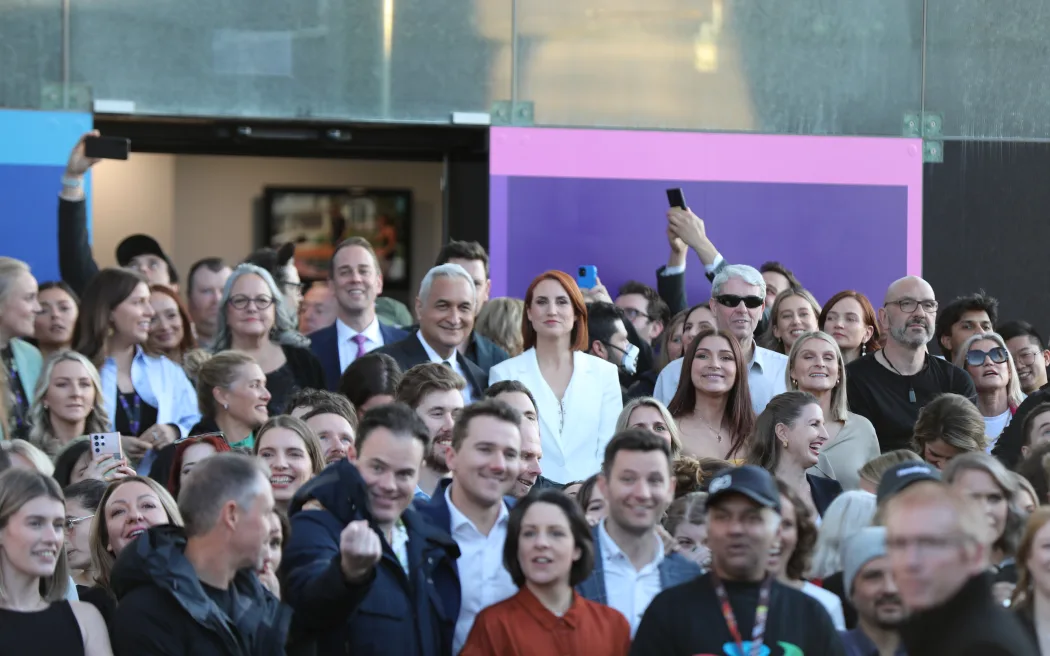
Newshub staff - including anchors Mike McRoberts and Samantha Hayes, rear centre - gather outside the newsroom in Auckland for a last team photo on 4 July, before the final 6pm bulletin airs.

Photo: RNZ

The last AM show aired this morning, with presenters Melissa Chan-Green and Lloyd Burr making emotional farewells, telling viewers “we are still in this together”.

Staff have been coming in and out of the Newshub offices this afternoon, carrying flowers and camera equipment.

Some employees told RNZ the emotions of ending the shows had been a ‘rollercoaster’.

Shortly before 5pm, all staff gathered outside the studio for a photo. The crowd erupted in applause and cheering, with Paddy Gower proclaiming: “and one more thing – that was f***ing Newshub”.

Newshub political editor Jenna Lynch told RNZ the Newshub “family” was looking after each other today.

“Everyone is doing the Newshub thing and just wrapping around each other, and caring for each other, which is really special.

“The family vibe that has been in there since I’ve been here is still there and will continue.”

Lynch said Newshub staff had been reflecting on all the stories that made change.

Working for Newshub had been an honour and the greatest job she had done, she added.

VIA RNZ
Continue Reading

Lifestyle

Fuel tanker trailer rolls, SH1 near Ōhau closed

Published

on

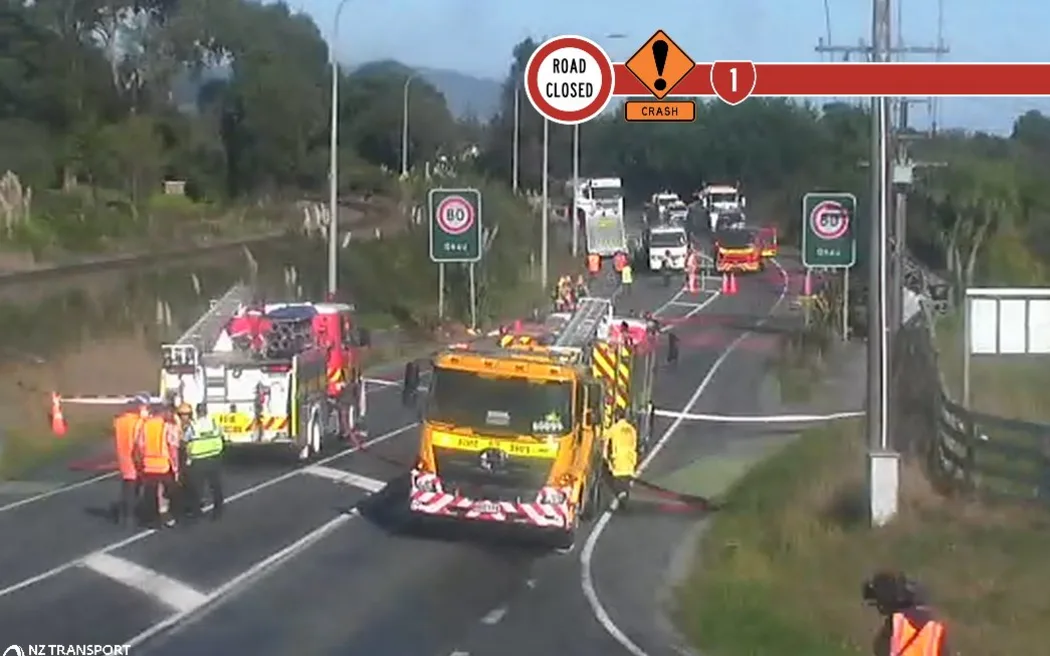
State Highway 1 near Ōhau, south of Levin, will now be closed until tomorrow morning.

The road has been shut since 8am on Wednesday after the trailer of a fuel tanker rolled.

Diversions are in place at Vista Road, Muhunoa East and Bishops Road.

The road is likely to remain shut till 2am on Thursday.

Motorists are advised to avoid the area if possible, and to expect delays.

Continue Reading

Trending

Copyright © 2026 The Buzz: Powered by Apna Network Limited - Concept by Digital Hub NZ