Connect with us

HTML Image

i

World

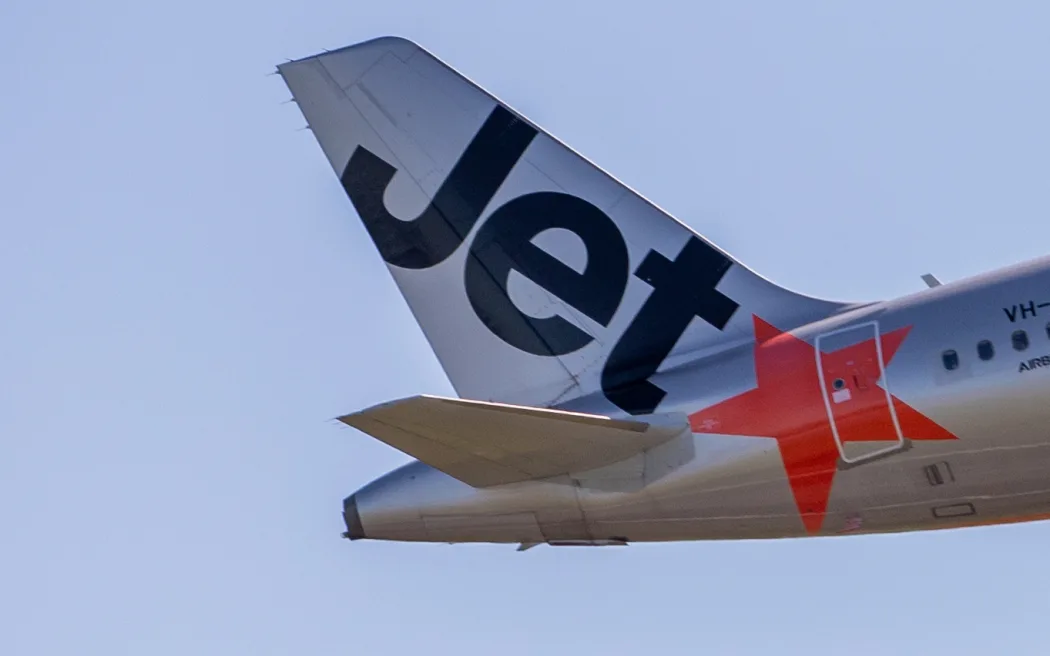
Jetstar denied family travel compensation because receipts were in Japanese

Published

on

By Kristy Sexton-McGrath, ABC national tourism reporter, and Jessica Haynes, ABC

What was meant to be a dream holiday in Japan for Cassandra Nichterlein and her young family turned into a costly nightmare when their return flight was cancelled.

Nichterlein, her husband and their three children – all under six years of age – were ready to return to Sydney after a 10-day break in Osaka.

But the family’s plans unravelled soon after arriving at the airport on 19 July.

“There was a sign on the check-in counter telling us the flight had been cancelled due to mechanical failure,” Nichterlein said.

“That’s pretty much where the explanations ended.”

Airport staff gave the family the same instructions as other passengers to, “find your own accommodation and seek compensation from the airline”.

With no offer of accommodation or vouchers for meals, the family checked into a hotel near the airport and waited for news from the airline about a replacement flight.

They initially considered themselves fortunate. They were able to cover the cost on a credit card.

Others were not so lucky.

“There were a group of teenagers on a university break, and they literally had no money for food, let alone accommodation, so we gave them A$50 to help out,” she said.

“They had nothing, and it was dehumanising for Jetstar to just leave them there like that, with no offer of help.”

Nichterlein tried contacting the airline directly through phone, email and its website chatbot and visited the airport multiple times to no avail.

What the family did not realise was that Jetstar’s communication systems had been impacted by the Crowdstrike outage.

After three nights in Osaka with no information, she and her husband made the decision to catch a bullet train to Tokyo in the hope there would be more flight availability.

They spent four nights in the Japanese capital before eventually being offered a return flight, the whole week costing the family-of-five an extra A$7000.

“It was quite traumatic, not knowing when we would get home,” Nichterlein said.

“You have an expectation as a customer, that when you fly with an airline, you’ll be safe, and that if something like this were to happen, you would be looked after.”

Ordeal continued after family’s return

The family made it back to Australia on 26 July and, as instructed by the airline, uploaded their hotel receipts.

While each airline has different policies on compensating customers for flight delays, Jetstar states on its website that it “will consider claims for all costs caused by the delay or cancellation on a case-by-case basis, including claims for higher amounts where reasonably incurred”.

Engineering issues and Jetstar IT system outages are among a handful of instances which it classifies as within its control.

Nichterlein believed it would be a straightforward process for a refund because she met the criteria and the family was not offered a replacement flight for a week.

“We spent hours and hours and hours uploading receipts and then were questioned about them, because they’re written in Japanese,” Nichterlein said.

“They offered us a A$600 payment, which is just insulting.”

‘It’s time that Virgin and Qantas were made accountable’

The issue of compensation for families like the Nichterleins was a key element of this week’s Aviation White Paper.

The federal government used the paper to introduce a new “Charter of Rights” entitling airline customers to refunds for flights that were disrupted, cancelled or unreasonably delayed, as part of a wider industry shake-up.

The scheme is expected to be operational by 2026.

Transport Minister Catherine King said Australians were often not treating customers fairly.

“If you’ve bought a ticket and the flight doesn’t go, you should expect the service is provided, so this is about providing remedies to consumers who have found it very difficult to pursue these issues and continuous improvement in our airlines and airports,” King said.

Aviation expert Professor Ron Bartsch said the government had made the right move, but “possibly too late”.

“We’ve already seen Bonza and Rex exit the domestic market, and we’ve got a very entrenched duopoly now, and it’s interesting and somewhat ironic that Rex airlines had the best on time performance and lowest cancellations rate, and yet they’re now no longer in existence in the domestic market,” Professor Bartsch said.

“So, I think it’s time that Virgin and Qantas were made accountable and do pay adequate compensation when they don’t provide the service they advertise.”

He said the reforms would improve passenger experience.

“When you look at the worldwide best practice standards in passenger compensation, and the systems that they have in place in the European Union and in Canada, providing compensation does make airlines more accountable, and therefore the passengers do get a better service,” he said.

In statements from Qantas and Virgin, the companies welcomed the release of the white paper and said they would review it closely.

Jetstar has now offered to reimburse the Nichterlein family’s expenses, after the company was approached by the ABC.

In a statement, a spokesperson said the “flight was cancelled due to an engineering issue on the same day that the global CrowdStrike outage took place, which grounded our flights and impacted our customer communications system”.

“This meant we were unable to communicate with our customers and there were limited alternative flights for a number of days,” the spokesperson said.

Nichterlein said although Jetstar had told the ABC she would be reimbursed, she had not been contacted by the airline or received any money.

“The issue is that these companies have a deliberate wall set up,” she said.

“They push you into accepting an offer because there’s nowhere else to turn.”

Source: ABC and RNZ

Continue Reading
Click to comment

Leave a Reply

Your email address will not be published. Required fields are marked *

World

Voters deliver historic rebuke to Trump as Democrats win House and Senate

Published

on

By Joseph Ax, Brad Heath and Jason Lange

Democrats seized control of both the Senate and House on Tuesday (US time), scoring sweeping victories in Republican strongholds for the first time in generations as tens of millions of voters delivered a scathing rebuke to President Donald Trump.

Voters in conservative bastions who had propelled the president to his second term in office just two years ago swung dramatically toward Democrats, fueled by deep frustration over the unpopular war with Iran, anxiety over the high cost of living and anger at Trump’s stewardship of the country.

Kansas elected its first Democratic senator since the Great Depression nearly a century ago. In South Carolina, a state that Trump carried by nearly 18 points in 2024, Democrats turned aside his hand-picked Senate candidate.

And in Texas, the biggest Republican state, Democrats ended a decades-long losing streak in seismic fashion, winning a Senate seat and ousting three-term Governor Greg Abbott.

The results will usher in a new era of divided government in Washington, following two years in which the Republican-controlled Congress rarely exercised its power to rein in Trump.

Once seated in January, Democrats are expected to use their power to investigate Trump’s administration, family and allies and demand concessions on major legislation. The Democratic Senate can block Trump’s nominees, including any US Supreme Court justices should a vacancy arise.

“There is now a generational remake of the Senate map that is going to change America,” said Chuck Schumer, the party’s Senate minority leader. “Americans voted for change, and now Democrats must deliver.”

Trump, who is barred by the US Constitution from seeking a third term, has exercised an iron grip on his party for most of the last decade. But the new balance of power in Washington may accelerate his lame-duck status, as attention turns toward the 2028 presidential race and potential successors begin competing for political influence in a post-Trump world.

Despite worries from Democrats that Trump might seek to overturn the election results, as he did in 2020, the president accepted the outcome, congratulating Democrats in an interview with Fox News. He also said he would work with Democrats on issues such as immigration, though he threatened to veto any “insane” bills they passed.

rnz

Continue Reading

World

Cold case solved: DNA links serial killer Ted Bundy to 1974 murder of Utah teen

Published

on

A Utah cold case tied to notorious serial killer Ted Bundy has been solved.

Fifty-two years to the day her body was found, detectives closed the investigation into the murder of 17-year-old Melissa Ann Smith. DNA evidence identified Bundy as the killer, investigators revealed Tuesday.

Smith’s body was found by hunters in a wooded area bordering Salt Lake and Summit counties on 27 October, 1974. The investigation into her murder has remained open since that day, until now.

A recent break in a Utah County cold case is being attributed to the resolution. Investigators say the same DNA profile used to identify Bundy as the killer of Laura Ann Aime was used to solve Smith’s murder.

Developments in that case brought the Smith investigation back to the surface and helped resolve the decades-old mystery, Summit County Sheriff Kacey Bates said.

Tuesday’s announcement was hinted at by Utah County investigators in April, when they announced the closure of the Aime cold case, which was tied to Bundy. At the time, a UCSO detective said the DNA profile used to link Bundy to the murder had been shared with other departments, with the hope that it could lead to closing more cases.

Bundy, who is confirmed to have killed and assaulted women across Washington, Oregon, Colorado, Utah and Florida between 1974 and 1978, confessed to 28 murders but is believed to be responsible for hundreds of deaths.

He was executed by electric chair in Florida in 1989.

Source: RNZ & CNN

Continue Reading

World

Netanyahu touts Trump endorsement on eve of vote, suggests they may restart war on Iran

Published

on

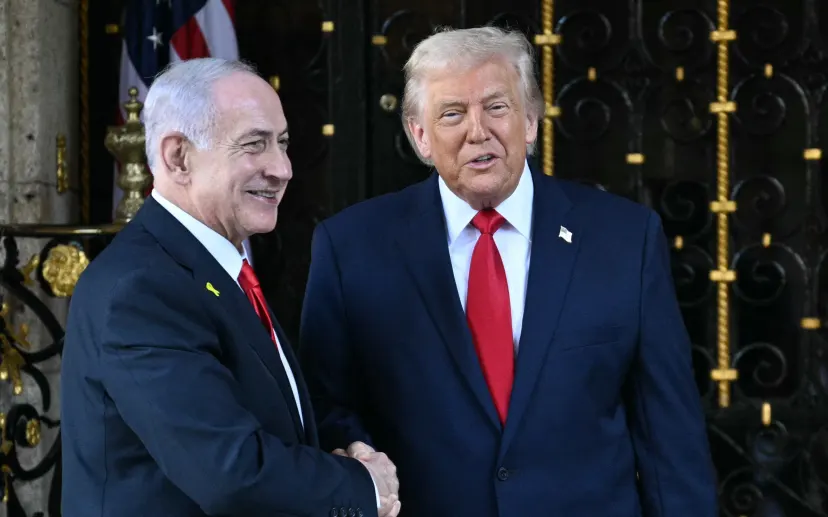
Israeli Prime Minister Benjamin Netanyahu boasted of his endorsement from Donald Trump on the eve of Israel’s election, suggesting the two leaders could restart their war against Iran if he wins, after Trump said they should “finish the job”.

“US President Donald Trump has come with a friendship that has never existed before between an Israeli prime minister and an American president. And it is doubtful we will ever have such a friendly president again,” Netanyahu said in a televised appearance late on Sunday night. “He has another two years, and he says he is calling on you to vote for me.”

In his own social media post on Sunday, Trump, who launched the Iran war jointly with Netanyahu in February, said: “Vote for Bibi Netanyahu for Prime Minister, we have to finish the job that we started!”

Netanyahu said Trump was willing to take action “that would finally, finally, remove the Iranian threat”, but only as long as Netanyahu himself remains in power.

“And I have already instructed the Mossad and the IDF (military) to bring down this regime, to bring down this regime because that is the only way to put an end to this threat,” Netanyahu said, referring to Israel’s main intelligence service and military.

Asked for comment on Netanyahu’s remarks, White House Deputy Press Secretary Anna Kelly said: “As President Trump stated, Iran is in very bad condition, both economically and militarily, and the blockade will remain in full force and effect, with oil flowing in record numbers of barrels through the Hormuz Strait.”

“The United States will not be attacking Iran at any time prior to the midterm elections,” Kelly added via email, referring to the November 3 vote in the US.

Netanyahu’s leading opponent, centrist former military Chief of Staff Gadi Eisenkot, posted his own comments on social media, praising Trump as “a true friend of Israel”.

“I value his efforts and his commitment to Israel’s security, and I am confident that he will work in full cooperation with any leader chosen by the people.”
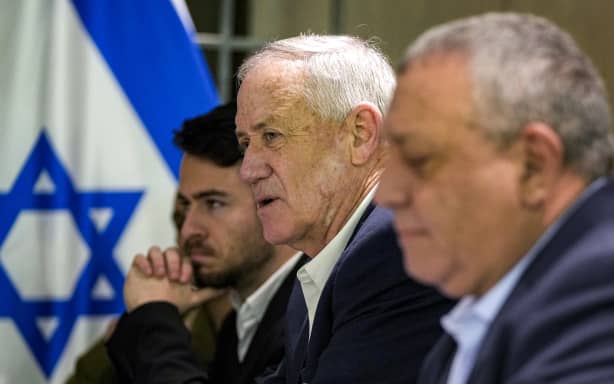
Former Israeli Defence Minister Benny Gantz (2nd-R) and former Israeli army chief of staff Gadi Eisenkot (R), both members of the current Israeli five-person war cabinet led by Prime Minister Benjamin Netanyahu, meet with the visiting US Secretary of State in Tel Aviv on February 8, 2024. (Photo by Mark Schiefelbein / POOL / AFP)
Former Israeli Defence Minister Benny Gantz (2nd-R) and former Israeli army chief of staff Gadi Eisenkot (R).

Mark Schiefelbein / POOL / AFP

Eisenkot accuses Netanyahu of fear-mongering

Tuesday’s vote, Israel’s first since the October 7, 2023, Hamas attacks, is the first chance for voters to deliver a verdict on the worst security failure in generations and the wars on multiple fronts that followed.

With Netanyahu already at the helm of the most right-wing government in Israeli history, politics have shifted even further to the right. Nearly all Jewish-led parties, including that of the hawkish Eisenkot, now oppose the “two-state solution” that underpinned decades of peace negotiations with the Palestinians.

But many voters say the divisive politics of Israel’s longest-serving leader make the country weaker. Polls suggest Netanyahu’s Likud Party will lose seats, potentially depriving his coalition of right-wing, far-right and ultra-Orthodox parties of its narrow majority.

Eisenkot and an array of opposition parties ranging from the rump of the centre-left to the right, also have no clear path to unseat him.

Netanyahu, 77, is an unrivaled master of political survival: the only time since 2009 that opponents managed to wrest him briefly from the premiership, it took four inconclusive elections within two years to get him out. He was back 18 months later.

Neither side planned major public events for Monday. But both posted on social media, drumming on the election’s major themes: for Netanyahu, that he is the only leader with the mettle to face down Israel’s enemies; for his opponents, that his divisive politics have weakened the country.

Netanyahu shared an AI-generated video on Monday of Iran’s Supreme Leader Ayatollah Mojtaba Khamenei, whose father Ali Khamenei was killed on the first night of US-Israeli strikes on Iran in February. Lying in a hospital bed, the younger Khamenei says his own vote would be “definitely not Bibi. Another term like this and I will be meeting my father sooner than expected.”

On Sunday Netanyahu posted a computer-generated photo of a mushroom cloud over Tel Aviv, saying Israel was in existential danger from Iran.

Eisenkot responded by accusing him of “relying on a campaign of fear-mongering, lies, and threats – including images of nuclear bombs in the heart of Tel Aviv. This time, it won’t work for him.”

Trump’s endorsement of Netanyahu carries its own political risks a week before a legislative election in which his own Republicans are seeking to hold onto power.

The Iran war is deeply unpopular in the United States, blamed for a surge in prices especially for fuel. Major fighting has been suspended for months after ceasefire negotiations held without Israeli participation.

Source: Reuters & RNZ

Continue Reading

Trending

Copyright © 2026 The Buzz: Powered by Apna Network Limited - Concept by Digital Hub NZ