

Latest News
End to coordinated terror response ordered within weeks

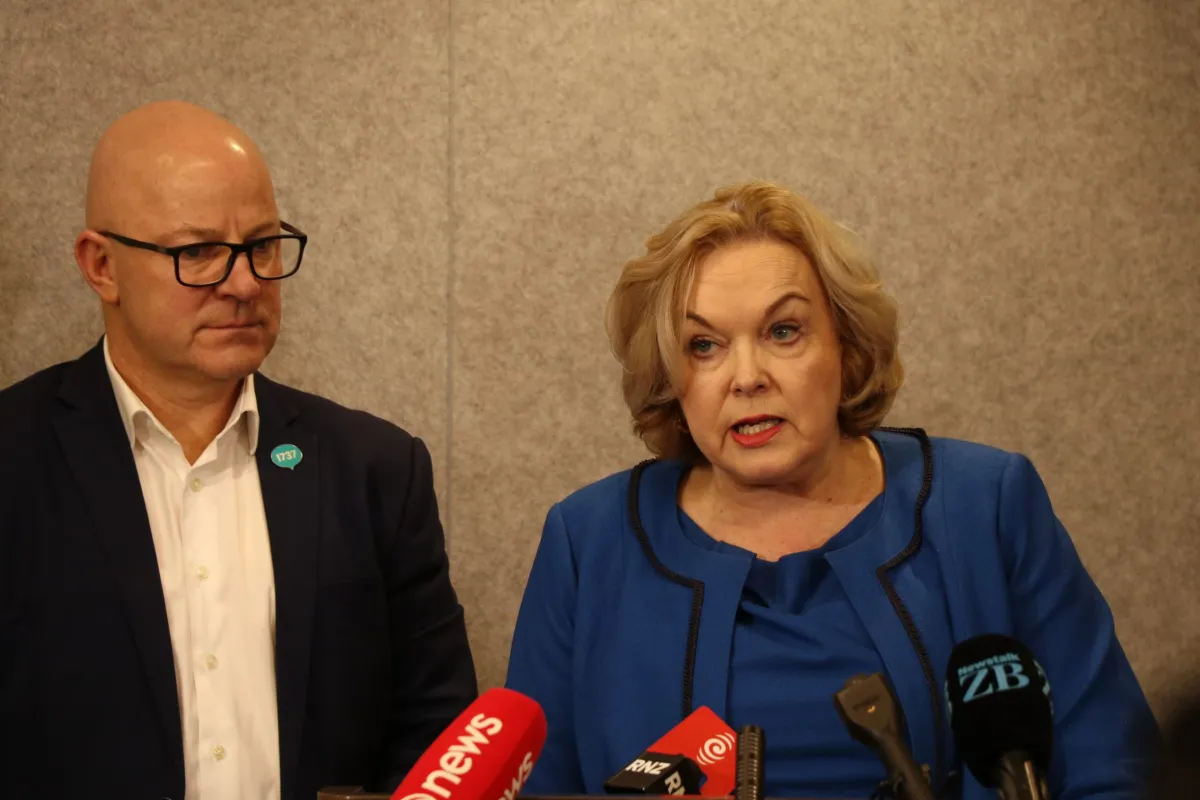
Judith Collins directed officials to end a coordinated state response to the Christchurch terror attack within weeks of taking her ministerial post.
Last Friday, Collins announced the Government was winding down its response to the recommendations of a Royal Commission inquiry into the 2019 terror attack on two city mosques, in which 51 people were killed, and dozens injured.
Official documents released the same day reveal it was in December, less than a month into her new ministerial role, that the minister ordered bureaucrats to start work on ending the coordinated, cross-government response
Almost 150 pages of documents were released last Friday, a flurry of correspondence, advice and briefings for Collins as she and other ministers weighed up the coalition’s approach to the Royal Commission’s 44 recommendations.
Absent, however, was consultation with the Muslim community before key decisions were made.
Three days before Christmas, Collins asked the Department of Prime Minister and Cabinet (DPMC) to draft a letter on her behalf to PM Christopher Luxon, detailing how she would achieve her priorities as lead coordination minister of the Government’s terror attack response.
The draft, provided on January 25, said: “My top priority for this portfolio is to conclude the government response by June 2024, while ensuring the essence of the Royal Commission’s intent and lessons learnt from the attacks are appropriately addressed.”
On February 20, Collins, the former National Party leader, informed Kāpuia – a 28-strong group formed for the express purpose of providing ministerial advice – of her intentions to conclude the coordinated response.
In just-released correspondence, Kāpuia chair Arihia Bennett responded: “The roopu [group] was not consulted on this, prior to seeing this draft paper.” Bennett’s May 30 letter said: “Kāpuia wishes to express its disappointment and concern at the direction the Government is now taking.”
The group was disbanded in June, as its funding was “time-limited”.
Kāpuia’s final report, provided to Collins in May, said its most important advice was the Government’s response was incomplete. “To make all New Zealanders safer, there is a clear need to address the remaining gaps in the Government’s response.”
The previous month, Bennett, a former chief executive of Te Rūnanga o Ngāi Tahu, wrote to the Minister with Kāpuia’s fears that if the commission’s recommendations were not “fully and consistently” implemented “more lives will be lost in New Zealand”.
March 15 this year marked the attack’s fifth anniversary. Collins and Cabinet colleague Matt Doocey met Muslim representatives and members of the affected community in Christchurch on March 12, and again in May. Some meeting attendees accused the Government of making pronouncements, and not listening.
Aliya Danzeisen, of Hamilton, the Islamic Women’s Council’s national coordinator, tells Newsroom: “That’s how it’s been throughout, since they’ve come in.”
Asked about the lack of consultation, Collins says: “Engagement with affected groups and communities has been a cornerstone of the Government’s response from the beginning. They have played an important role in the response and their input has been invaluable.”
The Ministry said Kāpuia was consulted and its feedback was included in advice to the Cabinet. “Ultimately, final decisions on the recommendations lie with the Government to make.”
Advice from DPMC in May said ending the coordinated response “will not compromise delivery of the remaining, agreed work” to support individuals affected by the terror attack.

Responsibility for responding to the commission’s report was spread across 12 ministerial portfolios. Collins was responsible for a recommendation to hold discussions about restorative justice with affected whānau, survivors and witnesses – a cohort comprising more than 600 individuals.
DPMC suggested the recommendation be rejected, and Collins followed that advice. Officials acknowledged in January: “A specific discussion on restorative justice has not taken place.”
Progress on that recommendation had been paused to allow the Muslim community to concentrate on the coronial inquiry, which is ongoing. Hearings are being held this week.
In the background, however, DPMC continued to research the issue.
It advised the minister “themes” of restorative justice were: achieving justice through a dialogue of understanding; and addressing harm by meeting the needs of the victims.
“This approach has not been tested with the affected community,” the advice noted, while acknowledging many in the affected community “believe it should include discussions about compensation”.
Other countries – specifically the United Kingdom, Norway and Canada – hadn’t explored alternative restorative approaches to terror attacks.
DPMC told Collins in January the “intent” of the recommendation had been “met” by the Government response, and wraparound support.
“It will be important to ensure that the community has ongoing access to the services and support they need, to mitigate the risks associated with not progressing this work.”
“New Zealanders should receive assurance that cost savings will not compromise their national security.”
Kāpuia’s final report, sent to Judith Collins in May
Asked last week if financial considerations had factored into ministers’ decisions to wind down the response, Collins said: “Absolutely not.”
However, in justifying its suggestion to reject the restorative justice recommendation, DPMC pointed to “work that has been undertaken to date, and the fiscal environment”.
In May’s Budget, for DPMC there was a $7 million decrease in spending on the “system response to the Royal Commission of Inquiry”. Meanwhile, the Ministry of Ethnic Communities – upgraded from an “office” because of a Royal Commission of Inquiry (RCOI) recommendation – had its annual budget cut by almost $2 million.
A month before, the Ministry of Justice announced to the Muslim community it would reduce support through the coronial inquiry victims’ assistance scheme, including funding for those travelling from overseas.
Collins tells Newsroom: “I acknowledge we are in a fiscally constrained environment, but this was not the driver for the decisions ministers made on the remaining recommendations.
“In making these decisions, the Government’s primary consideration was whether the overarching intent of the RCOI – to make New Zealand safer and more secure – was being met.”
Kāpuia’s final report said: “New Zealanders should receive assurance that cost savings will not compromise their national security.”
Collins says the Government wanted to make decisions to give certainty and clarity to the March 15-affected community.
However, Danzeisen, a member of Kāpuia who is speaking in her role with the Islamic Women’s Council, bristles at this suggestion.
“What, certainty that we’re protected when the work isn’t done? Certainty that the [security and intelligence] roles will be effective when they haven’t even established the most important, central aspect of the whole Royal Commission?”
(Danzeisen saves some criticism for the previous Labour government, saying money was probably wasted in its response. And while it was strong on consultation she thinks it was weak on taking action to respond to the Royal Commission’s recommendations.)
Her latter point is about a recommendation, rejected by the new Prime Minister, to create a new national intelligence and security agency.
A May briefing by DPMC said Luxon thought leadership and accountability could be lifted “without adding complexity” to the country’s security apparatus.
Ben King, DPMC’s chief executive, had been designated national security advisor, “which would formalise the CE’s current responsibilities for national security”. Also, the chief executive-level national security board, chaired by King, which is responsible for implementing the country’s national security strategy, had been “strengthened”.
The Royal Commission raised concerns about a lack of clear leadership and accountability in the national security system. Kāpuia’s final report said: “There is still no one agency responsible for either countering terrorism or wider national security.”
Luxon, the Minister for National Security and Intelligence, also decided not to create an advisory group suggested by the Royal Commission because it “would not yield sufficient benefits to warrant the administrative burden, and overheads”.
Instead, security agencies would use “existing mechanisms” to seek advice.
Kāpuia said an advisory group – comprising representatives from communities, civil society, local government, and the private sector – was crucial to ensure a range of perspectives were considered when countering terrorism.
Recently reported events seem to suggest there are benefits of greater monitoring and oversight.
In March, just after the terror attack’s fifth anniversary, the Government Communications Security Bureau revealed a foreign spy agency ran a secret operation in this country for years without ministers knowing.
A week later, Inspector-General of Intelligence and Security Brendan Horsley released a report which said the Security Intelligence Service had too much discretion when using intrusive “class” warrants for surveillance.
Then, in June, the Supreme Court issued a ruling that the Government broke the law in 2016 by cancelling a woman’s passport on the advice of the Security Intelligence Service. Judith Collins was one of the ministers involved.
Danzeisen, of the Islamic Women’s Council, makes a philosophical point about governments. They’re there to protect communities, and citizens give up some rights to be safe, and have a cohesive community.
But the Government here didn’t keep the Muslim community safe in 2019, she says. (To be fair, the Royal Commission found intelligence services had virtually no hope of finding the terrorist.)
Intelligence services viewed the Muslim community as a potential threat, rather than a potential victim – so, she argues, it hasn’t been treated fairly, either.
The Muslim community’s wellbeing is suffering, she says, not just because of the terror attack, but because of ongoing abuse and hatred. Yet the Government is pulling some services.
The social contract with the Government is broken, Danzeisen says. “So what are they going to do to repair it? What are they going to do to restore it?”
NEWSROOM



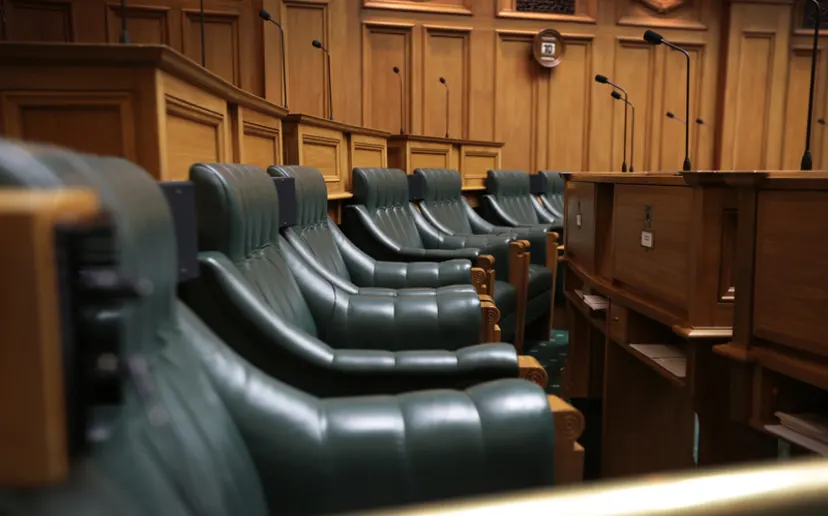
The chief executive of the Parliamentary Service is confident there will be enough room to accommodate the increased number of MPs and their staff coming into Parliament.
On current numbers, up to 131 MPs could be sitting in the Chamber following the election, brought on by a record overhang result.
Clerk of the House of Representatives Dr David Wilson told the Spinoff that currently the debating chamber had enough chairs to seat 124 MPs – including the Speaker of the House – and work was being done to accommodate more by altering the seating arrangement.
In a statement, Parliamentary Service chief executive Rafael Gonzalez-Montero said planning for a larger Parliament had been going for “some time”.
“Now that the election results have confirmed an increase to the number of members we are looking at several options.
“We are confident we will be able to accommodate all members within the Chamber.”
VNP / Phil Smith
Gonzalez-Montero said office accommodation for members and their staff would be “stretched” for a short time, but the new Members’ Building was only a few months away from “practical completion”.
That building – located behind Parliament – was due to be ready to occupy in April next year and had capacity to accommodate around 30 backbench MPs.
“All members should be in fit-for-purpose accommodation from that point,” Gonzalez-Montero said.
Following the 2023 election, 123 MPs sat in the Chamber – a record number at the time. That decreased to 122 following the resignation of National MP Judith Collins.
Collins held the seat of Papakura and stepped down in May and Parliament voted against holding a by-election because it was too close to the election.
The election result also meant high-ranking National Party MPs like Chris Bishop, Paul Goldsmith, Nicola Willis and Gerry Brownlee – Speaker of the House and an MP for 30 years – would likely not make it back into Parliament.
Only resigning or retiring MPs were permitted to give a valedictory speech meaning none of them would get the chance to give a valedictory statement.
Asked if their would be special allowances for valedictories, Wilson said in a statement that normally only MPs were allowed to speak in the House but the House could suspend its own rules or temporarily alter them.
“It could do so to allow former members to address the House.”
Wilson said no such arrangements could be made until the next Parliament opened and members sworn in.
rnz


Police say person who fired gun at officers still at large

New Zealand sides named for RLWC finals

Parliamentary Service working on extra chairs and offices for increased number of MPs


-

 Latest News2 months ago
‘Chilling’: Business groups speak out against National’s supermarket break-up plan
-

 NZ News2 months ago
Tom Phillips report: The missed opportunities to find the children
-

 Politics2 months ago
National vows to try to split Pak’nSave and New World
-

 Latest News2 months ago
Cars bearing Chinese police markings stir unease in Auckland
-

 Fiji News2 months ago
Plans to have new Constitution by Dec 24th 2026
-

 NZ News2 months ago
Cop who stole $68,000 can now be named as champion Muay Thai fighter Haimona Tamati-Te Paki
-

 Politics2 months ago
MBIE confirms botched biometric projects costs blown out to $50.7 million
-

 Latest News2 months ago
Five Karangahape Road venues lose their liquor licences after police intervention