

Latest News
Extra year’s worth of emissions by 2050 thanks to fossil fuel ban reversal – MBIE


Undoing the oil and gas exploration ban will result in an extra 51 million tonnes of planet-heating emissions being pumped into the atmosphere in the years to 2050, according to a government analysis.
That is almost as much as the whole of New Zealand produces in a year.
The real impact might be lower if an increased flow of fossil gas means the country can burn less coal, which has higher emissions, the analysis found.
The Ministry for Business Innovation and Employment (MBIE) published the climate impact of reopening New Zealand waters to hunting for new oil and gas reserves on the same day the government announced its five-point climate strategy.
The light-on-details strategy was widely panned by scientists as well as environmental groups, however the government has promised full details in a soon-to-be-released plan.
Between now and 2025, MBIE estimated moves by the government to encourage oil and gas extraction would add 14 million tonnes of carbon dioxide emissions to the country’s tally, compared with keeping the ban in place – roughly the amount of greenhouse gas New Zealand’s cars and trucks produce in a year.

Energy Minister Simeon Brown. Photo: RNZ / Angus Dreaver
Officials said there might be climate benefits from reversing the ban, though they did not calculate these.
The benefits were that having a higher supply of gas – if oil and gas companies had higher confidence to invest in extracting fossil fuels – might mean electricity companies and heavy industry could burn less coal.
A higher supply of gas might also encourage people to electrify more vehicles, appliances and industrial boilers by underpinning the electricity supply and making the power sector more stable, said MBIE’s report. Officials did not quantify how much greenhouse gases these benefits might save. They concluded repealing the ban would have a significant impact on raising emissions.
Energy Minister Simeon Brown said new figures showing a 20 percent drop in gas reserves showed why more oil and gas exploration was needed.
But energy and resources experts commenting on the oil and gas situation said the government should not expect a rush of applications from scrapping the ban.
‘Difficult to predict’
David Dempsey, associate professor of civil and natural resources engineering at the University of Canterbury, said many gas users had been decarbonising their operations – for example, replacing natural gas for heating with electricity or bioenergy. He said it was “difficult to predict” how removing the offshore ban would affect applications for new exploration permits.

David Dempsey. Photo: Supplied/ University of Canterbury
“Companies wanting to finance a new resource over the several decades it takes to explore, develop and extract, will be carefully weighing the political risk of future changes in exploration and mining laws,” he said.
“Companies will also be considering what future demand for natural gas looks like” – for example if a major gas user, such as methanol producer Methanex, closed its business here, or other companies decarbonised.
Environmental law professor Barry Barton of the University of Waikato said one of the key reasons oil and gas companies were cool on investing in exploration here was geology.
“We should not expect a rush of companies to come to New Zealand because of these policy changes,” he said.
“Geologically, New Zealand has turned out to have more gas resources than oil. Commercially, the New Zealand market is a small and isolated one where a company would struggle to commercialise a large gas find.
“The decline in gas reserves is largely due to difficulties with production from existing fields.”
Barton said gas should be kept for “niche” uses and not be used for baseload electricity generation.
Expert reports, including one from the Climate Change Commission, have concluded gas has a role in supplying peak electricity demand out to 2050, but a shrinking one.
MBIE compared the current situation (where offshore gas fields’ supplies are quickly dwindling) with a world where New Zealand has more gas, on the assumption reversing the ban will drive more gas production.
Its report used different assumptions from ones previously used by the Climate Change Commission, because MBIE says gas supplies are running out faster than expected when the commission did its work.
Emissions from burning gas fall either with or without the ban, but they fall much faster if the ban stays in place, according to the analysis. But these plunging emissions could come at the cost of the supply of gas running out sooner than demand tails off, with some industrial plants closing as a result, says MBIE.
If the ban stayed, and the Government did not encourage fossil fuel operators, there would be almost no gas still being burned in New Zealand by 2050, compared with a roughly 80 percent drop in emissions from gas if the ban was killed.
VIA RNZ



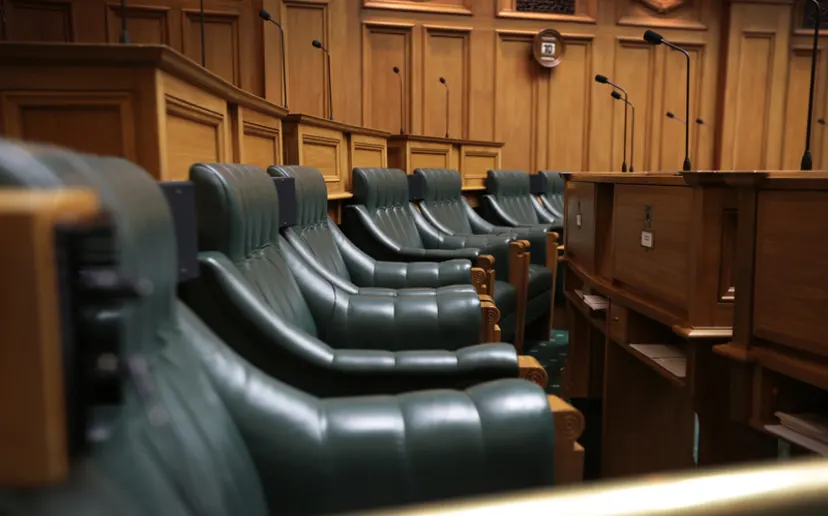
The chief executive of the Parliamentary Service is confident there will be enough room to accommodate the increased number of MPs and their staff coming into Parliament.
On current numbers, up to 131 MPs could be sitting in the Chamber following the election, brought on by a record overhang result.
Clerk of the House of Representatives Dr David Wilson told the Spinoff that currently the debating chamber had enough chairs to seat 124 MPs – including the Speaker of the House – and work was being done to accommodate more by altering the seating arrangement.
In a statement, Parliamentary Service chief executive Rafael Gonzalez-Montero said planning for a larger Parliament had been going for “some time”.
“Now that the election results have confirmed an increase to the number of members we are looking at several options.
“We are confident we will be able to accommodate all members within the Chamber.”
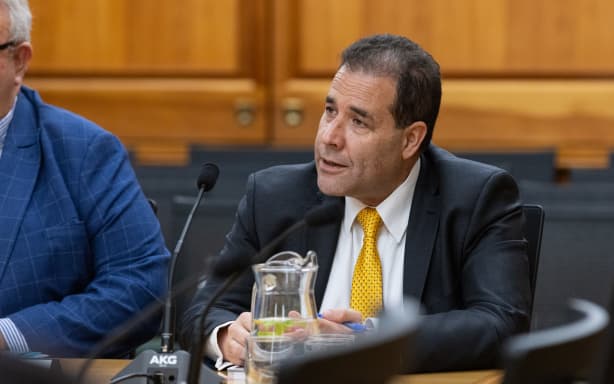
VNP / Phil Smith
Gonzalez-Montero said office accommodation for members and their staff would be “stretched” for a short time, but the new Members’ Building was only a few months away from “practical completion”.
That building – located behind Parliament – was due to be ready to occupy in April next year and had capacity to accommodate around 30 backbench MPs.
“All members should be in fit-for-purpose accommodation from that point,” Gonzalez-Montero said.
Following the 2023 election, 123 MPs sat in the Chamber – a record number at the time. That decreased to 122 following the resignation of National MP Judith Collins.
Collins held the seat of Papakura and stepped down in May and Parliament voted against holding a by-election because it was too close to the election.
The election result also meant high-ranking National Party MPs like Chris Bishop, Paul Goldsmith, Nicola Willis and Gerry Brownlee – Speaker of the House and an MP for 30 years – would likely not make it back into Parliament.
Only resigning or retiring MPs were permitted to give a valedictory speech meaning none of them would get the chance to give a valedictory statement.
Asked if their would be special allowances for valedictories, Wilson said in a statement that normally only MPs were allowed to speak in the House but the House could suspend its own rules or temporarily alter them.
“It could do so to allow former members to address the House.”
Wilson said no such arrangements could be made until the next Parliament opened and members sworn in.
rnz


Police say person who fired gun at officers still at large

New Zealand sides named for RLWC finals

Parliamentary Service working on extra chairs and offices for increased number of MPs


-

 Latest News2 months ago
‘Chilling’: Business groups speak out against National’s supermarket break-up plan
-

 NZ News2 months ago
Tom Phillips report: The missed opportunities to find the children
-

 Latest News2 months ago
Cars bearing Chinese police markings stir unease in Auckland
-

 Politics2 months ago
National vows to try to split Pak’nSave and New World
-

 Fiji News2 months ago
Plans to have new Constitution by Dec 24th 2026
-

 Latest News2 months ago
Five Karangahape Road venues lose their liquor licences after police intervention
-

 Politics2 months ago
MBIE confirms botched biometric projects costs blown out to $50.7 million
-

 NZ News2 months ago
Cop who stole $68,000 can now be named as champion Muay Thai fighter Haimona Tamati-Te Paki