Connect with us

HTML Image

i

Fiji News

Macuata’s mystery lake – and earthen boats

Published

on


Close to 45 kilometres Northeast of Labasa, the hometown of the Babasiga Lions, the meandering road took me across unkempt tramlines, roadside mud pools and sprawling cane fields.

In no time I was in the middle of nowhere, and everything seemed slow, strange and consumed by silence.

All I felt was this — each dashing kilometre was taking me closer to the pointed tip of Vanua Levu called Udu Point.

When I started from town that day, the weather was dry and sizzling hot.

In a little over an hour, it turned wet and cloudy.

“Climate change for you!” said Shalend, my driver for the day.

I realised instantly I had lost the perfect sunshine I saw kissing the skies since sunrise at Vakamasisuasua.

I never gave up hope, knowing the sun had the habit of emerging from the clouds unexpectedly.

Off a gravelly road from a signboard that read ‘Wainidrua Village’, after spending almost two hours inside a Toyota Hilux 4WD, we grinded to a sudden halt outside what looked like a sugarcane farm.

“The floating island is somewhere in the sugarcane fields,” Shalend said.

I left Labasa with an insatiable quest to find the mystic lake that enveloped the floating island.

Discovering it in a cane field was never my dream.

In a few seconds, Shalend managed to reduce the appeal of the place from sound to plain and then to uninteresting.

“The floating island is in the sugarcane fields,” he said for the second time.

I realised there was no village close by, just a wooden house at a road junction in the middle of nowhere.

A few minutes later, I stood next to a giant of a man, the owner of the house in one of Fiji’s most rustic places.

He was gentle and concerned, although he wore a face that looked unfriendly.

I verbally gave away a few things he needed to know about me and declared my interest in his backyard.

“Go to Wainidrua Village and see a man there by the name Ilibani Rova,” he said.

The floating island is one of Macuata’s natural wonders.

People travel there in droves during the holidays to experience the “ride” and take photographs for memory’s sake.

“Some go there to pray,” said Shalend, “they say the place has supernatural powers.”

For me, there was no way I was going to bypass traditional protocol, even if the place was good for embracing my spirituality.

The land has eyes and ears, I told myself.

Three floating islands replete with its cargo of pandanus plants, ferns and grass used to drift inside the lake.

Those were the days when our ancestors were carving territories by busy killing each other half-nude.

Today, only one floating isle can be seen submerged freely in the lake.

Legend has it that the floating islands were once used by ancestral gods for long distance travelling.

While supernatural beings in other cultures used carpets and brooms to travel, according to story books, the gods of the vanua of Nubu used waqa qele or earthen boats.

“You will not get hurt. You will be safe and you will see the island move,” Mr Rova said while giving me his blessings.

“You came to the right place. Our mataqali owns the land where that waqa qele is. We thank you for following the right channel.”

I later heard that some locals in the area had been charging people money to visit the pond.

Mr Rova, is the turaga ni mataqali of Bukawaqa, a part of the yavusa Kedekede.

He instructed two of his daughters to be tour guides.

They called me tau.

I didn’t know why!

From a distance, the floating island looked inexplicably quaint, being the only spot in the vast green cane fields that had pandanus plants thriving on it.

You would expect pandanus plants to grow along the sandy coast but when you spot it in the interior, it often signifies a sacred spot steeped in Fijian mythology like Nakauvadra and Balawaviriki.

Pandanus is a tropical shrub with a twisted and branched stem.

It has spiral tufts of long, narrow spiny leaves, and fibrous sweet-smelling edible fruits.

The fibre from the leaves of the pandanus, are often woven into material for roofing and mats.

In Labasa, it is the suluka (tobacco wrapper) of choice.

There is nothing special about floating islands in general.

But the story behind Macuata’s buoyant isles is unique in the world.

According to legends passed down to Mr Rova, in olden times the lake was connected to the open sea through a mysterious river passage that only the ancestral gods mastered well.

“This water highway allowed free superior movement of the kalou vu and people of Nubu on the three waqa qele, to and away from here,” he said.

The earth boats served as vessels for ancestors of the people of Nubu, which they used to travel in while trading, going on fishing safaris and waging war against enemy tribes.

As was the river, the boats themselves were magical.

Unlike the majestic wooden canoes made of vesi hardwood, they were asymmetrical carpets of thick kuta, a special kind of reeds which grow around lakes and wetlands.

When harvested, dried, flattened and woven, it becomes valuable material for mats and garments used in traditional wedding attires and other handicrafts synonymous with the people of Macuata and Bua.

The three islets were supposedly gifted by the gods to the people of Nubu.

While most people have now forgotten the names of the other two islands only a few know the existing one’s name – Vanalato a word that loosely translates to ‘mast or vana made from lato or pandanus three.

The mighty drua had sails designed by women from intricately woven pandanus leaves.

On the other hand, the floating islands used their standing pandanus plants and umbrella-shaped foliage to catch the wing.

Mr Rova said before the arrival of Christianity the floating islands were manoeuvred using special chants that were only hummed by priests or bete.

The mystic islands only understood the Nubu dialect and would only move when the chants were chorused in the local tongue.

This was the only tabu.

Today, there are restrictions and any language can be spoken.

“The lake is extremely deep. Its bottom is believed to be out in the deep ocean,” Mr Rova said.

“Our ancestors used to find mangrove leaves and rays in the lake, showing its connection to the sea.”

The demise of the two floating islands and the imprisonment of Vanalato developed after a conflict developed in the area.

Mr Rova said the ease of movement of ancestral gods and the people on the magical earthen boat made the people of Nubu very outstanding and powerful.

“As a result, other tribal gods who resided at the mouth of the river had their hearts stirred by envy and covetousness. They wanted to own one and they made their desires known.”

But the people of Nubu refused to give up the islands because they were sacred gifts from their gods.

So the Gods at the river mouth decided to take vengeance on the people of Nubu.

They planted kuta reeds across the river way to block the passage used daily by the earth boats from the interior of Vanua Levu.

To this day the river way is marked by a field of kuta reed which stretches away from the lake in all directions.

Whenever it rains heavily, the dry land around the lake will fill up with water, perhaps proving it was once part of a water highway that spanned all the way to sea.

I took Mr Rova’s words seriously.

Engrossed in excitement, I lost my usual awareness of the natural environment and balance, and fell into the swampy portions of the marshland, barely a metre or two from the edge of the bottomless lake.

I had crossed rivers, traversed deep seas and climbed mountains to get stories for Discovering Fiji but this a tough in its own simple way.

Drenched, I watched the floating island subtly move at one end.

Just being there to capture that single moment of movement on my phone was worth the travel.

“It’s moving now but very slowly,” Loata Wati, the younger of the sisters shouted.

“If today was windy, we’d be able to get on board and go for a ride.”

“We believe small eels at the bottom of the island propel the waqa qele and make it move faster.”

The thought of going for a ride tempted me.

But should I really get on the island to believe it is floating especially when soaked through?

The answer was no.

I had seen it.

Whether only for a second or two, I was proud to have travelled from Suva to the heartland of north-eastern Vanua Levu to discover for myself one of Macuata’s natural wonders and perhaps Fiji’s only earthen boat.

What was only a legend to me last week is today a proven reality and a sweet memory worth having.

I’ve been there, done it, and I will do it again one day!

  • History being the subject it is, a group’s version of events may not be the same as that held by another group. When publishing one account, it is not our intention to cause division or to disrespect other oral traditions. Those with a different version can contact us so we can publish your account of history too — Editor.

VIA FIJI TIMES

Continue Reading
Click to comment

Leave a Reply

Your email address will not be published. Required fields are marked *

Fiji News

Fiji ‘worse off today’, former PM warns, as Rabuka’s constitution overhaul faces backlash

Published

on

Mahendra Chaudhry, Fiji’s first and only prime minister of Indian descent, has warned that the island nation is “worse off today than we were at independence” and that its political leadership must focus on solving social and economic issues rather than “making multiple constitutions”.

Chaudhry made the comments over the weekend while making a submission to a special parliamentary committee – led by Prime Minister Sitiveni Rabuka – on the country’s constitutional reform process in Vanua Levu, Fiji’s second main island.

“Are we doing enough to alleviate the problems that we face as a nation that our people face, problems of poverty, hunger, unemployment, poor health services, education problems, crumbling infrastructure, the invasion by drug traffickers, HIV, NCDs (non-communicable diseases)?

“Is the economy delivering to the people? Are we giving sufficient attention to the economic problems that the nation faces? Because you can do nothing on the back of a failing economy.

“These are areas where our attention should be focused,” the former prime minister, whose government was held hostage at gunpoint for 56 days during the 2000 ethno-nationalist coup, said.
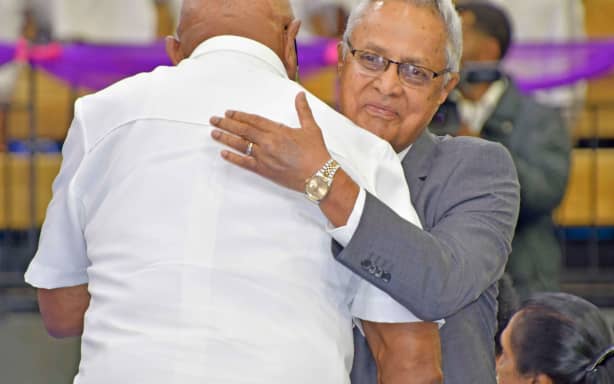
Sitiveni Rabuka and Mahnedra Chaudhry embrace at the reconciliation church service on 14 May 2023.
Mahendra Chaudhry, right, embraces Sitiveni Rabuka during a reconciliation church service on 14 May 2023.

Fiji Government

Rabuka’s coalition has made it its mission to replace the 2013 Constitution – widely criticised as being imposed by the previous Bainimarama administration – ahead of a looming election.

His government is currently conducting nationwide public consultations on its Constitution (Amendment) Bill 2026, which passed its second reading earlier this month and is set to be brought back to parliament for its third reading next week.

If the bill passes its third reading, Fiji is set to hold its first national referendum in December, where the people will vote on whether they want Rabuka’s constitution. In its current form, the bill – presented to parliament in September – has been criticised as a downgrade from what the Constitution Review Commission had proposed.
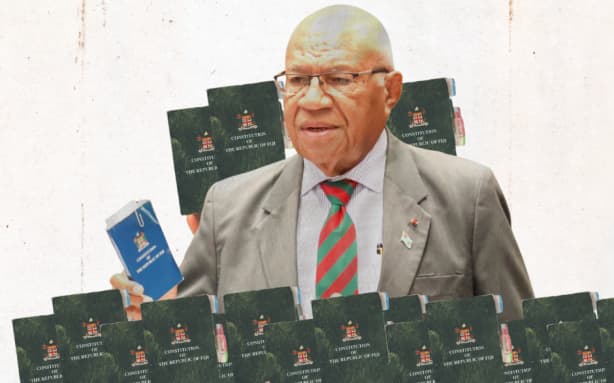
Fijian Prime Minister Sitiveni Rabuka
Prime Minister Sitiveni Rabuka

RNZ Pacific / Fiji Parliament

Rabuka and his inner circle are backing the removal of the current constitution despite widespread opposition from local community leaders, non-governmental organisations as well as his own coalition partners who say that the process is being “rushed”.

Rabuka, 78, said he had a responsibility that he would review and amend the 2013 Constitution and “that’s what we’re going for”.

“You voted for us – some in government and some in opposition – so we have the collective vote of the people of Fiji,” he said at one of the public consulations last week.

“And you have entrusted us of doing the amendment in accordance with the rules of the country.”

The move has also given rise to online conspiracies and misinformation that Rabuka is deliberately trying to delay the election, forcing him to provide assurances that the general election will proceed as planned.

More than 723,000 eligible voters are expected to head to the polls no later than 6 February 2027.

Rabuka has so far kept the date of the general election close to his chest, stating previously that the election date will be announced after the constitutional reform process was completed.

“This is the fifth constitution that we will be looking at. Have the four previous constitutions served our purpose? Has it helped the people?” Chaudhry asked.

“Why do we rush this process of a new constitution? It can wait,” he said.

Chaudhry said Fiji could have an election under the 2013 Constitution and the incoming government could deal with the constitutional reform process.

“We have got to listen to the people. In this process, what I have noticed is that everybody has complained,” he said.

“If anything that has come through very clearly and loud in this consultation meeting, it is the people saying, ‘No, look, give us more time’.”

While the government’s constitution bill maintains the common national identity ‘Fijian’ for all its citizens, it proposes a new parliamentary system, brings back an unelected senate, changes the current electoral system, and provides “excessive concentration of constitutional power in the Executive”, according to Fiji’s Centre for Democracy and Dialogue.

It also includes Christianity as a founding value.

Chaudhry said the country should be looking at the proposed constitution that was presented by the Constitution Review Commission and not the government’s version of the document.

“Having had a look at the constitution presented as Bill 32 of 2026, I find it divisive, undemocratic, and discriminatory in many of its provisions,” he said.

“I have no problems with Christian values. I think they are good values, but I believe that religion and state must be kept apart because this is one aspect which can cause serious division [in a] multiracial country like Fiji between communities.

“I am a Hindu. My wife is a Christian. We have no problems. She practices her religion. I do mine. So where is the problem? Why do we have to put in something which is causing controversy? Is it necessary? It is not.”

RNZ

Continue Reading

Fiji News

PM confirms the next general elections will be held under the current electoral system and by Feb 6th 2027
Published

on

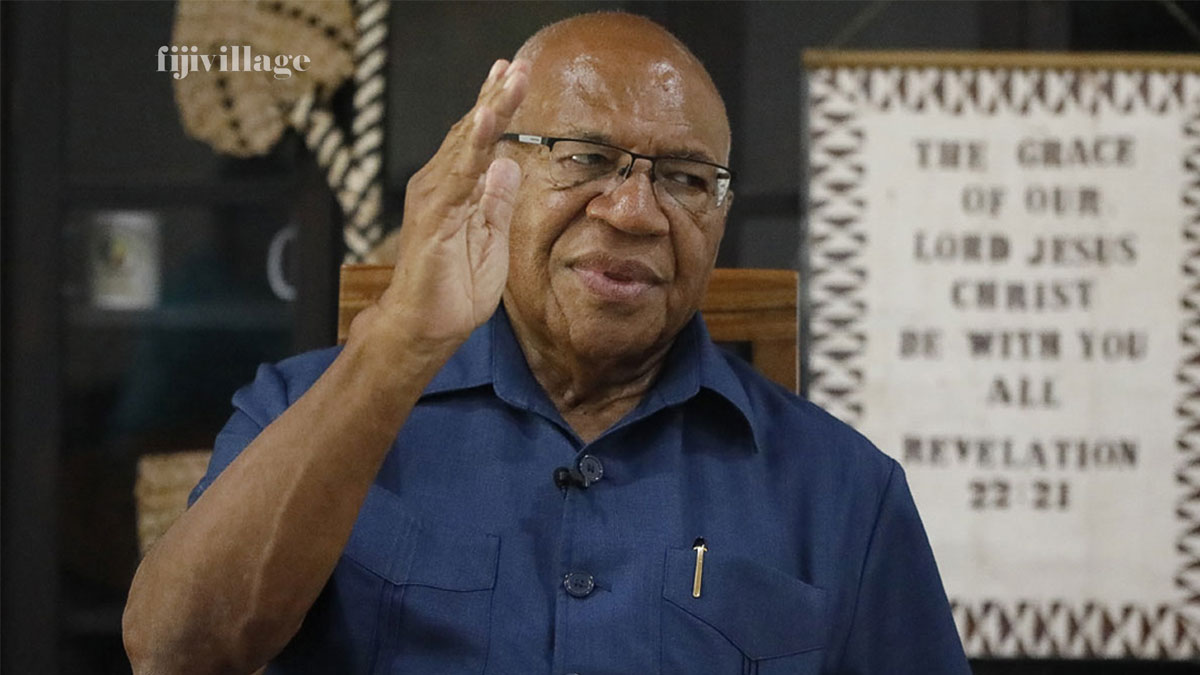
With some creating confusion by saying that the general elections will not be held during the required legal timeline under the 2013 Constitution, and uncertainties surrounding drastic changes to the electoral system that could affect the Fijian Elections Office’s preparations with only about 8 weeks to go for the Writ of Elections to be issued, Prime Minister, Sitiveni Rabuka has today made it clear that logically, the next general elections will be held under the current electoral system.

Rabuka made this clear in an exclusive interview when fijivillage News asked him on whether he can confirm to the people if the next general elections which has to be held by February 6th 2027, will be held under the current electoral system.

We also asked Rabuka whether any electoral changes, including those in the Constitution Amendment Bill on the drawing up of electoral boundaries if a multi constituency electoral system is approved, will be used in the elections after the 2027 elections as we need the boundaries drawn up, and population figures based on the census, which is scheduled to be held next year.

In his response, the Prime Minister says the constituency boundaries have to be drawn up and the census will take place next year.

Rabuka says the census data will provide the essential information for the Electoral Commission to do their work in time for any elections eventually the next government will face.

In a recent interview, Supervisor of Elections, Ana Mataiciwa had said that the Fijian Elections Office is ready to deliver the general elections under the current system based on the legal timeline where the last day for the Writ of Elections to be issued by the President on the advice of the Prime Minister is December 24th this year and the last date for the general elections is February 6th 2027.

She had said it would be impossible to deliver the general elections operationally within this timeframe if drastic changes are made to the electoral system including a multi constituency system.

The transitional provision of the Constitution Amendment Bill states that on the commencement of the law, the current parliament continues until it is dissolved or ends its term in accordance with section 58 of the 2013 Constitution.

This means the next general elections will be held under the legal timetable specified in the 2013 Constitution – the last day for the Writ of Elections to be issued is 24th December this year and the last day for the general elections is February 6th next year.

It is also stated that the 2026 Constitution Amendment Bill, if passed, will come into force on 31st March 2028.

However the President may, by Proclamation published in the Gazette, fix a date earlier than 31st March 2028.

Despite the commencement, section 58 of the 2013 Constitution continues to apply to the current parliament, and the maximum term of the current parliament remains 4 years from the date of the first meeting of the first Parliament.

The Constitution Amendment Bill also proposes the retention of a 55 member Parliament however a system is proposed where 33 constituency members or such number as Parliament may by written law

prescribe, which includes 5 maritime constituencies chosen directly by the registered voters of those constituencies in a first-past-the-post election; and 22 party list members or such number as Parliament may by written law prescribe, allocated to political parties in proportion to the total number of votes for the candidates of that party in the constituency seats.

Parliament or the House of Representatives is to be composed in a manner that reflects, as closely as practicable, the proportion of votes cast for political parties.

A political party is entitled to proportional representation if it secures not less than

5 percent of the party vote.

Constituency seats won are deducted from each party’s proportional entitlement, with the balance filled from party lists.

The Party list seats must be allocated in accordance with a written law prescribing an appropriate mathematical rounding method, which rounds fractions to whole numbers to determine seat allocations.

Candidates unaffiliated with a political party may contest constituency seats, and if elected, serve as independent members without affecting proportional allocation.

A candidate of a party can stand for election in a constituency seat and be included in the party’s list for a party list seat.

The Bill says Parliament may provide, by written law, for temporary special measures relating to the way in which party lists must be constituted, for example measures to ensure, as far as possible, equal numbers of male and female candidates; or measures to otherwise facilitate diverse representation on party lists.

The maritime constituencies are Rotuma, Yasawa, Kadavu, Lomaiviti and Lau.

A candidate for election to the House of Representatives must be either nominated by a registered political party or nominated as an independent candidate in accordance with the laws governing elections.

A person may be a candidate for election to the House of Representatives only if the person is a citizen of Fiji; is qualified to be registered as a voter and is registered on the Register of

Voters; is ordinarily resident in Fiji for at least 2 years immediately before being nominated; is not an undischarged bankrupt; is not a member of the Electoral Commission and has not been a member of that Commission at any time during the 4 years immediately before being nominated; is not subject to a sentence of imprisonment when nominated; has not, at any time during the 8 years immediately before being nominated, been convicted of an offence under any law for which the maximum penalty is a term of imprisonment of 12 months or more; and has not, in the 5 years immediately before being nominated, been found guilty of any offence under a law relating to elections, registration of political parties or registration of voters.

The total number of candidates that a political party may nominate for any general election must not be more than the total number of seats in the House of Representatives, and the total number of candidates that a political party may nominate for any by-election must not be more than the total number of vacant seats in the House of Representatives for which the by-election is held.

If a seat in the House of Representatives becomes vacant, the vacancy must be filled in the case of a constituency seat, by a by-election; and in the case of a party list seat, by the next candidate on the party list; or if there is no next candidate on the party list, by a by-election.

The Bill also proposes the House of Representatives continues for 5 years from the date of its first meeting after a general election of the members of the House of Representatives, unless sooner dissolved in accordance with the Constitution.


fiji village

Continue Reading

Fiji News

‘Respect the people’: Fiji coalition clash over Rabuka’s fast-tracked constitutional referendum

Published

on

Cracks are starting to show within Sitiveni Rabuka’s coalition government ahead of a looming general election and a potential national referendum, as the country prepares to mark its 56th anniversary on Saturday.

This follows the National Federation Party (NFP) and the Social Democratic Liberal Party (Sodelpa), both the minor partners that helped Rabuka return to power, publicly calling out the prime minister for fast-tracking a constitutional reform process.

NFP leader Biman Prasad, who said earlier that his party fully supported the joint parliamentary process to review Fiji’s proposed Constitution (Amendment) Bill to change the 2013 Constitution, shifted his stance after Rabuka pre-emptively announced a referendum date.

“We (NFP) have said all along very clearly that the new constitution, once and if it is passed and approved, the implementation of that constitution should not be rushed,” Prasad, who was one of three Fiji deputy prime ministers, said on Monday.

However, in a statement on Tuesday, he declared that the NFP “outrightly rejects” Rabuka’s attempt to fast-track the process, comparing the approach to the previous Bainimarama administration’s unilateral implementation of the 2013 Constitution.

He said Rabuka’s announcement was inconsistent with Section 160(3) of the 2013 Constitution on holding a referendum.

“This is not how to formulate a genuine, meaningful, and fair constitution for all our people,” Prasad said.

“It is now clear that [Rabuka] is pre-empting the outcome even before the bipartisan special parliamentary committee, which was unanimously agreed to by parliament last week, has met and started scrutiny and consultation with the people on the draft constitution bill.”

“The prime minister must reconsider his position and respect the people.”

Biman Prasad, left, and Sitiveni Rabuka in December 2022.

RNZ Pacific / Kelvin Anthony

The election and referendum timelines

Fiji is expected to hold elections by 6 February at the latest as the Rabuka administration’s term legally comes to an end on 24 December. Rabuka has delayed announcing an election date, previously telling RNZ Pacific that it depends on the constitutional reform process.

The prime minister prematurely announced the referendum date for 9 December after the government’s Constitution (Amendment) Bill passed its second reading last Friday. He also announced that he would write to the Electoral Commission to suspend all election-related campaigning until after the referendum.

During the crucial second reading, the government secured 38 votes (out of 53) in favour of the bill to meet the required two-thirds majority of 36 MPs needed to progress the legislation to the next stage.

The Electoral Commission has stated that it would “give the matter serious consideration” before making any decision.

“We will deliberate and consider the extent of the discretion provided under section 15(2) of the National Referendum Act 2026 that provides guidance when the discretion is activated, and whether it should be exercised, including the reasons for and against doing so and the potential impacts of either approach,” it said in a statement.

Demand for ‘constitutional order’

Sodelpa is calling on Rabuka to “immediately respect constitutional boundaries” regarding the national referendum process.

“The rule of law and constitutional order in Fiji cannot be subordinated to executive convenience or political scheduling,” Sodelpa leader Aseri Radrodro, who is also Rabuka’s education minister, said in a statement.

The party said no one was above the law and that all parliamentarians must make decisions that prioritised the Fijian people.

Some of Fiji’s leading civil society organisations have warned that the Electoral Commission cannot lawfully suspend general election campaigning at this stage.

Fiji’s opposition condemned the announcement, saying that Rabuka was “putting the cart before the horse”.

Justice Minister Siromi Turaga has defended the process, stating on Monday that the government would systematically inform the Fijian people about the bill.

But Prasad said parliamentarians cannot do a deal on the constitution behind closed doors.

He said the government must first go back to the people to ask them what they think about the constitution bill.

“That will take time,” he said.

“All our citizens must understand what the draft constitution says and what it means for them. We could never do this in 30 days.

“If this process must be finished after the next election, so be it.”

Prasad said announcing a referendum was not Rabuka’s decision, as under the law, only the president can do that.

“And only after the bill has been passed by parliament. How does the Prime Minister then expect the people to vote for a constitution they have barely seen?”

“This announcement [of a] referendum and the process is wrong. The whole point of a new constitution is to bring our people together. It is not to divide us further.”

More than 723,000 eligible Fijian voters have registered to cast their vote at the general election.

RNZ

Continue Reading

Trending

Copyright © 2026 The Buzz: Powered by Apna Network Limited - Concept by Digital Hub NZ