

World
India elections: Why India’s Modi failed to win outright majority

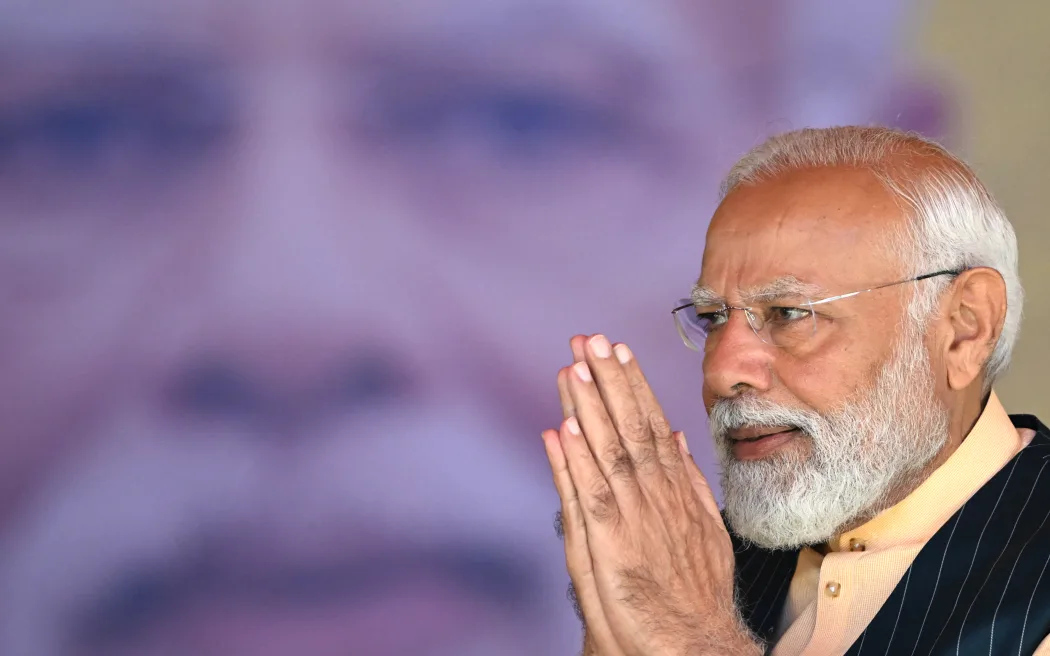
Explainer: Indian PM Narendra Modi is on course for a third consecutive term in a much tighter general election than anticipated.
His Bharatiya Janata Party (BJP) looks set to fall short of a majority and is leading narrowly in the 543-seat parliament, below the required 272 seats. However, its coalition partners have gained additional seats.
The results are a personal blow to Modi, who has always secured majorities in elections as both chief minister of Gujarat state and India’s prime minister, and dominated the country’s politics for a decade.
The verdict marks a surprising revival for the Congress Party-led INDIA opposition alliance, defying earlier predictions of its decline, and sharply diverging from both exit polls and pre-election surveys.
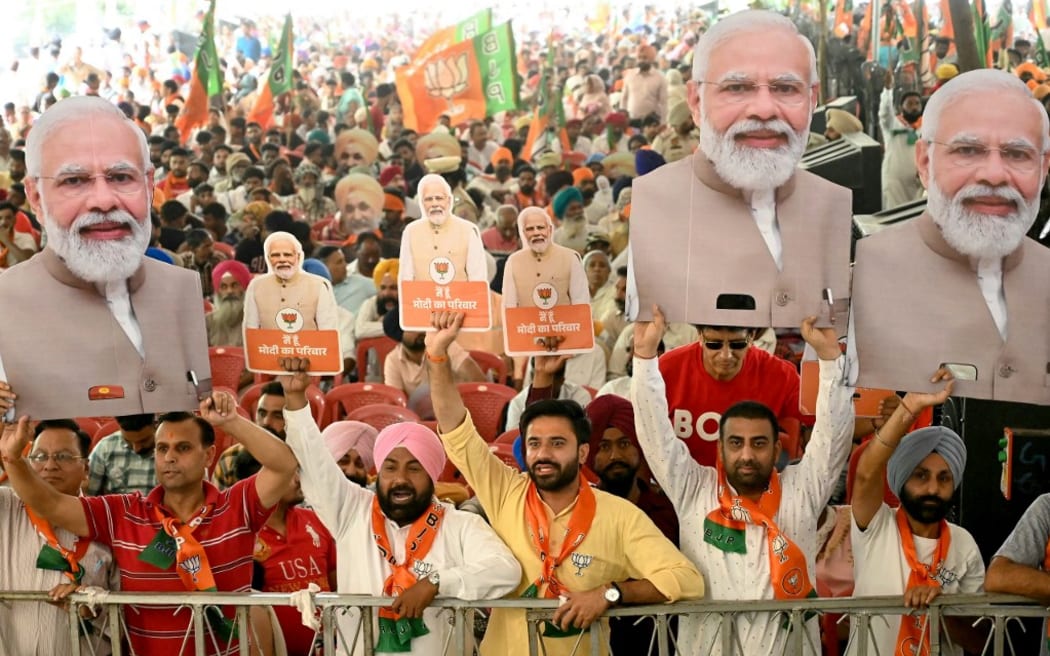
BJP supporters at an election rally in in Amritsar on May 30, 2024. Photo: AFP/Narinder Nanu
More than 640 million people voted in a marathon seven-week election, hailed as a “world record” by election authorities. Nearly half of the voters were women.
Many world leaders have crawled across the finishing line in their third term elections and Modi is no exception. The BJP remains India’s single largest party by seats, and if Modi secures a third term with his allies, the prime minister matches the record of Jawaharlal Nehru, India’s first premier.
But the significant loss of seats for his party – more than 50 – dims the allure of a third term, especially given Modi’s campaign targeting 400 coalition seats, making anything less seem like an under-achievement.
This has led to jubilation in the Congress camp and some despair in BJP quarters. Despite the BJP emerging as the single largest party, the burden of hype and expectations has left many of their supporters disheartened.
Modi’s supporters believe securing a third term can be attributed to several factors: a record of stable governance, the appeal of continuity, efficient welfare programmes, and the perception that he has enhanced India’s global image.
To his Hindu nationalist base, Modi delivered on key manifesto promises: revoking the autonomy of Indian-administered Kashmir, building the Ram temple in Ayodhya and implementing a controversial citizenship law. Many BJP-ruled states have implemented laws tightening regulations on interfaith marriages.

The Ram temple in Ayodhya. Photo: MONEY SHARMA / AFP
The BJP’s significant drop in seats may be linked to joblessness, rising prices, growing inequality and a controversial army recruitment reform, among other things. Modi’s harsh and divisive campaign, particularly targeting Muslims, could also have alienated voters in some regions.
His ambitious slogan “Ab ki baar, 400 paar,” aiming for more than 400 seats for his NDA alliance, may have backfired, with such a massive majority raising fears of constitutional changes among the poor.
Modi’s party faced its largest setback in Uttar Pradesh (UP), a state larger than the United Kingdom and three times as populous. With 80 parliamentary seats, UP holds significant sway in national politics – many consider it the gateway to Delhi. Both Modi and Rahul Gandhi hold seats there.
rnz

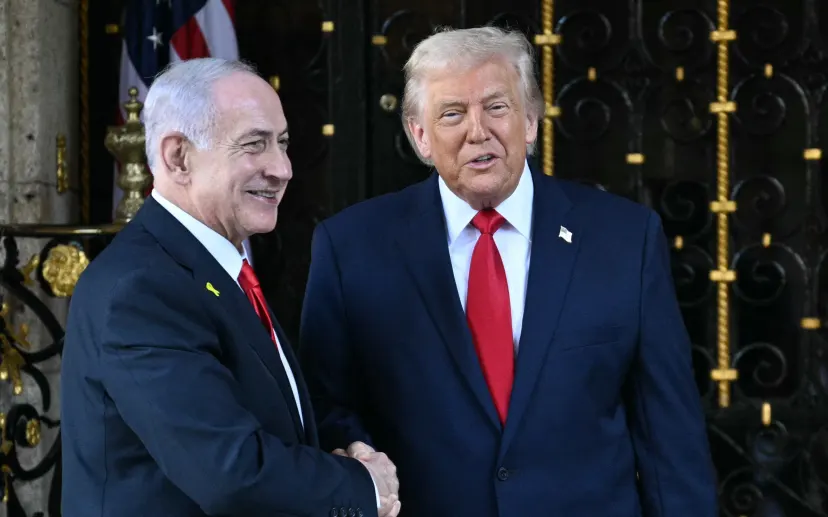
Israeli Prime Minister Benjamin Netanyahu boasted of his endorsement from Donald Trump on the eve of Israel’s election, suggesting the two leaders could restart their war against Iran if he wins, after Trump said they should “finish the job”.
“US President Donald Trump has come with a friendship that has never existed before between an Israeli prime minister and an American president. And it is doubtful we will ever have such a friendly president again,” Netanyahu said in a televised appearance late on Sunday night. “He has another two years, and he says he is calling on you to vote for me.”
In his own social media post on Sunday, Trump, who launched the Iran war jointly with Netanyahu in February, said: “Vote for Bibi Netanyahu for Prime Minister, we have to finish the job that we started!”
Netanyahu said Trump was willing to take action “that would finally, finally, remove the Iranian threat”, but only as long as Netanyahu himself remains in power.
“And I have already instructed the Mossad and the IDF (military) to bring down this regime, to bring down this regime because that is the only way to put an end to this threat,” Netanyahu said, referring to Israel’s main intelligence service and military.
Asked for comment on Netanyahu’s remarks, White House Deputy Press Secretary Anna Kelly said: “As President Trump stated, Iran is in very bad condition, both economically and militarily, and the blockade will remain in full force and effect, with oil flowing in record numbers of barrels through the Hormuz Strait.”
“The United States will not be attacking Iran at any time prior to the midterm elections,” Kelly added via email, referring to the November 3 vote in the US.
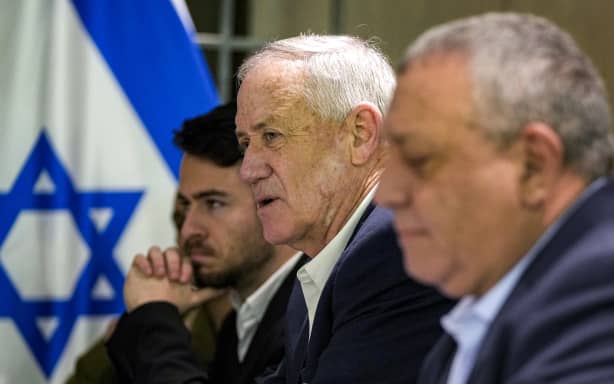
Netanyahu’s leading opponent, centrist former military Chief of Staff Gadi Eisenkot, posted his own comments on social media, praising Trump as “a true friend of Israel”.
“I value his efforts and his commitment to Israel’s security, and I am confident that he will work in full cooperation with any leader chosen by the people.”
Mark Schiefelbein / POOL / AFP
Eisenkot accuses Netanyahu of fear-mongering
Tuesday’s vote, Israel’s first since the October 7, 2023, Hamas attacks, is the first chance for voters to deliver a verdict on the worst security failure in generations and the wars on multiple fronts that followed.
With Netanyahu already at the helm of the most right-wing government in Israeli history, politics have shifted even further to the right. Nearly all Jewish-led parties, including that of the hawkish Eisenkot, now oppose the “two-state solution” that underpinned decades of peace negotiations with the Palestinians.
But many voters say the divisive politics of Israel’s longest-serving leader make the country weaker. Polls suggest Netanyahu’s Likud Party will lose seats, potentially depriving his coalition of right-wing, far-right and ultra-Orthodox parties of its narrow majority.
Eisenkot and an array of opposition parties ranging from the rump of the centre-left to the right, also have no clear path to unseat him.
Netanyahu, 77, is an unrivaled master of political survival: the only time since 2009 that opponents managed to wrest him briefly from the premiership, it took four inconclusive elections within two years to get him out. He was back 18 months later.
Neither side planned major public events for Monday. But both posted on social media, drumming on the election’s major themes: for Netanyahu, that he is the only leader with the mettle to face down Israel’s enemies; for his opponents, that his divisive politics have weakened the country.
Netanyahu shared an AI-generated video on Monday of Iran’s Supreme Leader Ayatollah Mojtaba Khamenei, whose father Ali Khamenei was killed on the first night of US-Israeli strikes on Iran in February. Lying in a hospital bed, the younger Khamenei says his own vote would be “definitely not Bibi. Another term like this and I will be meeting my father sooner than expected.”
On Sunday Netanyahu posted a computer-generated photo of a mushroom cloud over Tel Aviv, saying Israel was in existential danger from Iran.
Eisenkot responded by accusing him of “relying on a campaign of fear-mongering, lies, and threats – including images of nuclear bombs in the heart of Tel Aviv. This time, it won’t work for him.”
Trump’s endorsement of Netanyahu carries its own political risks a week before a legislative election in which his own Republicans are seeking to hold onto power.
The Iran war is deeply unpopular in the United States, blamed for a surge in prices especially for fuel. Major fighting has been suspended for months after ceasefire negotiations held without Israeli participation.
Source: Reuters & RNZ


Police say person who fired gun at officers still at large

New Zealand sides named for RLWC finals

Parliamentary Service working on extra chairs and offices for increased number of MPs


-

 Latest News2 months ago
‘Chilling’: Business groups speak out against National’s supermarket break-up plan
-

 NZ News2 months ago
Tom Phillips report: The missed opportunities to find the children
-

 Politics2 months ago
National vows to try to split Pak’nSave and New World
-

 Latest News2 months ago
Cars bearing Chinese police markings stir unease in Auckland
-

 Fiji News2 months ago
Plans to have new Constitution by Dec 24th 2026
-

 NZ News2 months ago
Cop who stole $68,000 can now be named as champion Muay Thai fighter Haimona Tamati-Te Paki
-

 Politics2 months ago
MBIE confirms botched biometric projects costs blown out to $50.7 million
-

 Latest News2 months ago
Five Karangahape Road venues lose their liquor licences after police intervention