

Latest News
Geoffrey Miller: Antony Blinken’s endgame for New Zealand, AUKUS and a visit down under


The US Secretary of State’s visit to New Zealand and Australia this week comes as the two countries jointly host the FIFA Women’s World Cup.
New Zealand foreign minister Nanaia Mahuta has highlighted the potential for ‘good old-fashioned sports diplomacy’ – and the secretary is scheduled to attend the United States vs Netherlands match in Wellington on Thursday afternoon.
But the travel is more than just a chance to take in a game.
Antony Blinken’s visit just happens to coincide with a trip to Wellington by Anthony Albanese.
The Australian prime minister is coming for talks with his New Zealand counterpart, Chris Hipkins.
It seems inevitable that New Zealand’s potential role in the AUKUS defence pact will be up for discussion in closed-door meetings involving Albanese, Blinken, Hipkins and Mahuta.
The US Secretary of State will arrive in New Zealand after a stopover in Tonga to dedicate a new US embassy in Nuku’alofa.
The new US embassy in Tonga fulfils a pledge made by US Vice President Kamala Harris in a virtual address to the Pacific Islands Forum in July last year.

US Secretary of State Antony Blinken shakes hands with Tonga’s Prime Minister Tonga’s Prime Minister Hu’akavemeiliku Siaosi in Nuku’alofa on 26 July. Photo: AFP/ Tupou Vaipulu
The swift opening of the new diplomatic mission – which commenced operations in May – is one way to show that Washington means business when it comes to the Pacific.
An in-person visit to Tonga – population 100,000 – by America’s top diplomat is another.
Further south, calls on New Zealand by top-ranking US officials have traditionally also been rare: the last visit by a US Secretary of State came when Rex Tillerson spent eight hours in Wellington in 2017.
But New Zealand has seen a parade of senior US officials arriving over the past year, including Deputy Secretary of State Wendy Sherman, White House Indo-Pacific coordinator Kurt Campbell and Assistant Secretary of State Daniel Kritenbrink.
Soon after Campbell’s visit in March, New Zealand’s defence minister Andrew Little indicated New Zealand was willing to explore joining the ‘second pillar’ of AUKUS – comments that were later somewhat walked back by Hipkins.
Read more:
- The battle for influence in the Pacific between the world’s superpowers
- Approach with caution: Why NZ should be wary of the AUKUS security pact
- AUKUS participation talks highlight New Zealand’s nuclear-free status
- After being a ‘welcome guest’ at NATO, NZ now needs to consider what our partnership with the alliance really means
- Hipkins meets Xi Jinping: behind the handshakes, NZ walks an increasingly fine line with China
In recent years, New Zealand has already made remarkable foreign policy shifts – and it is worth remembering just how far Wellington has come.
After all, when Tillerson visited six years ago, New Zealand was still getting used to rebuilding ties with the United States, after the bilateral relationship had languished for several decades.
The US suspended its obligations to New Zealand under the ANZUS treaty in 1986, in response to the introduction of a nuclear-free policy by New Zealand’s Fourth Labour Government.
Normalisation began with the ‘Wellington Declaration’ – signed when Hillary Clinton visited New Zealand in 2010 – and the companion military-focused ‘Washington Declaration’ in 2012.
However, the US began allowing New Zealand into its military drills even later: New Zealand was invited to participate in the joint US-Australia ‘Talisman Sabre’ exercise for the first time in 2015.
New Zealand has been a consistent participant since then, including in the 2023 edition of Talisman Sabre that is currently underway in northern Australia.
This year’s version is the biggest yet, involving 13 countries and some 30,000 troops.
Countries involved for the first time include Germany and India (the latter as an observer), while militaries from all three of the smaller Pacific Island nations that have standing armies are also on board: Fiji, Papua New Guinea and Tonga.
While all militaries need to train, this year’s Talisman Sabre is designed more than ever to project US-led unity and strength vis-à-vis China.
In this respect, New Zealand presents something of a dilemma.
Wellington’s foreign policy has undoubtedly become more hardline over the past year.
By and large, New Zealand has been listening and responding to its more hawkish Western partners.
Chris Hipkins’ Labour Government has signed up to new US-led groupings and joint statements, expanded New Zealand’s ties with NATO and committed to spending hundreds of millions of dollars more on its military.
But as Hipkins’ recent trip to China showed, New Zealand is still China’s best friend in the West – and in substance and tone, the New Zealand prime minister is still striking a markedly softer tone than his more hawkish friends.
For the most part, Hipkins is content to describe Wellington’s relationship with Beijing as ‘complex’ and has largely settled on the relatively mild adjective of ‘assertive’ to describe China’s ambitions.
The ‘assertive’ descriptor popped up in Hipkins’ most-detailed foreign policy address to date, made to the New Zealand Institute of International Affairs (NZIIA) shortly before the PM headed to Europe for the NATO summit in mid-July.
The PM then referred to ‘China’s increasing assertiveness’ in his speech in Vilnius – and he drew on ‘assertive’ once again when he spoke to the recent China Business Summit in Auckland.
The choice has not come out of thin air: the strongest words on Beijing in the recent Strategic Foreign Policy Assessment from New Zealand’s Ministry of Foreign Affairs and Trade (MFAT) are a reference to ‘the Chinese Government’s more assertive foreign policy’.
The MFAT blueprint also frequently deploys the ‘complex’ wording favoured by Hipkins.
This results in some rather tortured and deliberately oblique phrasings in reference to risks for New Zealand, such as ‘increasing regional complexities arising from engagement by development partners from outside the region’.
By contrast, the NATO leaders’ communique issued in Lithuania is crystal clear in its calling-out of Beijing: ‘The People’s Republic of China’s (PRC) stated ambitions and coercive policies challenge our interests, security and values’.
To be fair, Antony Blinken himself has attempted to take a more constructive tone of late in a bid to build bridges with Beijing, following the recent visits by the Secretary of State and other top US officials to China.
But this should still be seen in context: while Blinken was conciliatory when he pledged in June to ‘manage’ US rivalry with China ‘so that the relationship does not veer into conflict’, he also recently delivered remarks in Indonesia that decried ‘the use of force, coercion, or aggression’ – talking points that were squarely aimed at Beijing.
Back in Wellington, New Zealand may now be reading the same book as its Western partners, but it is not yet quite on the same page.
But there is still time for the US to influence the trajectory of New Zealand foreign policy.
The most significant components of New Zealand’s foreign policy realignment are yet to come.
Hipkins recently [National Security Strategy signalled the release] of a new National Security Strategy, while the results from an expedited ‘Defence Policy Review’ process are expected soon.
But with New Zealand’s election taking place on 14 October, the reports – and Blinken’s visit – are likely to inform decisions that will be taken by the country’s next government.
Antony Blinken is entering New Zealand’s field of play.
The geopolitical stakes are high.
And the game is not over yet.
* Geoffrey Miller is the Democracy Project’s geopolitical analyst and writes on current New Zealand foreign policy and related geopolitical issues. He has lived in Germany and the Middle East and is a learner of Arabic and Russian. He is currently working on a PhD on New Zealand’s relations with the Gulf states.
SOURCE RNZ

Latest News
The ‘disgusting creep’ who raped his daughter, step-grandaughter, sisters and former partners


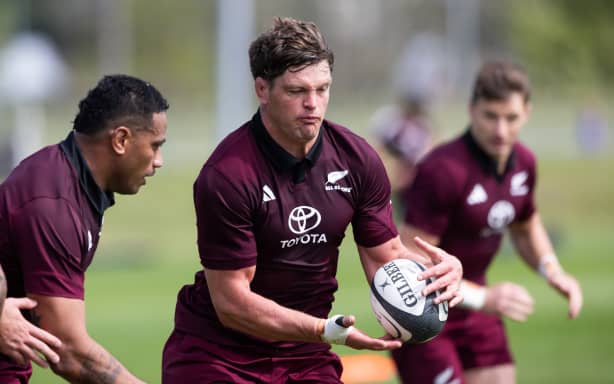
Dave Rennie’s best-laid plans for the first Bledisloe Cup test against Australia on Saturday have had to be quickly torn up following Richie Mo’unga’s injury, with Damian McKenzie moved from fullback to No.10 and Beauden Barrett given a rare start.
Most observers assumed Barrett would start at first-five following Mo’unga’s calf issue, floated by RNZ on Wednesday and which was confirmed this morning, but instead Rennie has opted to start Barrett at fullback and move McKenzie a little closer to the action in the absence of the injured Ruben Love.
Still, it represents a significant comeback for Barrett, who was not involved in the first six tests of the year and whose future with the All Blacks appeared tenuous even last month.
After not featuring in the three Nations Championship tests in July, Barrett played a bit-part role in the recent “Greatest Rivalry” series – only coming off the bench in the final test in Baltimore.
Brett Phibbs / www.photosport.nz
Mo’unga, who also had a calf issue on his return to New Zealand from three years in Japan, will also miss the return test in Sydney a week on Saturday.
Rennie’s other option would have been to start the uncapped Josh Jacomb at first-five but, with so much at stake on Saturday – the All Blacks’ unbeaten record at their fortress stretches back 53 tests to 1994 and a victory will lock up the Bledisloe for another year – the selectors have gone with experience over youth.
Barrett will be joined in the starting line-up by brothers Scott and Jordie.
Scott Barrett, selected in the second row with Josh Lord, is playing his first test (and only third match in total) since November last year, with Jordie Barrett named in the midfield as expected alongside Quinn Tupaea, who has recovered from a knee problem which ruled him out of the fourth test against the Springboks.
Other notable selections include Shannon Frizell’s inclusion as loose forward cover on the reserves bench for what will be his first test for the All Blacks since the 2023 World Cup final.
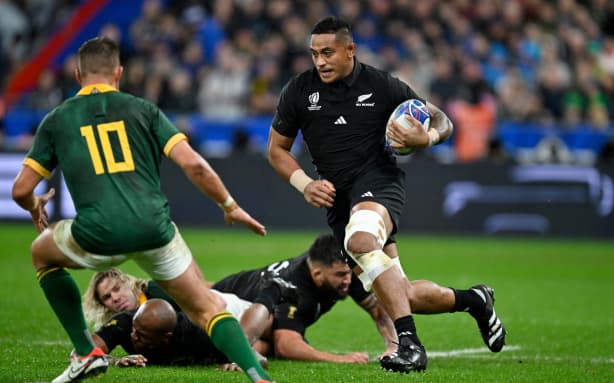
Tupou Vaa’i has been selected at blindside flanker, with Wallace Sititi starting at No.8 in the absence of the injured Ardie Savea, and Peter Lakai named at openside flanker.
Leroy Carter has been named on the left wing, with Will Jordan on the right, as expected. Cam Roigard will start at halfback inside McKenzie.
Ethan de Groot, skipper Codie Taylor and Fletcher Newell make up the front row, with Anton Segner also named as loose forward cover on the bench.
Andrew Cornaga/www.photosport.nz
The All Blacks have no specialist back-up lock, but Vaa’i is likely to move to the second row in favour of Scott Barrett in the second half, assuming the former captain finds the going difficult after such a long break from the game due to his sabbatical and recent back surgery.
Rieko Ioane and Josh Moorby make up the back reserves, along with back-up halfback Kyle Preston, further pointers to Rennie’s belief that the test will be played at a high tempo.
“The Bledisloe Cup means a huge amount to this group,” Rennie said in a statement.
“There’s a lot of history and pride tied up in it, and every Test against the Wallabies carries real weight for us.
“We have huge respect for this Australian side and the way they have been playing. We know we’ll need to be at our best.
“We’ve been on the road for the last eight games, so the boys are rapt to be home and really looking forward to running out at Eden Park one last time this year.”
All Blacks team to play Australia
(Caps in brackets)
1. Ethan de Groot (45),
2. Codie Taylor (112) – Captain
3. Fletcher Newell (41)
4. Scott Barrett (89)
5. Josh Lord (17)
6. Tupou Vaa’i (51)
7. Peter Lakai (14)
8. Wallace Sititi (23)
9. Cam Roigard (24)
10. Damian McKenzie (81)
11. Leroy Carter (10)
12. Jordie Barrett (85)
13. Quinn Tupaea (29)
14. Will Jordan (61)
15. Beauden Barrett (145).
Reserves:
16. Asafo Aumua (26)
17. George Bower (29)
18. Pasilio Tosi (17)
19. Shannon Frizell (33)
20. Anton Segner (2)
21. Kyle Preston (5)
22. Rieko Ioane (89)
23. Josh Moorby (5)
rnz


The ‘disgusting creep’ who raped his daughter, step-grandaughter, sisters and former partners

‘Not as attractive as it used to be’ – Peters on living in NZ today

Man took his own life after paying money to ‘sextortion’ blackmail involving AI-generated woman


-

 Latest News2 months ago
Two investigations launched after police shoot armed man at Sylvia Park
-

 NZ News2 months ago
Police manager sorry for ‘confusion’ over Superintendent Rakesh Naidoo’s bid to stand for Labour
-

 Sports2 months ago
A majority Māori and Pacific All Blacks squad shows how far rugby’s ‘greatest rivalry’ has come
-

 NZ News2 months ago
Auckland drug ring busted, members deported
-

 Fiji News2 months ago
Fiji PM Rabuka to appeal COI ruling, says he’ll resign if appeals fail
-

 Latest News2 months ago
‘There’s been a slip’: Inside the final hours before the fatal Mt Maunganui landslide
-

 NZ News2 months ago
Auckland man accused of murdering parents and attempting to murder brother named
-

 NZ News2 months ago
‘There is no future in this’: Judge’s warning to Hapai Otene months before he was shot dead by police