

NZ News
Man’s security licence cancelled after extorting Pak’nSave shoppers


A security guard who forced a cucumber into a man’s mouth before extorting money from him has been banned from working in the sector for four years.
According to the summary of facts, the victim went through the self-checkout at Pak’nSave in Manukau without paying for several items, including a plastic-wrapped telegraph cucumber.
On the way to his car, he was stopped by security guards Laki Savelio and Tiare Bishop, who made him go to their small, windowless office where they “repeatedly” accused him of shoplifting.
The victim suffered an hour-long ordeal.
At one point, the victim made a praying gesture with his hands as he recoiled from Savelio who had forced the cucumber into his mouth.
Savelio withdrew the cucumber, turned it around, pointed the other end at the man and nodded at him.
The victim pulled it to his mouth, his hair falling over his face.
Savelio brushed the man’s hair away so he could see the degrading act, again forcing the item into his mouth.
The victim wasn’t the only person targeted by the pair while they worked at the South Auckland supermarket last year.
The guards worked for Retail Theft Control Security (RTC), which was contracted to provide security services to the supermarket.
Both men were charged and Savelio was convicted and sentenced at the Manukau District Court in August to six months’ home detention.
Bishop is scheduled to be sentenced on October 13.
With the criminal case concluded, the Private Security Personnel Licensing Authority has cancelled Savelio’s certificate of approval and barred him from reapplying for four years.
‘Disgraceful, wilful and reckless’
Savelio didn’t appear at a Private Security Personnel Licensing Authority hearing last month.
However, chairwoman Trish McConnell sanctioned the cancellation of his licence in his absence.
“As well as resulting in a disqualifying conviction, Mr Savelio’s behaviour amounts to misconduct as a reasonable person would consider such behaviour by a security guard to be disgraceful, wilful and reckless,” McConnell said in the decision.
“Police advise that the judge when sentencing Mr Savelio to 6 months home detention, said Mr Savelio was fortunate he had not been charged with kidnapping.”
‘Just made $200 here at Manukau’
According to the summary of facts, the offending was all captured on CCTV.
It began with Savelio picking up a toy rifle and pointing it at the victim, who put his hands up before swiping away the barrel with his hand.
Savelio then gestured at the victim’s wallet and the man pulled out four $50 notes and put them on a shelf.
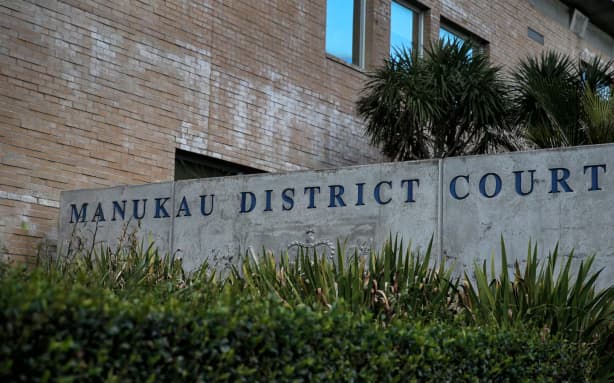
Photo / NZME
After 45 minutes, Bishop left the room and Savelio repeatedly leant towards him with the cucumber.
He made the victim hold the cucumber, pointed out the CCTV camera and switched off the lights.
He took the cucumber off the man and forced it into the man’s mouth, the summary said.
Eventually, Savelio turned the lights back on. He and the man then left the supermarket and, a short time later, Savelio and Bishop returned to the security room where they split the $200.
The facts showed Savelio later texted a friend, “just made $200 here at Manukau”, to which the friend replied: “I thought we were not allowed to do that anymore”. Savelio answered: “Only in Manukau with me uso.”
Later that month, Savelio and Bishop stopped a man who admitted forgetting to pay for a tin of baby formula.
They extorted $400 from him and he was trespassed from the supermarket.
A few days later, the two security guards accused another man of stealing, but when he produced a receipt, they took it from him and refused to give it back.
In the security office, when the man threatened to call a union organiser, Savelio said he could leave with a warning.
The summary said the victim wanted proof they were up to no good, so he offered to pay the pair $100, which they accepted.
That same day they squeezed $300 out of a man who, the summary said, didn’t want to jeopardise his recently secured residency visa.
When spoken to by police, Savelio said he was doing his job as his boss had told him to.
The agreed facts said the owner of RTC claimed some of the security company’s clients wanted them to deal with alleged shoplifters with “civil recovery” instead of phoning police.
This method meant the alleged shoplifter had the opportunity to pay $396, which would go back to the store, and police wouldn’t be involved, the summary said.
But “civil recovery”, the summary said, required the supermarket’s duty manager, accused shoplifter and security staff to sign documents agreeing the process was “appropriate”.
And the security staff must be trained to carry out that function – Savelio was not.
In August a representative from Pak’nSave owner Foodstuffs told NZME there was no civil recovery policy at Pak’nSave Manukau during that time.
For one representative charge of obtaining by deception more than $1000, Savelio was sentenced to six months’ home detention.
The judge imposed 12 months’ post-detention conditions and ordered him to pay $750 to the victims not already compensated by Pak’nSave.
Source: NZ Herald & RNZ



Latest News
Opportunities to mitigate multi-million-dollar RNZ budget blowout likely missed – experts

Multiple opportunities to identify and mitigate a multi-million-dollar budget blowout at RNZ appear have been missed, according to the former executive director at Audit New Zealand.
The public broadcaster on Monday revealed a near $12 million shock financial loss after a litany of financial blunders, which will now lead to sweeping job cuts.
The $11.8m loss is more than 25 times the $470,000 RNZ had expected to lose over the year to June.
CEO Paul Thompson took responsibility for the result, and said internal reports gave an inaccurate picture of the finances, meaning the scale of the loss only became clear in October.
RNZ’s former chief financial officer Hilary Parker resigned unexpectedly in early October.
The board said it would commission an independent review into what went wrong.
Independent contractor Stephen Walker, who left the Audit Office earlier this year, said the size of the loss was surprising, as was the length of time it took to identify it – months after the financial year ended.

Supplied / OAG
“Probably more of a concern is that they had seemingly been unaware that they were running up a significant deficit until they were in the preparation stage of their annual report in October.”
Walker said public entities typically produced monthly financial reports.
An interim audit also took place before the end of the financial year, he said, but if the organisation hadn’t identified significant losses at that stage, the auditor could also be in the dark.
“It seems that there’s a real weakness in forecasting and budgeting that’s occurred here and that the monthly accounts, when they’re produced, either haven’t identified these significant variances against budget or the magnitude of them really hasn’t come to light until right towards the end of the financial year,” Walker said.
“And really at that point, there’s no opportunity for the chief executive, the leadership team to take, and the board to take, any corrective action because the year has effectively been completed.”
Walker said the “significant miss” was difficult to account for given it was more than 10 percent of RNZ’s total funding.
He said based on RNZ’s annual report, financial complexity didn’t appear to be a factor.
“This $11.8m loss isn’t made up of one particular item … it seems to have been contributed to by a number of separate expense lines running over budget. So I don’t think it’s necessarily to do with complexity.”
Among the errors, RNZ wrongly counted $2m from land sales as income in its budget. Staff costs also came in $3.2m over budget, including $1.4m in redundancy payments.
Professor at Auckland University’s business school Norman Wong said based on media reports the issues identified were “significant and troubling”.

Supplied / University of Auckland
“But recognising the sale of land as income in their budget is a basic error that one would have expected to have been caught and corrected well before it got to this point.”
With funding reductions at RNZ over the past two years, Walker expected greater scrutiny of financial results.
“Virtually every public entity has had their annual budget reduced. And so you would expect … the leadership team on a monthly basis and board – I’m not sure how frequently the board will consider the information – but you would expect them to be interrogating the results on a regular basis throughout the year,” he said.
Walker said initiating an independent review was the correct course of action and that he’d want to understand what information the leadership team and the board were regularly receiving.
He said he’d “love to say” surprising financial results were rare, but conceded they occured on a semi-frequent basis during his time leading the Audit Office.
“The benefit of independent scrutiny by the Audit Office – and the auditors providing that support to the Auditor General – [is] that the reporting is fairly presented at the end of the year, whether it’s good, bad or ugly.”
rnz


Police say person who fired gun at officers still at large

New Zealand sides named for RLWC finals

Parliamentary Service working on extra chairs and offices for increased number of MPs


-

 Latest News2 months ago
‘Chilling’: Business groups speak out against National’s supermarket break-up plan
-

 NZ News2 months ago
Tom Phillips report: The missed opportunities to find the children
-

 Politics2 months ago
National vows to try to split Pak’nSave and New World
-

 Latest News2 months ago
Cars bearing Chinese police markings stir unease in Auckland
-

 Fiji News2 months ago
Plans to have new Constitution by Dec 24th 2026
-

 Latest News2 months ago
NRL finals schedule: Who plays who in week 2 and how the Warriors can make the Grand Final
-

 NZ News2 months ago
Cop who stole $68,000 can now be named as champion Muay Thai fighter Haimona Tamati-Te Paki
-

 Politics2 months ago
MBIE confirms botched biometric projects costs blown out to $50.7 million